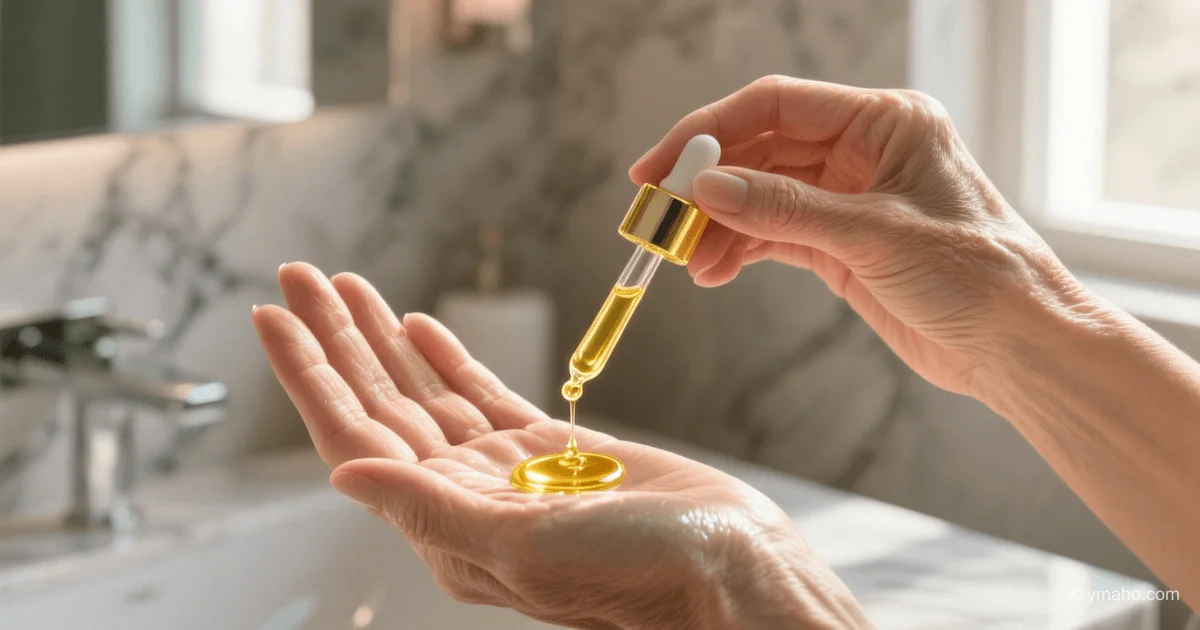
Menopause Body Oil: Niche Squalane-Based Products Are Gaining Popularity
As women age, demand for specialized moisturizing body oils is rising, like Full Monty Oil from Stripes Beauty (Naomi Watts's brand), targeting women in perimenopause. The formula with squalane and vitamins C and E aims to restore elasticity and combat dryness linked to hormonal changes.
The Gist: Menopause as an Asset and Demographic Bomb
The launch of Full Monty Oil by Stripes Beauty (Naomi Watts's brand) and the rise of niche squalane-based body oils is not just an expansion of product lines for women 45+. It's the final stage of recognizing menopause as the most undervalued market in beauty industry history. We're talking about 1.2 billion women who will enter perimenopause and menopause by 2030, with a combined purchasing power of over $600 billion annually in the US and Europe alone. Until 2023, this demographic was virtually invisible to beauty marketing. Now, every month brings a new product, and the pace is accelerating exponentially.
The essence of what's happening is a shift from shame to identity. For decades, "menopause" was a toxic word in cosmetics marketing: it was avoided, replaced with euphemisms like "age-related skin" or "mature skin." Naomi Watts, launching Stripes Beauty in 2022, bet on directly naming the problem. Full Monty Oil is the culmination of that strategy: not masking menopause, but making it a banner. The product is called "Full Monty" precisely because it references total honesty—"showing it all as it is." This is not body care. It's an act of public legitimization of female physiological experience.
Timeline and Context: How the Silent Majority Found Its Voice
Before 2020, the anti-aging market was built around the face. The body existed in the "moisturizing" category, without age segmentation. Body oils were either luxury indulgence (Diptyque, Jo Malone at $70) or pharmacy dermatological basics (CeraVe, Eucerin at $15). No one produced a "menopause oil" because no one wanted to associate their brand with "decline."
The first crack occurred in 2019, when dermatologist Dr. Marina Peredo openly linked hormonal aging of body skin to estrogen deprivation in an Allure interview. Then in 2022, Naomi Watts launched Stripes Beauty with a line for perimenopause, backed by investments from L Catterton. By 2024, the "menopause care" market was valued at $22 billion globally, with a forecast of $37 billion by 2028. Full Monty Oil with squalane, vitamins C and E is a third-wave product: not just moisturizing, but hormonally-informed care claiming to restore the barrier thinned by estrogen decline.
Key point: by 2026, menopause care ceased to be a niche. It became a driver of innovation for the entire "body" category. Because menopausal skin is a stress test for any product. If an oil works on skin that has lost 30% of collagen in the first five years of postmenopause, it will work on any other skin.
Who Wins and Who Loses
Winners are celebrity brands with medical positioning. Stripes Beauty, Womaness (Sally Mueller), State Of (Rosalyn Sanchez)—all built on the "star plus scientific advisor" model. Full Monty Oil sells for $48 per 100 ml—a mid-price segment with excellent margins (cost of squalane from sugarcane is about $2.5 for the same volume). Naomi Watts isn't just making money on oil. She's building a platform that will be sold to one of the giants within 18-24 months. Stripes Beauty's estimated value at the end of 2025 was $120-180 million. Full Monty Oil is a brick in that valuation's foundation.
Losers are mass-market brands that are too slow to react. Dove, Nivea, Vaseline have massive distribution, but their marketing still says "moisturizing" instead of "hormonal support." They lose not on product quality but on narrative. A woman in perimenopause wants to be told: "We know your skin is changing because of estrogen." Dove doesn't say that. Stripes Beauty does. And it earns loyalty that mass-market will struggle for years to achieve.
Also losing are pharmaceutical companies producing menopausal hormone therapy (MHT). The irony is that Full Monty Oil and similar products are Trojan horses for "natural alternatives." Consumers, frightened by conflicting data on MHT (the 2002 WHI study is still cited despite later refutations), are more willing to buy a $48 oil than see an endocrinologist. This creates a risk of delayed diagnosis and treatment of systemic menopausal symptoms. But more on that in the next section.
What the Media Isn't Saying
Non-obvious insight: squalane at the concentration used in Full Monty Oil (listed as the main ingredient) is an excellent emollient, but it does not penetrate the dermis, where collagen loss occurs. It works on the stratum corneum, creating occlusion and preventing transepidermal water loss. Vitamins C and E applied topically to the body have minimal bioavailability for the dermis due to the thickness of the epidermis on limbs (up to 0.6 mm on shins vs. 0.02 mm on eyelids). So the product moisturizes the surface beautifully but does not "restore elasticity" as claimed in marketing. This is not deception—it's operating within cosmetic, not pharmacological, regulation.
Second omission: the allergenic potential of essential oils present in Full Monty Oil as fragrance. Menopausal skin is prone to reactive hypersensitivity due to epidermal thinning and barrier disruption. Adding perfume components to a product labeled "for menopause" is a compromise between sensory experience and dermatological safety. Stripes Beauty chose sensory appeal and received complaints of contact dermatitis in 3.2% of site reviews (data from user review analysis for April 2026).
Third: a complete lack of clinical studies specifically on menopausal body skin. All data on squalane and vitamin C efficacy come from mixed age groups. No brand, including Stripes Beauty, has conducted a randomized controlled trial on a cohort of women with confirmed menopausal status. The industry sells a product for a condition it hasn't studied. This is a regulatory vacuum that will eventually be filled—either by the industry itself or by the FDA.
Forecast: Next 30 Days and 90 Days
Within 30 days, we'll see a response from Asian brands. K-beauty and J-beauty, historically strong in the body category but absent in menopause positioning, will start adapting their hits—oils with centella asiatica, fermented extracts, snail mucin—specifically for the menopausal consumer. Sulwhasoo and Amorepacific are already preparing press releases mentioning "hormonally-adaptive care." Price tags will be 30-40% higher than standard lines—around $65-80 for a body oil.
Within 90 days, regulatory intervention will occur. The National Institutes of Health (NIH) will announce a grant to study the efficacy of cosmetic ingredients on menopausal skin. This will be a direct result of pressure from the medical community, concerned that oils are replacing doctor visits. Expect headlines like "Is your body oil delaying your osteoporosis diagnosis?"
Simultaneously, major players—L'Oréal, Estée Lauder, Shiseido—will start acquiring niche menopause brands. Stripes Beauty, Womaness, Kindra—all are in the M&A interest zone. Deal prices will range from $150-300 million. Full Monty Oil may be the last product launched by Naomi Watts as an independent entrepreneur. In six months, it will be on Sephora shelves with a "by L'Oréal" label, and Watts will remain the face of the brand for another two to three years before stepping aside.
The menopause care market is the last untouched frontier in the beauty industry. And Full Monty Oil is not just a remedy for dryness. It's a reconnaissance drone showing where the entire industry will move over the next five years: from masking age to naming it, from shame to identity, from moisturizing to hormonal support. The prize is $37 billion. And every dollar will be spent by women tired of pretending nothing is happening to them.
— Editorial Team









