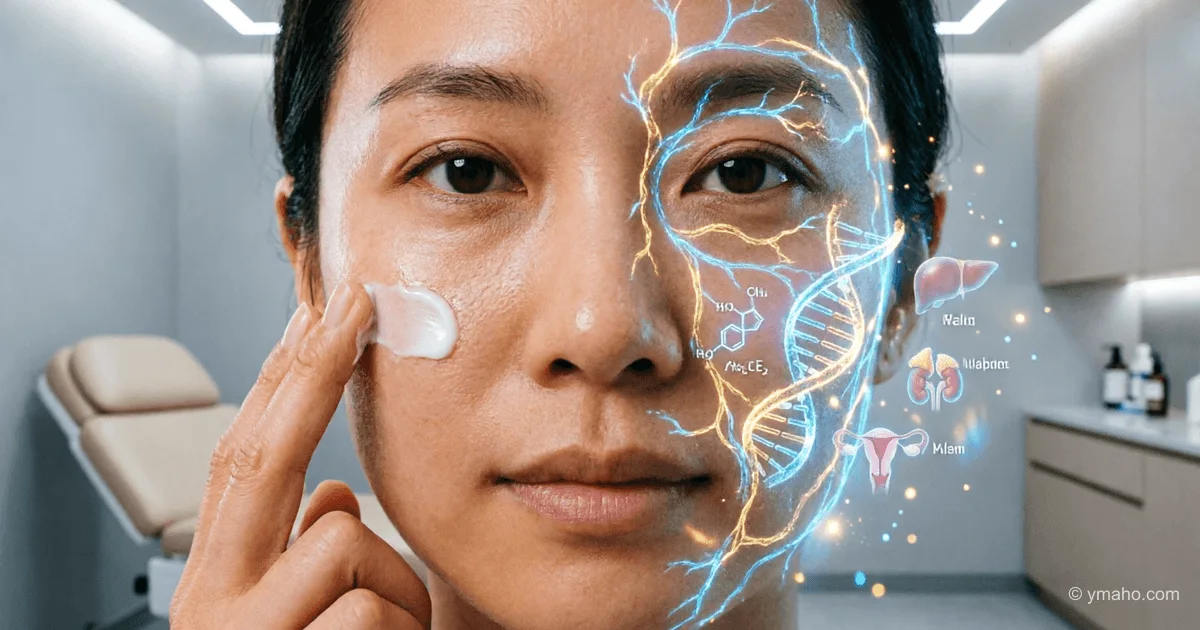
Metabolic Beauty: Skin as a Health Indicator
Cosmetology is moving from superficial correction to a holistic approach, where skin health directly depends on internal processes. Now endocrinologists, nutritionists, and psychologists are involved in restoring the microbiome and hormonal balance.
From masking symptoms to treating causes: how metabolic beauty redefines skincare
Introduction
For decades, cosmetology operated on a "see a problem, fix a problem" model. A wrinkle appeared—fillers were injected. Acne flared up—a facial was scheduled. Skin became dull—a peel was done. This approach, based on superficial correction of external manifestations, was long considered the only option. But it ignored the fundamental question: why did these problems arise?
Today, this linear thinking is being replaced by a new paradigm—metabolic beauty. Its central idea is both simple and revolutionary: the skin is not just an outer shell, but a full-fledged biomarker of the body's internal state. Acne may result from hormonal imbalance, dryness and early wrinkles from glycation and insulin resistance, and puffiness and dull complexion from chronic inflammation or circadian rhythm disruption.
In this article, we explore how scientific discoveries in cell biology and endocrinology are transforming skincare approaches, why cosmetologists today increasingly work alongside endocrinologists and nutritionists, and what this shift means for the future of the beauty industry.
Event Details and Timeline
The transition to a holistic metabolic approach was not instantaneous. It resulted from accumulating scientific knowledge and changing consumer expectations.
Stage 1: Realization of the limitations of superficial cosmetology (2015–2020).
Doctors increasingly encountered "resistant" patients—those for whom standard cosmetic protocols produced no lasting effect. Skin responded poorly to treatments, or the effect quickly faded. This prompted a search for deeper causes.
Stage 2: Scientific validation of the link between internal processes and skin (2020–2024).
Studies revealed clear correlations between skin condition and systemic factors. Scientists confirmed the importance of mitochondrial function (cellular energy supply), the role of chronic inflammation (inflammaging), and glycation (collagen damage by sugars) in aging processes. The "gut-skin axis" and the influence of the microbiome on dermatological diseases received solid scientific backing.
Stage 3: Implementation of metabolic beauty in clinical practice (2025–2026).
By 2026, metabolic beauty principles became standard in advanced clinics. The key change was a shift from one-off procedures to long-term protocols starting with comprehensive diagnostics: checking hormonal levels, insulin, inflammatory markers, and vitamin-mineral status.
Stage 4: Industry consolidation (2026).
Confirmation of the new approach's seriousness came with strategic alliances between research institutes and corporations. In April 2026, the Pasteur Institute and L'Oréal announced a major partnership to study the skin as a complex living ecosystem. The first joint project focuses on the influence of sex hormones on skin immunity—a study aimed at closing the existing gap in understanding why skin reacts differently to external influences during different cycle phases and pregnancy.
Impact and Significance (for the world, industry, society)
Impact on the industry:
Metabolic beauty is changing business models. While clinics once earned from repeat "beauty injections," the focus now shifts to comprehensive patient management. As Maria Mereckina, chief physician at Idealist clinic, notes, "if the regenerative potential of tissues is low, no lifting can produce a wow effect." Now, a body "check-up" comes first, followed by aesthetic procedures that become the final chord, not the only one.
This requires protocol revision: combining several aggressive techniques can trigger the opposite effect and increase inflammation. Therefore, a step-by-step, personalized approach is being implemented.
Impact on the perception of aging:
Metabolic beauty is changing the discourse on aging. Aging is no longer seen as an inevitability to be fought only with cosmetics. It is viewed as a biological process that can be slowed by targeting its root causes—inflammation, oxidative stress, mitochondrial dysfunction, and metabolic disorders.
Impact on society and medical practice:
This trend stimulates the development of integrative and preventive medicine. Aesthetic clinics actively recruit endocrinologists, dietitians, nutritionists, and psychologists. Patients increasingly view skincare as part of overall health care, leading to greater popularity of check-ups and personalized longevity programs. Conferences dedicated to integrative approaches in peri- and postmenopause attract growing numbers of participants, demonstrating demand for interdisciplinary solutions.
Reactions of Key Players
Research institutes.
The Pasteur Institute, one of the world's leading scientific centers, has officially prioritized research at the intersection of immunology, microbiology, and dermatology. The partnership with L'Oréal, signed in April 2026, aims to "decode skin health" and find biomarkers of aging. This is the first time academic science and a beauty corporation have joined forces at this level for fundamental research on the skin as a system.
Cosmetologists and doctors.
The professional community is restructuring its work. As physician Jennelle Daly (PA-C) emphasizes in her integrative dermatology model: persistent skin problems are rarely solved by topical products alone. She recommends starting with lab diagnostics—sex hormones, metabolic markers, inflammatory indicators. She also uses 3D skin visualization to show patients their "true skin age" and motivate comprehensive lifestyle changes.
Clinics.
In Russia and worldwide, the number of centers operating on "integrative cosmetology" principles is growing. They offer "anti-aging" and metabolic correction programs combining endocrinologists, dietitians, and cosmetologists. Specialized conferences are held, such as the school-conference "Integrative Approach to Health Preservation in Peri- and Postmenopause," discussing correction of hormonal homeostasis, micronutrient deficiencies, and reparative skin rehabilitation.
Forecast and Conclusions
What awaits us in the era of metabolic beauty?
- Diagnostics will become standard. Blood tests for vitamins, hormones, inflammatory markers, and insulin resistance will become mandatory first steps before any cosmetic intervention.
- Individual nutrition protocols. Nutraceuticals and diet therapy (e.g., reducing high-glycemic foods to combat glycation) will be prescribed as often as creams.
- Personalized biopreparations. Based on microbiome and genetic marker analysis, individual probiotic and prebiotic complexes will be created. Clinical trials are already underway, for example, studying the effect of the probiotic Lactobacillus casei Shirota on immune aging and acne in perimenopausal women.
- Technology integration. 3D visualization and AI skin analysis will become not just a "gimmick" but a standard tool for monitoring therapy effectiveness, allowing visualization of both superficial and deep changes.
Conclusion:
Metabolic beauty is not a temporary trend but a paradigm shift that has forever changed attitudes toward skincare. It has returned cosmetology to its medical roots: working with the cause, not the symptom. This is a transition from the aesthetics of "masking" to the aesthetics of "health." For consumers, it means a more conscious approach to their bodies; for the industry, it means the need to prove effectiveness not through words but through understanding the deep biological processes occurring in the body.
— Editorial Team









