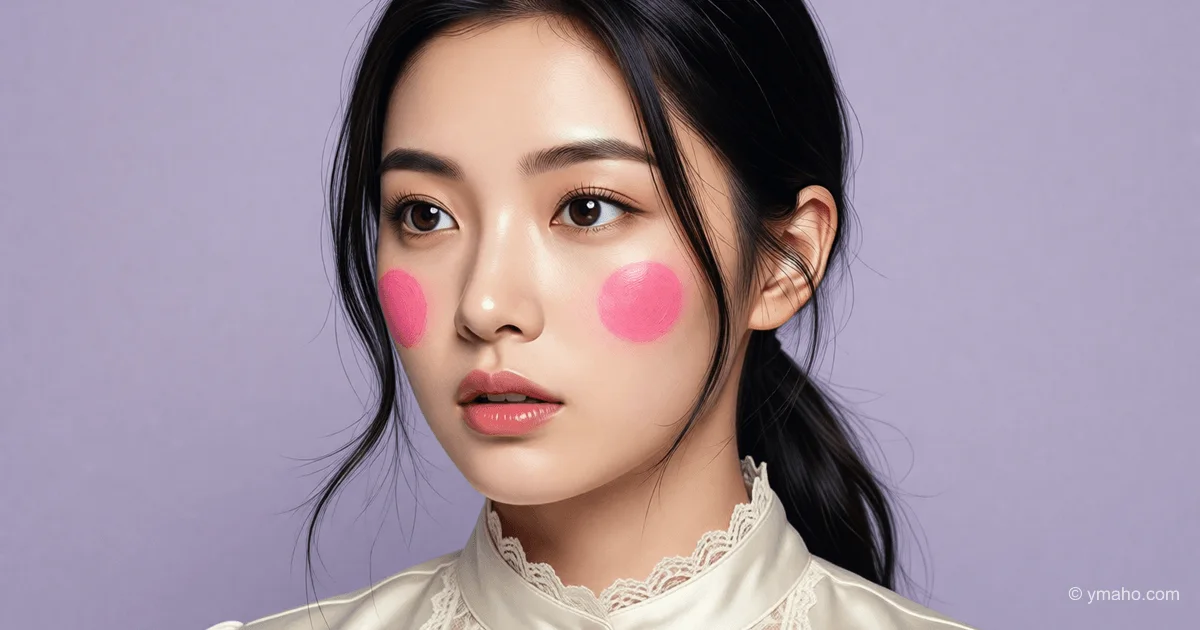
Influencers Are Massively Switching to 'Micro-Blush': Spot Tints Only on the Apples of the Cheeks Without Blending
The new Asian trend (May 21) opposes 'boyfriend blush' and creates a slight startle effect — as anti-stress makeup.
Micro-Blush: Why the 'Slight Startle' Effect Is a Reaction to an Anxious World
[The Gist]: What's Really Happening
What's called 'micro-blush' is actually a return to physiognomy, but with irony. Two small bright spots strictly on the apples of the cheeks, without blending, without transition — it mimics an autonomic reaction: fright, embarrassment, a sudden rush of blood. Influencers deliberately create a 'glitch' in perception. The face looks as if the person just received unexpected news.
The new trend opposes 'boyfriend blush' (a broad stripe under the cheekbones mimicking a healthy flush 'after a walk'). If boyfriend blush is the status 'I'm healthy, I'm outdoors, I have a man,' then micro-blush is 'I'm here, I feel, I can be surprised.'
Key insight: This trend comes from South Korea, where the anxiety level among women aged 20-30 reached a record 47% in 2026 (data from a national survey in April). Makeup has become not a mask for emotions but their display. Wearing a 'slightly startled' face means saying, 'The world is unpredictable, and I'm showing it.'
Timeline and Context
We need to look at three lines that converged in May 2026:
Line one: Fatigue from the 'grunge comeback.' Metallic shadows, dark lipstick, boyfriend blush — all were about aggression and strength. By spring 2026, users were tired. They wanted something naive, childlike, imperfect. That's how the 'toy makeup' trend appeared in Korea. Micro-blush is its direct descendant.
Line two: Anti-trend to 'resting bitch face' (RBF). RBF was considered a sign of confidence for the last 5 years. But studies show women with RBF get 22% fewer promotions because they're perceived as 'unfriendly.' Micro-blush with a startle effect makes the face unexpectedly alive, vulnerable, readable. It's tactical vulnerability.
Line three: Explosion of jelly blushers in Asia. Korean brand Fwee released the 'Mellow Blusher' line in March 2026 — jelly tints that set into a colored spot without blending in 10 seconds. Sales: 2.1 million units in April. Chinese Flower Knows picked up the trend with a 'limited startled fairy collection.' May 21, 2026 — mass influencer switch, picked up by TikTok.
Who Wins and Who Loses
Winners:
- Korean and Chinese cheap tint brands. Fwee, Flower Knows, Judydoll. Their products cost $5-12 each. Margins: 70-80%. Demand will grow 200-300% in June-July 2026.
- DIY videos 'how to make micro-blush with household items.' Thousands of views and ad integrations for powder and liquid highlighter brands.
- Psychologists and confidence coaches. They'll give interviews 'Why do we mask anxiety with blush? Should we show fear?' Fees for expert comments will rise.
Losers:
- Western brands with 'perfect contouring' philosophy (Anastasia Beverly Hills, Huda Beauty, NYX). Their complex blending palettes aren't needed for two spots. Sales of blush palettes (with 4-6 shades in one box) will drop 10-12% in Q2 2026.
- Makeup artists who trained to work with tone and transition. People will stop coming to them for 'basic makeup' because micro-blush can be applied at home in 30 seconds.
- People with asymmetry or imperfect skin. On them, the trend looks like two birthmarks, not an aesthetic technique. They'll either have to blend (breaking the trend) or put up with comments.
What the Media Aren't Saying
Key insight they're silent about: Micro-blush is the first trend in 2026 that cannot be replicated on dark skin. On Fitzpatrick types V-VI, a bright spot without blending looks like a burn or rash, not a startle. So the trend is racially segregated, though creators don't mention it.
Second: The 'startle effect' is not just aesthetics. It's a defense mechanism at an evolutionary level. In primates, sudden reddening of the cheeks is an alarm signal for the troop. When influencers deliberately mimic this signal, they literally send viewers an unconscious message: 'I'm in danger, be alert.' And this resonates with the general anxiety of 2026.
Third: The trend kills sales of makeup setting sprays. Without blending, blush spots hold on their own, even on oily skin. People will stop buying sprays for $25-40. The setting spray market could lose $50-70 million in 2026.
Forecast: Next 30 Days and 90 Days
Next 30 days (until June 22, 2026):
- Letual and Zolotoe Yabloko will urgently stock Asian tints Fwee and Flower Knows. Price in Russia: 1500-2500 rubles ($15-25), 100% above Korean retail. But they'll sell out.
- Sephora USA will launch a 'Micro-Beauty' category with a selection of spot products — blushes, concealers, highlighters in tiny jars with finger applicators.
- Parody videos will appear 'How I tried to replicate micro-blush and went to an interview with red spots.' Millions of views.
Next 90 days (until August 22, 2026):
- Major brands (Maybelline, L'Oréal Paris) will release budget analogs. A stick tube with a silicone applicator for spot application. Price $7-10. The market will quickly saturate, and the trend will go from premium to mass.
- The trend will evolve into 'micro everything': micro-concealer (one dot on a pimple, don't blend), micro-highlighter (a bead on the bridge of the nose), micro-shadow (a circle of color on the mobile lid). It will look surreal.
- Stylists will start rebelling. The professional community will release a manifesto 'We don't put dots on faces.' But this will only fuel interest. An anti-trend is the best promoter of a trend.
- By the end of August, psychologists will record a decrease in anxiety among women practicing micro-blush. Not because blush heals, but because the application ritual (30 seconds, two spots, no blending) reduces morning makeup stress. People who spent 15 minutes on perfect boyfriend blush now spend 30 seconds. The freed-up time goes to breakfast or breathing exercises. That's the real anti-stress.
Main 12-month forecast: By spring 2027, micro-trends in makeup will disappear as quickly as they appeared. But they'll leave a trace: people will understand that makeup doesn't have to be complicated. The 'sachet makeup' movement (makeup from a packet, one finger mascara and one tint) will become the new minimalism. And micro-blush will be remembered as the moment when the beauty industry finally allowed people to look truly alive — frightened, embarrassed, blushing. And that's beautiful.
— Editorial Team









