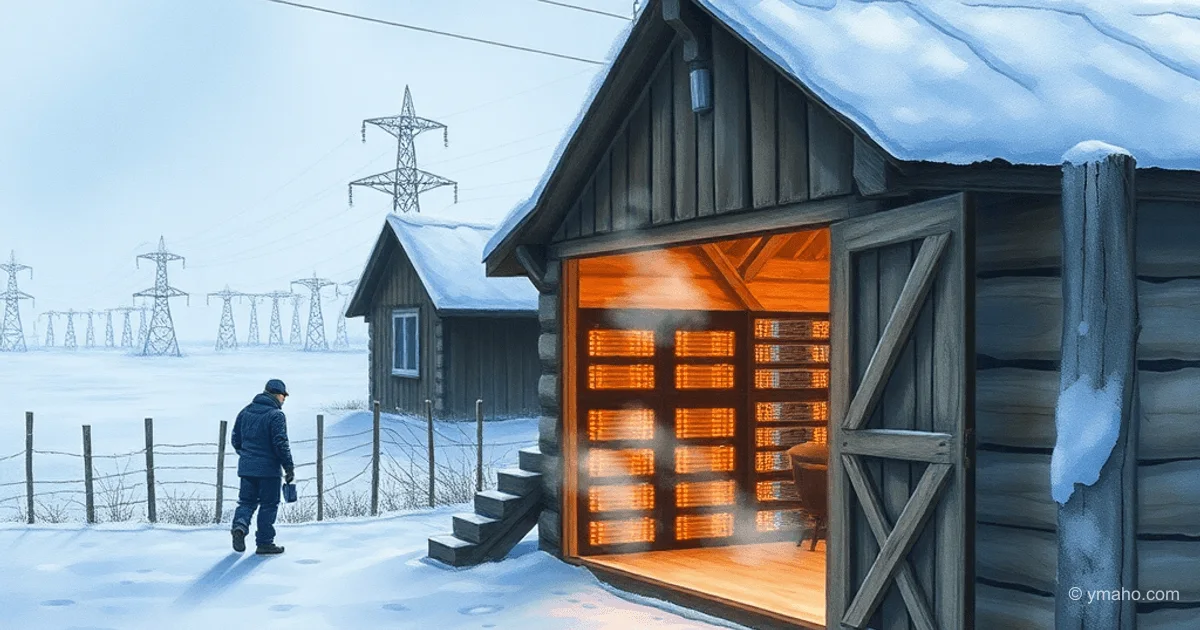
Miners in Chicken Coops: How Siberian Energy Providers Are Catching Illegals—and Why It Affects Everyone
In Siberia, energy providers have uncovered thousands of illegal cryptocurrency mining farms disguised as chicken coop heating systems or greenhouse operations. This isn’t just a local issue—these schemes distort electricity tariffs for all regional residents and threaten grid stability. If you pay an electricity bill, this story concerns you.
Why Are Miners Hiding in Chicken Coops?
Cryptocurrency mining consumes massive amounts of electricity. In Russia—especially in Siberia—electricity is cheaper than in most countries, making the region attractive to miners. But since 2024, mining has been officially banned in several regions—including Irkutsk Oblast—unless operators obtain special permits and pay industrial-rate tariffs.
To avoid steep bills and fines, some farm owners disguise their equipment as household appliances: “chicken coop heating,” “wood drying,” or “electric vehicle charging.” In reality, garages and dugout shelters house hundreds of GPUs or ASIC devices consuming as much power as an entire residential microdistrict.
“One citizen claimed he was drying timber for construction—even though only a dugout stood on the plot and a 150 kW load was connected,” says Andrey Kharitonov, Director of Irkutskenergosbyt.
How Do They Catch Illegals?
Energy providers don’t rely on statements—they analyze data. A typical home’s electricity consumption spikes in the morning and evening, when residents boil kettles, cook meals, and turn on lights. A mining farm draws consistently high power—24/7, seven days a week.
When the system detects such anomalies, inspectors are dispatched. If the owner refuses entry or server hum is audible inside, the utility may:
- Conduct thermal imaging (miners generate significant heat).
- File a lawsuit to recover unpaid charges at the commercial tariff rate.
- Demand compensation for damages—sometimes amounting to millions of rubles.
Since 2019, Irkutskenergosbyt has filed over 2,100 lawsuits totaling nearly 1.4 billion rubles. Most rulings have favored the utility.
What Changes for Ordinary People?
When illegal miners use subsidized residential tariffs instead of industrial ones, the shortfall is covered by other consumers. That means your electricity bill may be higher than it should be.
Additionally, overloading local grids increases the risk of outages. Imagine your neighborhood’s infrastructure rated for 500 kW—but someone secretly connects a 300 kW mining farm. In summer, it’s manageable. In winter, with heating systems running, the grid could simply fail.
New rules effective January 2026 extend industrial tariffs even to garage cooperatives. Result? Many “gray” miners have shut down operations—financial penalties proved more effective than persuasion.
Key Facts
- Over 8,000 illegal mining farms identified across Irkutsk Oblast and neighboring regions.
- Disguising operations as agricultural or industrial activities is common: chicken coops, greenhouses, wood drying.
- Lawsuits are the primary enforcement tool: 1,404 court rulings in favor of utilities since 2019.
- Tariff fairness: illegal mining raises costs for everyone else.
- Regulatory pressure is increasing: new rules make evading industrial tariffs significantly harder.
What Does This Mean for Ordinary People?
If you live in a region with low-cost electricity, expect tighter oversight of how it’s used. But that’s not necessarily bad news: fair tariff structures protect you from unexpected bill spikes and grid failures. And for anyone considering mining as a side hustle—the game no longer pays off: the risks of fines and litigation are simply too high.
— Editorial Team









