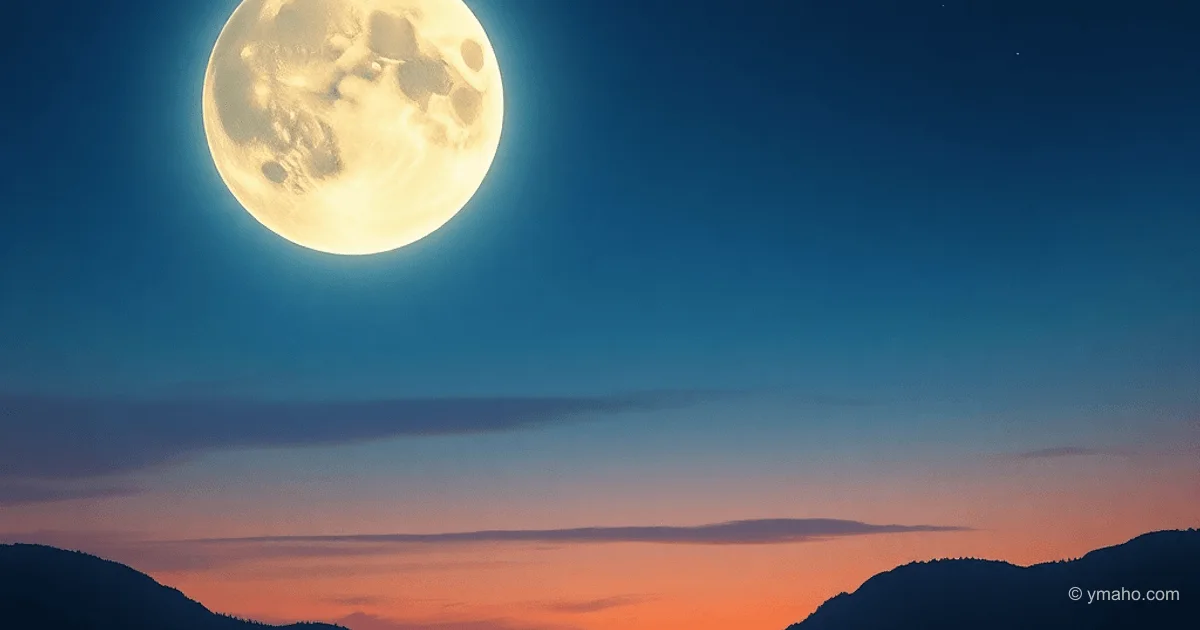
How to Spot the Moon and Jupiter’s Close Spring Meeting
Look up just after sunset on April 22, and you’ll catch the moon and Jupiter sharing a surprisingly close patch of sky. It’s a free, naked-eye event that turns an ordinary evening into a quick lesson on how our solar system’s moving parts line up.
About forty-five minutes after the sun dips below the horizon, face west. You’ll see a half-lit moon sitting just above and to the right of a brilliantly bright object that looks like a star. That object is actually Jupiter. The two will appear roughly three degrees apart. To picture that distance, hold your fist out at arm’s length. The gap between them will take up about a third of your fist’s width.
Why They Appear So Close
They won’t be alone in that stretch of sky. Directly above this pair sit Castor and Pollux, the two bright stars that mark the heads of the Gemini constellation. Think of the four objects as a temporary sky landmark, arranged in a loose diamond shape. Jupiter currently outshines every true star in the night sky, ranking third in brightness behind only Venus and the moon itself. Its steady, non-twinkling glow makes it easy to pick out even from neighborhoods with heavy streetlights.
What you’re actually seeing is a trick of perspective. The moon orbits Earth at an average distance of 239,000 miles, while Jupiter sits roughly 480 million miles away. They aren’t physically close. They just happen to fall along the same line of sight from our backyard vantage point. Astronomers call this a conjunction, which simply means two objects appear near each other in our sky because of how their orbits align with Earth.
What Binoculars and Telescopes Reveal
If you have a small telescope or a steady pair of binoculars, the view gets even better. Jupiter will show faint horizontal bands, which are actually massive storm systems wrapping around a planet eleven times wider than Earth. You’ll also spot tiny pinpricks of light lined up near it. Those are Jupiter’s largest moons. Watch closely later in the evening, and you’ll catch Io slipping behind the planet’s edge around 10:39 p.m. Eastern time. Roughly an hour later, Europa will reappear from Jupiter’s shadow. It’s a quiet, real-time demonstration of gravity at work.
To get the most out of the event, keep these simple tips in mind:
- Step outside about 45 minutes after local sunset for the best contrast.
- Find a spot with a clear view of the western horizon, away from tall buildings.
- Let your eyes adjust to the darkness for at least five minutes before looking up.
- Use binoculars on a tripod or rest your elbows on a fence to keep the image steady.
The spring atmosphere often plays a role in how sharp these details look. Warm air rising from the ground can make planetary images shimmer, much like heat waves above a summer highway. That’s why early evening, when Jupiter sits higher and the air is still settling, usually offers the clearest view. You’re watching light travel across hundreds of millions of miles, only to be gently blurred by the air in your own neighborhood.
Key takeaways
- The moon and Jupiter will appear just three degrees apart in the western sky after sunset on April 22.
- This close appearance is a line-of-sight effect called a conjunction, not a physical meeting.
- Jupiter’s steady brightness makes it easy to spot without any optical equipment.
- Small telescopes or binoculars will reveal Jupiter’s storm bands and four large moons.
- The event offers a quick, accessible way to observe orbital mechanics in real time.
What does this mean for regular people?
This alignment is a reminder that the night sky is constantly shifting, and you can track those changes with nothing but your eyes. Stepping outside to watch it takes less than ten minutes, yet it offers a direct connection to the scale and rhythm of our solar system. It’s a small, accessible moment of wonder that fits easily into a busy schedule.
— Editorial Team









