Moon’s Ancient Craters Hold Clues to Billions of Years of Water Ice
Scientists have discovered that the moon’s oldest, darkest craters likely contain the most water ice—and that this ice has been building up slowly over billions of years, not from one giant cosmic splash. This matters because water on the moon isn’t just a scientific curiosity; it could become the lifeblood of future lunar bases, providing everything from drinking water to rocket fuel.
Why Moon Ice Isn’t Just Leftover Snow
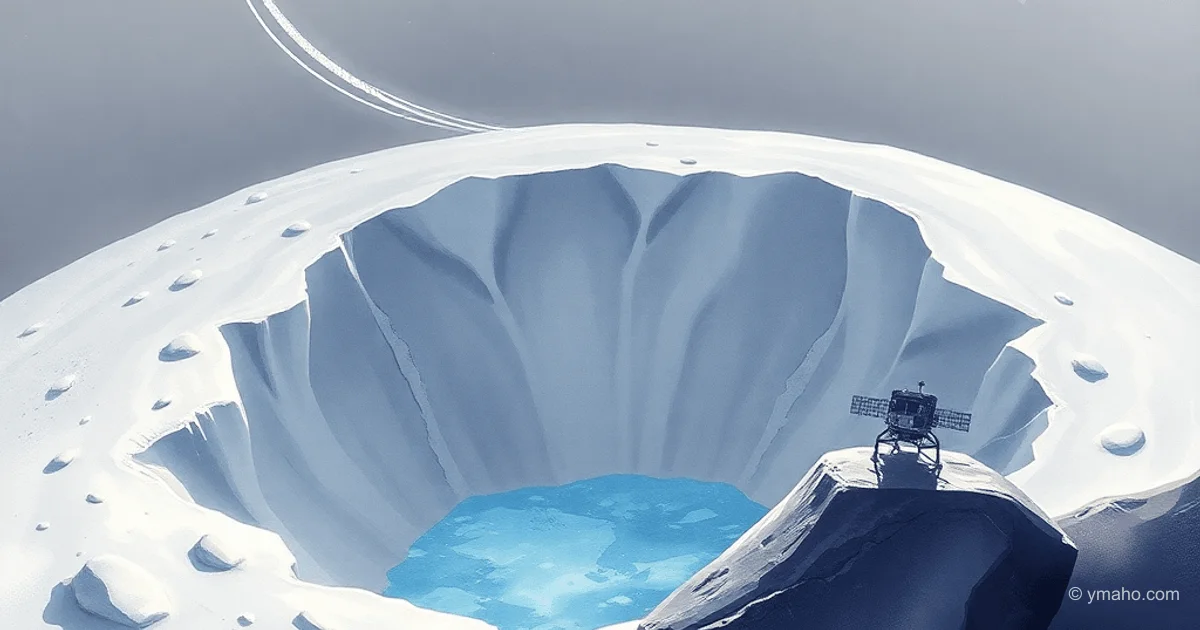
For decades, scientists debated whether the moon’s water arrived in a single dramatic event—like a massive comet slamming into the surface—or trickled in over time. New research now strongly supports the “trickle” theory. By studying which craters have stayed in permanent shadow the longest, researchers found that the oldest cold traps hold the most ice. Think of these craters like ancient freezers: the longer they’ve stayed shut and dark, the more frost they’ve collected.
But here’s a twist: the moon’s tilt has shifted slightly over billions of years. That means some craters once bathed in sunlight are now in shadow—and vice versa. When a crater gets exposed to sunlight, any ice inside doesn’t melt (there’s no air for liquid water); instead, it turns straight into vapor and vanishes into space or drifts to another cold spot. So only the craters that have stayed dark the longest still hold big ice deposits.
Where Did the Water Come From?
The source of lunar water remains partly mysterious, but scientists now believe it’s a mix of several processes:
- Tiny impacts: Countless small comets and asteroids delivered water over eons.
- Volcanic outgassing: Early moon volcanoes may have released water vapor from deep underground.
- Solar wind chemistry: Hydrogen from the sun hits the moon’s surface and can combine with oxygen—possibly even oxygen that drifted all the way from Earth—to form water molecules.
This slow accumulation explains why ice isn’t evenly spread across all shadowed craters. Only those that have been consistently cold for 3 billion years or more became true ice vaults.
What This Means for Future Moon Missions
NASA’s Artemis program aims to land astronauts near the lunar south pole—the very region where these icy craters sit. Knowing which craters are oldest and most likely to hold abundant ice helps mission planners pick landing sites. For example, Haworth Crater, shadowed for over 3 billion years, shows strong signs of water ice and could be a prime target.
Upcoming missions will carry new tools to study this ice in detail. One such instrument, called L-CIRiS (Lunar Compact Infrared Imaging System), is a thermal camera designed to map temperatures in craters with unprecedented precision. It’s scheduled to fly to the moon in late 2027 aboard a commercial lander.
Key Takeaways
- The moon’s water ice built up gradually over 3+ billion years—not from one big impact.
- Only craters that have remained in permanent shadow the longest hold significant ice.
- The moon’s changing tilt means “permanent” shadows aren’t truly eternal.
- Multiple sources—comets, volcanoes, solar wind—likely contributed to lunar water.
- This knowledge directly guides where astronauts should land to access vital resources.
What Does This Mean for Regular People?
While you won’t be sipping moon water anytime soon, this discovery shapes humanity’s next giant leap. Reliable water on the moon lowers the cost and risk of long-term space exploration—it means we won’t have to haul every drop from Earth. That makes lunar bases, Mars missions, and even deep-space travel more realistic. Plus, understanding how water moves through our cosmic neighborhood helps us grasp how common water—and maybe life—might be elsewhere in the universe.
— Editorial Team









