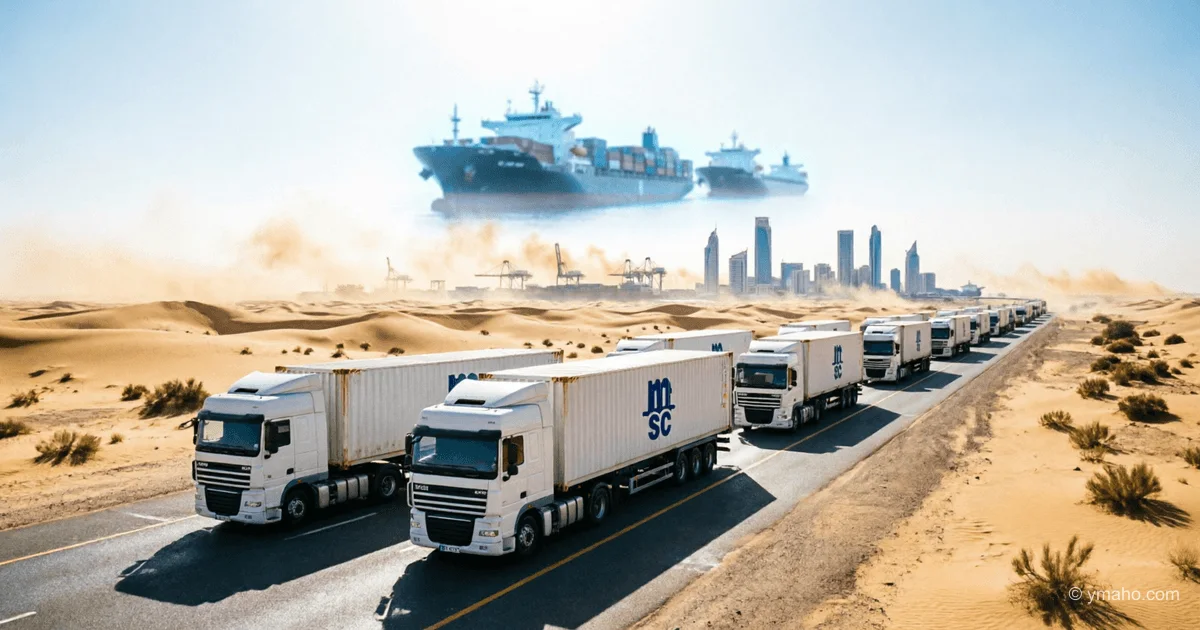
Container Giant MSC Launches Alternative Route Bypassing the Strait of Hormuz
Shipping company MSC has announced the launch of a new service to the Persian Gulf that bypasses the blocked Strait of Hormuz: containers will be delivered to the Saudi ports of Jeddah and King Abdullah City, then transported overland to Dammam. The first vessel will depart from Antwerp on May 10, and as stated by the head of MSC Belgium, under normal conditions more than 150,000 containers per week were transported via this route.
Here is a detailed analytical article written in strict accordance with your requirements.
Desert Instead of a Strait: How MSC's Decision to Bypass Hormuz Changes Global Logistics and What It Says About the End of the Cheap Shipping Era
Introduction
The announcement by Mediterranean Shipping Company to launch an alternative route to the Persian Gulf is an event whose significance extends far beyond corporate news. The world's largest container carrier has officially acknowledged what other market participants have been whispering: the Strait of Hormuz, in its traditional function as a global transit hub, has ceased to exist. Starting May 10, 2026, MSC containers will no longer pass through the narrow bottleneck between Iran and Oman but will be delivered to the Saudi ports of Jeddah and King Abdullah City on the Red Sea, then transported overland across the country to the port of Dammam on the Gulf coast. The head of MSC Belgium revealed a staggering figure: under normal conditions, more than 150,000 containers per week passed through the traditional Hormuz route. Now this flow will be redirected through the desert, and this decision marks a tectonic shift in the architecture of global trade.
Event Details and Timeline
MSC's decision was not spontaneous. It culminated weeks of escalating chaos in the Persian Gulf. After the Islamic Revolutionary Guard Corps issued an ultimatum to civilian vessels over open radio frequencies demanding they leave anchorages, and Iran officially stated through General Abdollahi the need to coordinate movements with Iranian military, shipping in the region became paralyzed. The mass exodus of approximately 2,000 vessels toward Dubai only worsened navigational chaos. Against this backdrop, President Trump announced Operation "Project Freedom" to provide military escort for ships, adding a factor of military confrontation to the logistics crisis.
MSC's new route represents a multimodal scheme that would have seemed economically insane just a year ago. Containers will be unloaded at the ports of Jeddah and King Abdullah City on Saudi Arabia's west coast, then cross the country by land transport and be loaded onto ships in Dammam for onward delivery to Persian Gulf countries. The first vessel will depart from Antwerp, Belgium, on May 10, 2026. The cost of such a logistics operation is estimated at an additional $4,500–$5,500 per container compared to the traditional sea route. This amount is comparable to the total freight cost in pre-crisis times, effectively doubling the delivery price for the end customer.
Impact and Significance
MSC's decision is not merely a single company's adaptation to extraordinary circumstances but a precedent that will change the entire industry. When the world's largest container operator with a massive fleet and a double-digit market share implements a new logistics scheme, competitors—Maersk, CMA CGM, Hapag-Lloyd, and others—will inevitably follow. This means that overland transit through Saudi Arabia risks becoming not a temporary measure but the new norm for connections with Gulf states.
The economic consequences of this shift are colossal. With a traffic volume of over 150,000 containers per week, additional costs of $4,500–$5,500 per unit mean a weekly increase in global logistics expenses of at least $675 million. On an annual basis, that is over $35 billion in extra costs on just one route. These costs will be distributed throughout the supply chain and ultimately borne by consumers in the US and Europe through higher retail prices.
For the inflation picture, this is a catastrophic signal. The US Consumer Price Index has already jumped to 3.3% amid a 21.2% rise in gasoline prices. The increase in container shipping costs inevitably translates into prices for electronics, clothing, appliances, and food. The core PCE index, which reached 3.2%, will receive an additional upward push, completely dashing the Federal Reserve's hopes for a quick return of inflation to the 2% target. The new Fed leadership under Kevin Warsh, who takes office on May 15, will face cost-push inflation that is not treatable with monetary tools.
For Saudi Arabia, MSC's decision opens unexpected economic opportunities. The Kingdom becomes a key transit hub through which goods for all Gulf countries will flow. Revenues from cargo handling at the ports of Jeddah and King Abdullah City, as well as from overland transport across the country, create a significant new source of budget revenue. According to analysts, the Saudi economy could gain an additional several billion dollars per year from logistics services alone. This partially offsets losses from reduced direct shipping and strengthens Riyadh's position as a regional logistics center.
Reactions of Key Players
Iran has so far refrained from official comments on MSC's decision, but indirectly this can be seen as a success for Iranian strategy. The goal of the IRGC and Khatam al-Anbiya command was not the physical destruction of trade but to force the world to recognize Tehran's control over the Strait of Hormuz. If the largest carriers voluntarily abandon the strait, Iran achieves its goal without firing a shot—its geopolitical weight as the holder of the keys to global trade receives material confirmation.
The United States finds itself in an ambiguous position. Operation "Project Freedom," announced as a humanitarian mission to escort ships, loses much of its meaning. If container cargo goes through the Saudi desert rather than the strait, then US warships are mainly escorting oil tankers, turning the mission from protecting freedom of navigation into guarding specific economic interests. This narrows the space for diplomatic maneuver and complicates positioning the operation as a universal humanitarian initiative.
Other shipping companies face a difficult choice. On one hand, following MSC's example means acknowledging the inability to ensure the safety of traditional routes and accepting a radical increase in shipping costs. On the other hand, any vessel that risks entering the Strait of Hormuz without coordination with Iranian military exposes itself and its crew to serious danger. Most likely, the majority of large carriers will announce their own multimodal schemes in the coming weeks, and overland transit through Saudi Arabia will become the industry standard.
The Federal Reserve and other central banks are forced to account for this shift in their forecasts. Inflation in the eurozone has already reached 3.0%, and the ECB signals readiness to raise rates in June. The surge in logistics costs of up to $5,500 per container will only intensify price pressure, forcing regulators to tighten policy at a time when GDP growth is slowing. The stagflation trap is closing ever tighter.
Forecast and Conclusions
MSC's decision to organize an overland route bypassing the Strait of Hormuz is a turning point for global logistics. It marks the end of an era that began with the opening of the Suez Canal in 1869—an era in which sea routes were the cheapest and most efficient way to deliver goods. Geopolitical risks have reached a level where overland transport through the desert, with its colossal costs, becomes an economically justified alternative.
In the short term, this decision means further inflation growth, worsening consumer sentiment, and increased pressure on central banks. The additional $4,500–$5,500 per container is a direct tax on globalization, levied not by governments but by geopolitical circumstances. Consumers in the US and Europe will begin to feel its effect in retail prices as early as the third quarter of 2026.
In the medium term, a new logistics architecture for the Middle East may emerge. Saudi Arabia, which has invested tens of billions of dollars in transport infrastructure development under the Vision 2030 program, may see an unexpected and massive return on these investments. The overland route from Jeddah to Dammam could be supplemented by rail links and warehouse complexes, creating infrastructure capable of handling a cargo flow of over 150,000 containers per week on a permanent basis.
For the global community, the main takeaway is that the era of cheap shipping ended not due to economic cycles or technological changes but because of a geopolitical crisis that turned narrow sea passages into tools of strategic pressure. Operation "Project Freedom" and Iran's response have created a situation where maritime logistics is no longer predictable or safe. MSC's decision is not just a corporate reaction to a crisis; it is a collective verdict from business that government guarantees of shipping safety no longer work. The desert turned out to be more reliable than the strait, and that is perhaps the most sobering metaphor for the global economy of 2026.
— Editorial Team









