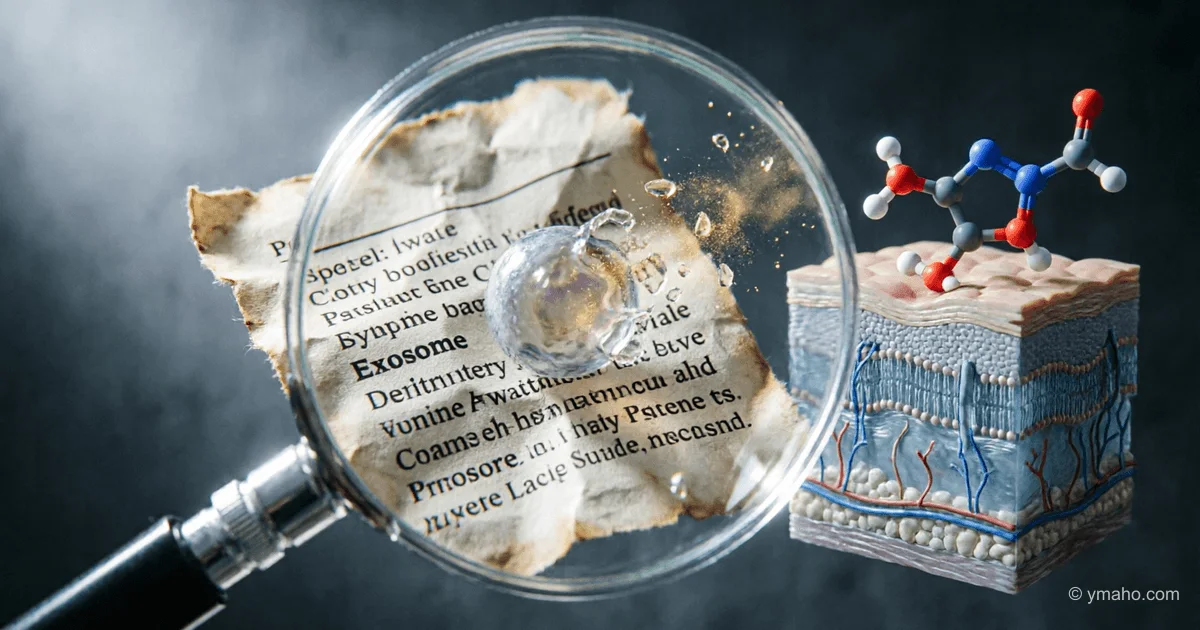
NAD+ and Exosomes: The Most Controversial Innovations in Skincare
The beauty industry is flooded with products containing NAD+ molecules and exosomes, but experts debate their effectiveness. The question of whether the giant NAD+ molecule can penetrate the skin remains open, and exosomes often turn out to be a marketing gimmick.
Here is a detailed analytical article based on the provided news and discussions surrounding NAD+ and exosomes.
NAD+ and Exosomes: The Most Expensive Beauty Scam or a Future Breakthrough?
Introduction
A cream costing 50,000 rubles promises cellular-level rejuvenation. Its ingredient list includes the NAD+ molecule (nicotinamide adenine dinucleotide), a key player in energy metabolism and DNA repair. Next to it, a serum with stem cell exosomes that "transmit youth signals" to neighboring cells. It sounds like science fiction. And, according to many experts, it is.
In 2026, the beauty market was swept by a wave of products based on two bright but highly controversial ingredients. They share one thing: huge amounts of consumer money, ready to pay for biotechnological immortality, and the loud question from scientists: "Does it even work in a cream format?"
NAD+ is a large, hydrophilic molecule. Can it pass through the lipid barrier of the stratum corneum? Most likely, no. Exosomes are nanoparticles isolated from cells. Do they retain their structure and function in a jar with preservatives on a store shelf? That's a big question. The beauty industry has once again stolen terms from serious medicine and molecular biology without burdening itself with evidence. But this time, the stakes are too high—consumer trust and billion-dollar investments in biotech startups.
Event Details and Timeline
Scandals around NAD+ and exosomes unfolded in parallel, creating a perfect storm.
2015–2017: Scientific Foundation in Medicine. NAD+ is known as a coenzyme that declines with age. Intravenous administration of NAD+ in mouse experiments showed rejuvenating effects. Exosomes were studied as drug delivery vehicles and disease markers. No one thought about cosmetics.
2018–2019: Transfer to Cosmetology. Aesthetic medicine begins using NAD+ injections for anti-aging effects. The first exosome injections appear in clinics. Clients see results, but injections are made under the skin, bypassing the barrier. Logical: what works inside should work outside, right? Cosmetic brands bet on this flawed syllogism.
2020–2022: Boom of Topical Cosmetics. Premium brands (mostly Asian and American) launch creams and serums with NAD+ and exosomes. The main argument: "We know the molecule, it's important for longevity." No publications on skin penetration. Consumers, scared of aging and fueled by hype, buy them up.
2023–2024: First Cracks. Dermatologists and formulators start raising alarms on social media. Chemist Michelle Wong (popular cosmetic blogger) breaks down formulations and proves: NAD+ is too large (663 Da, hydrophilic) a molecule to pass through the lipid barrier without a special delivery system, which is absent in 99% of products. Exosomes degrade at room temperature and in the presence of preservatives. The first high-profile debunkings occur.
2025–2026: Epidemic of Skepticism. Allure and Cosmetic Science publish investigations under headlines like "NAD+ in a Cream? Most Likely Not" and "Your Exosomes Are Dead." The FDA issues warnings to companies using the term "exosomes" in cosmetics without evidence. In Russia, Roskachestvo begins testing luxury brands. Yet sales do not drop—trust in marketing is still stronger.
The key trigger in 2026 is the publication of a systematic review in the International Journal of Cosmetic Science, where the authors drew a line: out of 48 tested cosmetic products with exosomes on the market, only 5 contained intact exosomes capable of carrying a signal. The rest were cell lysates or simply a mixture of proteins and lipids unrelated to real exosomes. The market shuddered.
Impact and Significance
For the World: This story became a classic example of "cosmetic hype-engineering"—when a complex scientific term is ripped out of context and turned into a marketing gimmick. International dermatology societies (EADV, AAD) issue special guidelines for doctors, warning: "Do not recommend creams with NAD+ and exosomes—they are a waste of patients' money." In response, some manufacturers try to sue doctors for defamation. The conflict escalates into a public war.
For the Industry: Serious damage is done to the reputation of biotech cosmetics as a whole. Consumers begin to confuse truly effective biotech components (fermented extracts, peptides) with outright speculative ones (NAD+, exosomes). This sets back the development of evidence-based cosmeceuticals. Small startups with honest technologies cannot break through the noise of marketing monsters. On the other hand, the industry of paleolithic skepticism swells, where any active cosmetics are denied—also harmful.
For Society: The gap between scientifically literate and scientifically naive consumers widens. The former have learned to check patents, read penetration studies, and distinguish "formulation with a claim" from "formulation with proof." The latter continue to buy creams for huge sums, believing that the NAD+ molecule will "slip" through the skin because "it says so." A class of "beauty skeptics" forms, whose idol becomes the chemist-formulator debunking formulations. This reduces loyalty to the entire industry.
Reactions of Key Players
1. Reputable Brands with Real Technologies (SkinCeuticals, Medik8, The Ordinary): Use the moment to strengthen their positions. They openly write blog articles titled "Why We Don't Add NAD+ to Our Serums (and What Works Instead)." The scientific departments of these companies release comparison tables: molecular size, penetration ability, availability of clinical trials. They bet on proven retinoids, peptides, and antioxidants. Sales grow thanks to an audience tired of hype.
2. Brands Using "Technical" Exosome-Like Technology (ELEVAI, Plated): Try to salvage the situation by renaming "exosomes" to "cell extracts" or "multi-vesicular structures." They publish storage and transport protocols confirming that their product contains native nanoparticles. But these are few. The majority cannot do this.
3. Large Corporations with Dubious Lines (e.g., recent L'Oréal lines with "exosome-like vesicles"): Resort to trickery: remove direct mentions of NAD+ and exosomes from labels, leaving abstract "active signaling molecules." In advertising, they continue to use the terms. This is walking a fine line. EU regulators have already started collecting fines for misleading labeling.
4. Russian Brands: Mostly observers for now. Some ("Librederm," "Planeta Organica") have released one or two products with claims of "NAD-complex," but no major scandals have occurred due to low reach. The main problem is the lack of clear responsibility for cosmetic claims in Russia, similar to the FDA or EU. Manufacturers can write anything until a complaint is filed with the FAS.
5. Marketing Agencies and Media: Found themselves at the epicenter. Many beauty publications that published enthusiastic reviews of NAD+ creams now have to backtrack, losing trust. Specialized "ingredient check" channels (e.g., Telegram channel "Beauty Science") become the main authorities. The future of media is to publish not press releases but patent analyses.
Forecast and Conclusions
The case of NAD+ and exosomes is a telling lesson for the entire beauty industry.
Forecasts for 2027–2029:
1. Tightening Regulation. The FDA and European Commission will introduce the concept of "cosmetics with cellular action claims," requiring data on in vitro (on skin in a test tube) or in vivo (on volunteers) penetration, as well as nanoparticle stability. In Russia, the FAS and Roskachestvo will begin to more actively demand justification for terms like "innovative nano-complexes."
2. Collapse of the Market for "Empty" NAD+ and Exosome Products. By 2028, 80% of "boutique" brands that built their line solely on these two ingredients without a proven delivery system will exit the market or rebrand. Only those who used liposomes, transfersomes, or other proven penetration enhancers for molecule delivery will remain.
3. Rise of Alternatives—Niacinamide and Peptides. Consumers will flock to what works and costs less. Niacinamide (vitamin B3, a precursor to NAD+ in the body) penetrates the skin well and has the same function of supporting energy metabolism but costs hundreds of times less. Exosomes will be replaced by synthetic lipid nanoparticles that are stable and cheap.
4. Birth of a New Profession—"Beauty Auditor." Independent certified organizations will emerge that, for a fee, test specific batches of cosmetics for the presence of claimed actives in working form. A "Tested for Penetration" emblem will appear on labels, giving consumers extra confidence.
Conclusion. NAD+ and exosomes in cosmetics are neither "evil intent" nor "100% effective." This is a classic case where the industry outpaced science, mistook wishful thinking for reality, and nearly undermined trust in all biotech cosmetics. The story will end well: only those brands will remain that either prove the penetration of their molecules through expensive research or honestly abandon speculative claims. For the consumer, the main lesson: do not believe beautiful words and loud molecular names. Believe publications, patents, and independent test results. And remember—the most expensive cosmetics are not always the smartest. Sometimes they are just the most expensive way to buy hope in a jar.
— Editorial Team









