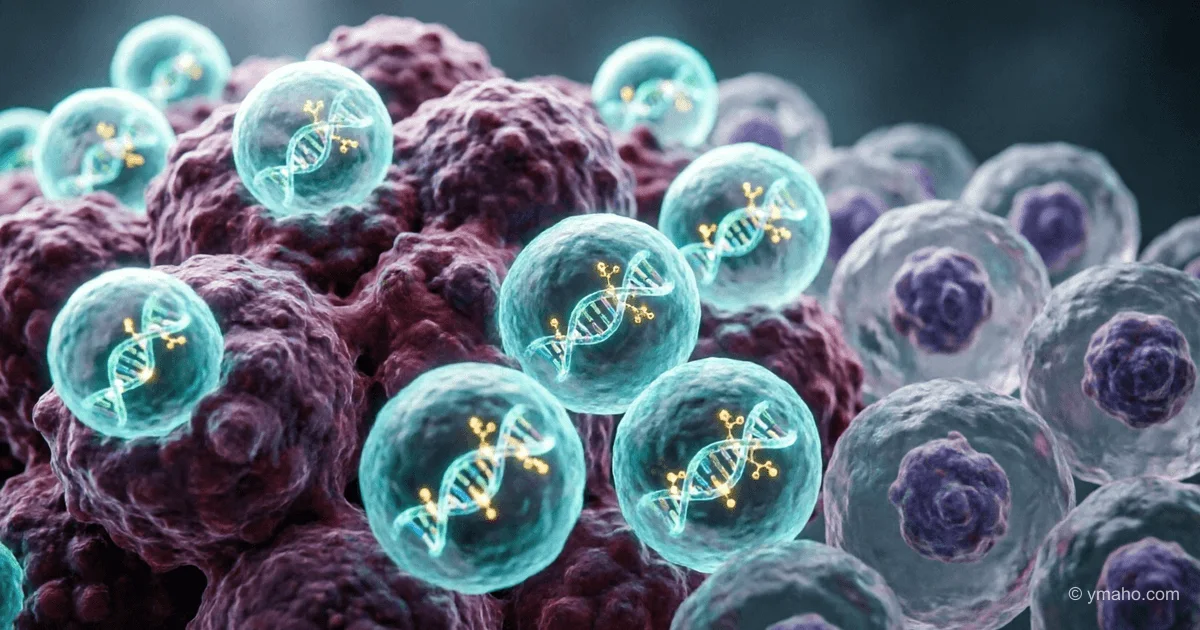
EUR J CANCER: Nanotechnology and Gene Therapy Against Tumor Chemoresistance
A comprehensive review in the Journal of Experimental & Clinical Cancer Research describes a unified 'microenvironment-epigenetics' axis driving cancer therapy resistance. The article highlights breakthrough approaches using nanoparticles to deliver CRISPR epigenome editors and inhibitors to overcome chemoresistance.
A review in the Journal of Experimental & Clinical Cancer Research, published on May 4, 2026, at first glance appears to be just another academic paper on how nanoparticles can help defeat cancer. But the authors—Sharma, Thuy, Ansari, Tripathi, and their colleagues—have done something far more significant than compiling known data. They have, for the first time, described the 'tumor microenvironment–epigenetics–nanotherapy' axis not as a collection of disparate mechanisms, but as a single, integrated system with specific vulnerabilities. For the industry, this means a paradigm shift: the target is no longer the cancer cell, but the ecosystem that makes it unkillable.
The Core: What's Really Happening
Chemoresistance kills more patients than cancer itself. For decades, oncologists have observed the same pattern: a drug works, the tumor shrinks, then inevitably returns—and no longer responds to the same therapy. The biology of resistance has been studied piecemeal: some investigated hypoxia, others cancer-associated fibroblasts, others epigenetic reprogramming. But a holistic picture was missing, and thus a strategy to strike at the root of the problem.
Sharma and co-authors have assembled this puzzle. Their central thesis: the tumor microenvironment doesn't just 'protect' cancer cells from drugs; it actively reprograms their epigenetics through specific signaling cascades. Hypoxia, via HIF-1α, activates DNA methyltransferases that 'lock' drug sensitivity genes, pushing the cell into a stable resistant state. Acidosis, characteristic of the tumor microenvironment, triggers histone modifications that cement the epithelial-mesenchymal transition—a process that makes cells mobile and metastatic. The key integrator of this chaos is microRNAs, which create self-sustaining feedback loops: once activated, resistance does not turn off on its own.
The practical takeaway of the article: this axis has specific therapeutic nodes. If inhibitors of DNA methyltransferases, histone deacetylases, or EZH2 are delivered directly into the tumor—that is, not just killing cells with chemicals, but 'reprogramming' their epigenetics back to a sensitive state—resistance can be reversed. This is where nanoparticles enter the stage. They solve the delivery problem: protecting molecules from degradation, penetrating the dense tumor matrix, and releasing their cargo only in target cells.
Timeline and Context
This publication is no coincidence. It fits into the context of a powerful technological leap that occurred in 2025–2026.
First, this is the year of triumph for lipid nanoparticles (LNPs). The technology proven effective in mRNA vaccines has been adapted for CRISPR editing. A breakthrough moment came on April 27, 2026: Intellia Therapeutics reported the success of Phase III clinical trials for lonvoguran ziclumeran—the first-ever therapy using in vivo CRISPR editing delivered by LNPs to treat hereditary angioedema. The result: an 87% reduction in attack frequency with a single dose. This is not just another drug; it is the first clinical proof that LNP-delivered CRISPR works systemically in humans.
Second, competing giant Editas Medicine is accelerating its own LNP program. At an investor meeting in March 2026, CEO Gilmore O'Neil confirmed that the company has fully focused on in vivo CRISPR delivered by lipid nanoparticles. Their program EDIT-401, editing the LDLR gene, showed a 90% reduction in cholesterol in primates and aims to administer the first human dose in Phase I by the end of 2026.
Third, the explosive growth of the epigenetic market. According to a report by The Business Research Company published in February 2026, the global epigenetics market is valued at $156 billion USD in 2026 and will exceed $350 billion by 2030. The reason: epigenetic technologies are moving from the laboratory niche into clinical practice. It is this transition that makes Sharma's review a strategic document, not a library reference.
Who Wins and Who Loses
Winners:
Intellia Therapeutics. After the historic success of the HAELO Phase III trial, the company has already begun a rolling submission to the FDA. Lonvo-z is not just a drug, but a platform proof of concept. If LNP delivery works for editing the KLKB1 gene in the liver, logic dictates it will also work for epigenetic editing in tumors. Intellia gains a technological lead in a race where nano-epigenetics becomes the battlefield for oncology markets and beyond. Projected success could also boost the company's stock by 30–50% within a year of potential FDA approval in 2027.
Editas Medicine. O'Neil highlighted the key advantage of LNP-delivered CRISPR over viral vectors: long-lasting effect without the risk of chronic hepatotoxicity. When CRISPR directly edits a gene, the result (cholesterol reduction or, in the future, 'repair' of epigenetics) persists in daughter cells. The company has $146 million USD in cash, funding operations through Q3 2027. If EDIT-401 works in humans, Editas will open a market of 10 million cardiology patients in the US alone.
Patients with aggressive cancers. The current chemotherapy paradigm is like bombing a city to destroy the enemy; healthy cells also suffer. The approach described in the review offers a targeted special operation: infiltrate the tumor, reprogram its cells back, turning them from resistant to sensitive to standard chemotherapy doses. This promises significantly less toxic and more effective treatment.
Manufacturers of epigenetic analysis tools. The market for epigenetic reagents—DNA methyltransferases, ChIP-seq kits, antibodies to histone modifications—is growing at a phenomenal rate, over 22% per year. Every lab starting research on the TME-epigenetics axis will purchase these tools.
Losers:
Proponents of traditional 'naked' inhibitors. Many small-molecule inhibitors of DNMT or HDAC could not be used systemically due to high toxicity. Sharma's review essentially puts an end to the idea of using them without a targeted delivery system. Investors who bet on companies developing non-selective epigenetic drugs will lose money.
Manufacturers of viral vectors. The comparison between LNPs and AAV made by Editas' CEO reveals a growing trend—a shift away from viruses due to issues with liver toxicity, limited cargo capacity, and single-use administration. If LNPs show comparable efficacy in oncology, the AAV market, currently worth several billion USD, faces stagnation.
What the Media Isn't Saying
The first critical point is the 'heterogeneity of the enhanced permeability and retention effect.' The review mentions it as a challenge, but media omit the details. The EPR effect, on which nanomedicines have relied for decades, works significantly worse in humans than in mice. In different patients and even in different metastases of the same patient, vascular permeability can vary dramatically. This means a universal dose of nanoparticles that works for everyone may not exist—costly personalization, including pre-imaging or biopsy, will be required.
Second: the problem is not to 'edit' a cell, but to 'reprogram' the entire population of cancer stem cells. The review describes self-sustaining miRNA loops. If CRISPR/Cas9 nanoparticles eliminate resistance in 95% of cells, the remaining 5% could restart the entire process through secretion of exosomes carrying the same microRNAs. Complete eradication of the disease may require not a single injection, but long-term combination therapy.
Third: the financial paradox. Developing personalized nano-epigenetic therapy for a single cancer patient, by current estimates, could cost over $200,000 USD. This is comparable to CAR-T, but with even more complex logistics. Who will pay? Insurance companies will be extremely skeptical until overall survival data emerge, which will take years after therapy begins.
Forecast: Next 30 Days and 90 Days
30 days (by June 5, 2026):
Investors will begin to revalue Editas Medicine. The announcement of plans to administer the first human dose in 2026, combined with Intellia's success, creates a narrative that LNP-CRISPR is not a scientific project but a mature industrial technology nearing market entry. In the coming weeks, I expect a wave of positive analyst reports on genetic companies.
Labs will massively start dissecting the axis proposed by Sharma. In the next 30 days, several preprints will appear on PubMed and bioRxiv attempting to reproduce or refine the TME-epigenetics connections, especially regarding EZH2 and HDAC. A race to colonize the new niche of 'integrative epigenetics of the tumor microenvironment' will begin.
90 days (by August 5, 2026):
Editas will release refined Phase I protocols. If they include even a signal of an oncology application (e.g., editing PD-L1 in tumors), their stock will soar. Competitors, including Intellia, will likely also disclose oncology directions.
At ASCO 2026, which concludes in June, there will surely be presentations with preclinical data on nano-epigenetic editing. Given that Sharma's review came out in early May, large labs had just enough time to prepare and submit abstracts to the major oncology conference. The market will get its first direct visualization of how CRISPR nanomachines attack epigenetic locks of resistance in tumors.
The main strategic forecast: the TME-epigenetics axis will become a standard target in pharmacology. In the coming months, we combine LNPs as delivery, CRISPR/Cas as a tool, and epigenetics as a target. This turns the abstract idea of combating resistance into an engineering problem. Chemoresistance, which for decades has been the leading killer of cancer patients, for the first time gains the status of a fixable technical glitch rather than a biological curse. And this is perhaps the most important shift in oncology in the last ten years.
— Editorial Team









