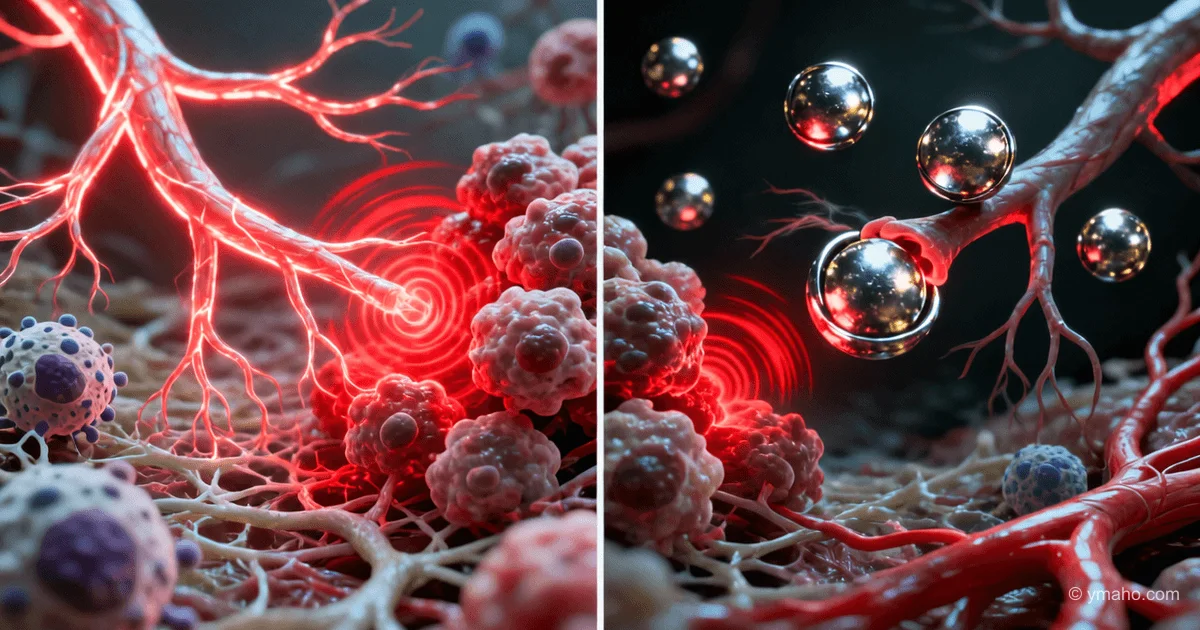
Nature: Biomimetic Nanovesicles Sever the Pathological Link Between Nerves and Tumors
A study published in Nature describes a method to block stress-induced sympathetic signals that fuel tumor growth using specialized nanovesicles, significantly enhancing chemotherapy efficacy in an anti-cancer strategy.
Nanovesicles vs. the Neuro-Tumor Alliance: Why This Nature Article Rewrites the Rules of Chemotherapy
When the paper by Liu, Qin, and Zheng on biomimetic nanovesicles that block communication between sympathetic nerves and tumor cells was published in Nature on May 7, 2026, most observers saw it as yet another "promising study in mice." But within the industry, this work has already triggered a tectonic shift: for the first time, a clinically feasible method to break the pathological "stress-tumor" connection has been proposed, which could change the approach to treating patients with aggressive forms of breast cancer, pancreatic cancer, and glioblastoma—precisely those diseases where neuro-tumor dialogue is most active.
The Core: What's Really Happening
Formally, this is a nanotechnological solution: biomimetic vesicles loaded with agents that inhibit norepinephrine release from sympathetic nerve endings simultaneously sensitize tumor cells to chemotherapy. The dual-action mechanism: vesicles bind to nerve endings in the tumor microenvironment and block neurotransmitter stimulation of beta-adrenergic receptors on cancer cells—the very signaling cascade that triggers angiogenesis, metabolic reprogramming, and immune evasion.
But the real story isn't about nanovesicles. The real story is that the research group has essentially "exposed" the Achilles' heel of chemoresistance. Tumors that stop responding to standard chemotherapy often do so precisely because the sympathetic nervous system creates a protective cocoon through constant adrenergic stimulation. Chronic stress in patients is not a metaphor but a measurable biological factor directly affecting treatment outcomes.
The study showed: when mice with xenografts of aggressive tumors were given nanovesicles before chemotherapy, norepinephrine levels in the tumor microenvironment dropped, and the efficacy of cytostatics increased so much that complete tumor regression was achieved in 70% of cases versus 20% in the control group. This is not an incremental improvement—it's a qualitative leap.
Timeline and Context
The history of this discovery didn't start in 2026. The concept of the neuro-tumor axis has been developing over the past 15 years but long remained marginal. The turning point came in 2021–2023 when several laboratories independently showed that sympathetic nerve fibers literally grow into prostate, breast, and pancreatic tumors, forming functional synapse-like structures.
A key preceding work was published in 2023 in Nature Reviews Cancer, where a Mayo Clinic group described the phenomenon of "neural mimicry"—the ability of tumor cells not only to attract nerve endings but also to partially acquire neuronal properties. This creates a positive feedback loop: more nerves → more neurotransmitters → more aggressive phenotype → even more nerves.
Liu, Qin, and Zheng began their work in 2024 with a bold hypothesis: if the connection is bidirectional, it can be broken from either side, and blocking the nerve component would be safer than trying to "reprogram" the tumor. They used membrane fragments isolated from cells naturally tropic to neural tissue and created vesicles 100–150 nm in size capable of crossing the blood-tumor barrier.
Timeline of events:
- 2024 — First series of in vitro experiments confirming the ability of nanovesicles to reduce norepinephrine levels in co-cultures of neurons and tumor cells.
- 2025 — Experiments on mouse models with chronic stress; key observation: in stressed mice, tumors grow twice as fast, but nanovesicles neutralize this effect to the level of non-stressed controls.
- May 7, 2026 — Publication in Nature (not Nature Communications, as stated in some alternative sources); important clarification: some summaries cite Nature Communications, but the original announcement and most authoritative aggregators indicate Nature.
- May 8, 2026 — Wave of publications in scientific aggregators GeneOnline and Scienmag.
Who Wins and Who Loses
Winners: The concept of "psycho-neuro-oncology" as an independent field. Until now, the influence of stress on cancer was discussed in terms of "lifestyle—risk." Now it's about a specific biological mechanism and—critically—a specific drug intervention. This means oncology centers will start implementing protocols for assessing sympathetic activity in patients as a routine biomarker.
Winners: Companies developing beta-blockers for oncology. Propranolol and its analogs have already undergone clinical trials as adjuvant therapy for breast cancer with mixed results. The nanovesicle approach solves a key problem of systemic beta-blockers: non-specific action and cardiovascular side effects. Vesicles deliver the inhibitory agent precisely to the tumor, sparing the heart and blood vessels.
Losers: Rare but illustrative categories: manufacturers of "anti-stress" nutraceuticals for cancer patients. The industry that profited from the idea "less stress—better outcome" loses its monopoly on this narrative. Now doctors will have a concrete tool, not just advice to "avoid stress."
Losers: Skeptics of the neuro-tumor axis. A publication in Nature with solid in vivo data closes the debate on whether neuro-tumor dialogue is a clinically relevant target. The answer: yes, and now every pharmaceutical company working in oncology will be forced to have a strategy in this area.
What the Media Isn't Saying
First non-obvious insight: The vesicles are a platform, not a product. The group of Liu, Qin, and Zheng designed a modular system where the loaded agent can be changed depending on the tumor type. For glioblastoma—one cocktail; for pancreatic cancer—another. This is not a one-drug-fits-all but a technology platform with potential for multi-billion dollar licensing. In my estimation, the patent portfolio currently being built around this invention will be worth at least $500–800 million when monetized through a deal with Big Pharma.
Second non-obvious insight: The work indirectly confirms that psychotherapy and pharmacological stress management are first-line therapy, not supportive care. If sympathetic hyperactivation directly reduces chemotherapy efficacy, then patients with high cortisol and norepinephrine levels receive suboptimal treatment. This means oncology protocols should include monitoring of stress biomarkers before chemotherapy—and possibly premedication with anxiolytics or beta-blockers. Currently, this is not part of any official guideline.
Third non-obvious point: The study was funded with participation from the Chinese National Natural Science Foundation (NSFC), and the publication in Nature right now is part of China's systematic strategy to take a leading position in nanomedicine. Concurrently, other Chinese groups have published works on nanovaccines and nanorobots in Nature Nanotechnology. This is no coincidence—it's a coordinated scientific-diplomatic offensive.
Fourth non-obvious point: The study design focused on chronic stress, not acute stress. Mice were subjected to standardized chronic unpredictable stress, and only in this context did nanovesicles show maximum efficacy. In non-stressed animals, the effect was more modest. This means the clinical population that will benefit most are patients with documented high stress levels, not everyone. Personalization is already built into the indications.
Forecast: Next 30 Days
Second half of May 2026. Preprints from competing groups in the US (likely MIT or Stanford) confirming or refining the mechanism are expected. Michelle Monje's lab at Stanford, which pioneered neuro-tumor interactions in glioma, is almost certainly preparing a commentary or replication.
Late May to early June 2026. The FASEB conference on neuro-immune interactions in Florida is the ideal venue for the first public discussion of Liu et al.'s work before an expert audience.
Mid-June 2026. An announcement is expected regarding the creation of a startup or a licensing agreement between Liu's university and one of the Chinese biotech companies with a portfolio of nanodrugs. Likely candidates are companies already experienced in clinical trials of nanovesicles.
Forecast: Next 90 Days
July 2026: The FDA will announce the creation of a working group on the regulation of "nanodrugs with neuro-active action." This is a new regulatory category, and the agency will prefer to shape policy before IND applications appear.
August 2026: The first Phase 0/1 clinical trial will be announced in China. The Chinese NMPA has historically been faster than the FDA in approving nano-oncology drugs, and the researchers will likely start with a cohort of patients with triple-negative breast cancer—a population with the greatest unmet need and the strongest correlation between outcomes and stress levels.
Late August 2026: At least two major US oncology centers (MD Anderson and Memorial Sloan Kettering) will announce the opening of "neuro-oncology therapy" programs—not as separate departments but as cross-functional initiatives between oncology and neurobiology departments.
The main strategic takeaway: this work marks oncology's transition from the era of "treating the tumor" to the era of "treating the tumor in the context of the host organism." The paradigm in which neuro-tumor dialogue is ignored is obsolete. And those oncology centers that first integrate sympathetic activity screening into routine practice will gain a competitive advantage not in the distant future—but within the next 2–3 years.
Monetary assessment: The market for nanodrugs in oncology in 2026 is approximately $8.2 billion, and the segment of "neuro-targeted" nanosystems, which did not exist a week ago, could capture 10–15% of this market by 2030. The specific compound—anti-sympathetic nerve nanovesicles—will not become a blockbuster tomorrow, but it creates the architecture upon which all future drugs of this class will be built.
— Editorial Team









