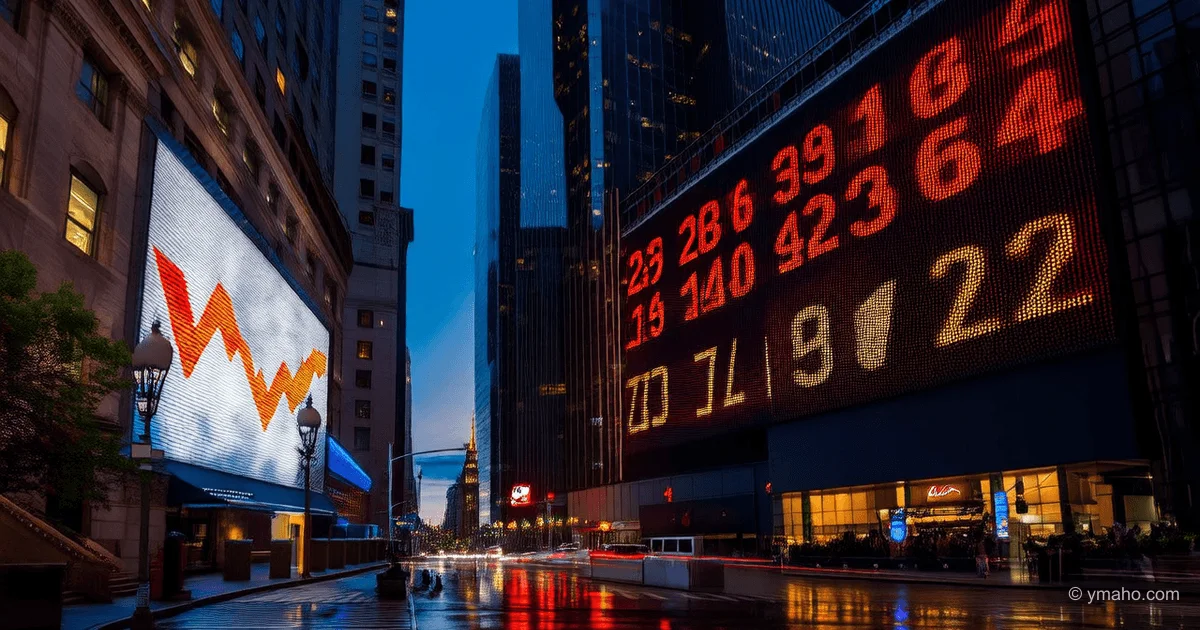
NASDAQ Tech Stocks Fall as Yields Rise
The high-tech NASDAQ index fell 0.71% in trading on May 12, showing a sharper decline than the Dow Jones and S&P 500 as investors reassess inflation risks.
Analytical Note
Subject: NASDAQ's May 12 Drop — Not a Correction, but the Start of a Great Rotation from Growth to Value
Date: May 13, 2026
Author: Independent Analyst
The Core: What's Really Happening
NASDAQ lost 0.71% in the trading session on May 12, and that's just the tip of the iceberg. Beneath the surface lies a process that will reshape the stock market for years: institutional investors have begun a massive rotation from overheated tech stocks into defensive assets and fixed-income instruments. The VIX fear index surged to 24.65, while the CEO confidence index hit its lowest levels since 2023. This is not a one-off reaction to inflation data — it's a structural shift in risk assessment.
The key non-obvious insight: NASDAQ's decline is not so much the result of rising Treasury yields (though 10-year notes yield 4.46%), but rather a consequence of a hidden liquidity crisis in the high-risk asset segment. Margin calls on structured products tied to tech stocks triggered a cascade of forced selling, which algorithmic traders amplified rather than absorbed.
Timeline and Context
The chain of events unfolded rapidly. On May 11, the U.S. Bureau of Labor Statistics released April CPI: 3.8% year-over-year — the highest since May 2023. The energy component surged 17.9%, gasoline 28.4%. The bond market reacted instantly: the 10-year Treasury yield hit 4.46%, a level last seen in July 2025, while 30-year bonds broke through 5%.
On May 12, trading opened in the red across the board. The S&P 500 fell 0.62% from its all-time high, the Dow Jones dropped over 307 points. But NASDAQ suffered the most — down 0.71%, even as Apple, Microsoft, and Nvidia each lost over 1%. Key point: NASDAQ's decline outpaced other indices, indicating a targeted exit from the tech sector rather than broad market panic.
The CME FedWatch tool that same day recorded a sharp rise in the probability of a Fed rate hike: the market priced in a 29% chance of tightening by end of 2026. This is a tectonic shift in expectations: just a week earlier, the market was discussing rate cuts; now it's discussing hikes.
Winners and Losers
Losers:
The tech sector as a whole. Companies with high P/E multiples, especially unprofitable or low-margin ones, face a double blow: rising capital costs reduce the present value of future cash flows, while inflationary pressure increases costs. Amazon shares fell 1.37%, and that's just the beginning.
The crypto market suffers even more: Bit Digital shares plunged 8.84%, Circle 6.16%. The crypto sector, long positioned as an "inflation hedge," has proven most vulnerable to rising yields.
Retail investors who bought tech stocks at the peak are facing margin calls. Leveraged structured products tied to the NASDAQ index create a feedback loop: falling prices trigger forced selling, which amplifies the decline.
Winners:
Holders of short-term Treasuries and money market instruments. A 4.46% yield on 10-year notes makes fixed income competitive with the dividend yields of many tech companies. Banks and financial institutions sitting on cash enjoy attractive risk-free returns.
The energy sector and commodity companies. Inflation driven by an energy shock channels capital into oil and gas assets. This is classic rotation: money flows from growth to value.
What the Media Isn't Saying
First. The official reason for NASDAQ's fall is "reassessment of inflation risks." But the real mechanism is more complex. Institutional investors use NASDAQ ETFs as hedging tools, not long-term positions. When Treasury yields rise, algorithms automatically reduce exposure to risky assets, creating selling waves unrelated to companies' fundamentals.
Second. Kevin Warsh, candidate for Fed chair, publicly opposes the policy of "forward guidance." This means the market loses visibility on the rate path. Without a clear roadmap, volatility becomes the new normal. The media frames this as a "disciplined approach," but for tech companies it's a disaster: they can't plan capital expenditures when the cost of money is unpredictable.
Third (the key non-obvious insight). Behind NASDAQ's decline lies the hidden dynamics of corporate buybacks. Tech companies have long supported their stocks through share repurchases financed by cheap debt. Now that Treasury yields exceed 4.4%, the cost of servicing corporate debt is rising. Apple, Microsoft, and Alphabet, with massive buyback programs, will be forced to either reduce buybacks or increase debt loads at prohibitively high rates. In either case, stock support weakens. That's what the market began pricing in on May 12, not just "inflation fears."
Fourth. The S&P 500 lost 0.62% from its all-time high, but the media omits that this decline occurred on rising trading volume. Average daily volume on the NYSE exceeded 5.2 billion shares — 15% above the monthly average. This means fear has returned to the market, and institutional players are aggressively cutting positions, not just riding out the dip.
Forecast: Next 30 Days and 90 Days
30 days (to mid-June 2026):
Key event: the vote on Warsh's nomination as Fed chair and his first meeting. If Warsh confirms readiness to raise rates (and given his criticism of QE and demand for "discipline," he likely will), the 10-year Treasury yield will test 4.8%. NASDAQ could fall another 5-7% from current levels.
I expect Apple and Microsoft to lose another 3-5% each, as their buyback programs come under pressure from rising debt costs. Tech companies will start cutting capital expenditures, creating a secondary blow to suppliers and the semiconductor sector.
The crypto market will continue to fall: Bitcoin could drop below $75,000 if yields keep rising. Crypto stocks (Bit Digital, Circle) will lose another 10-15%, as their business models are incompatible with high rates.
90 days (to mid-August 2026):
A critical moment arrives. If inflation remains above 3.5% and Warsh raises rates at the July 28-29 meeting, NASDAQ could enter a bear market (a 20% drop from highs). This would be the largest correction since 2022.
Non-obvious scenario: tech companies respond to rising rates by issuing massive amounts of convertible bonds to refinance expensive debt and support buyback programs. This would create a supply overhang in the convertible market and additional pressure on stocks.
Alternative, less likely scenario: if the conflict with Iran is resolved, oil falls below $85 per barrel, inflation slows, and the Fed can soften its rhetoric. In that case, NASDAQ could bounce 10-12% from the bottom, as tech stocks regain their "quality safe haven" status. But even in this scenario, Warsh won't allow rapid rate cuts, limiting upside potential.
Final conclusion: NASDAQ's fall on May 12 is not a local correction but the beginning of a fundamental reassessment of the tech sector in an era of high rates. The era of cheap money, lasting since 2009, is over. Investors must accept: 4.5% on risk-free Treasuries is not an anomaly to be fixed by rate cuts, but a new reality. Tech companies with high multiples and dependence on cheap debt will suffer the most in this reality. The rotation from growth to value, started on May 12, will last not weeks but years.
— Editorial Team









