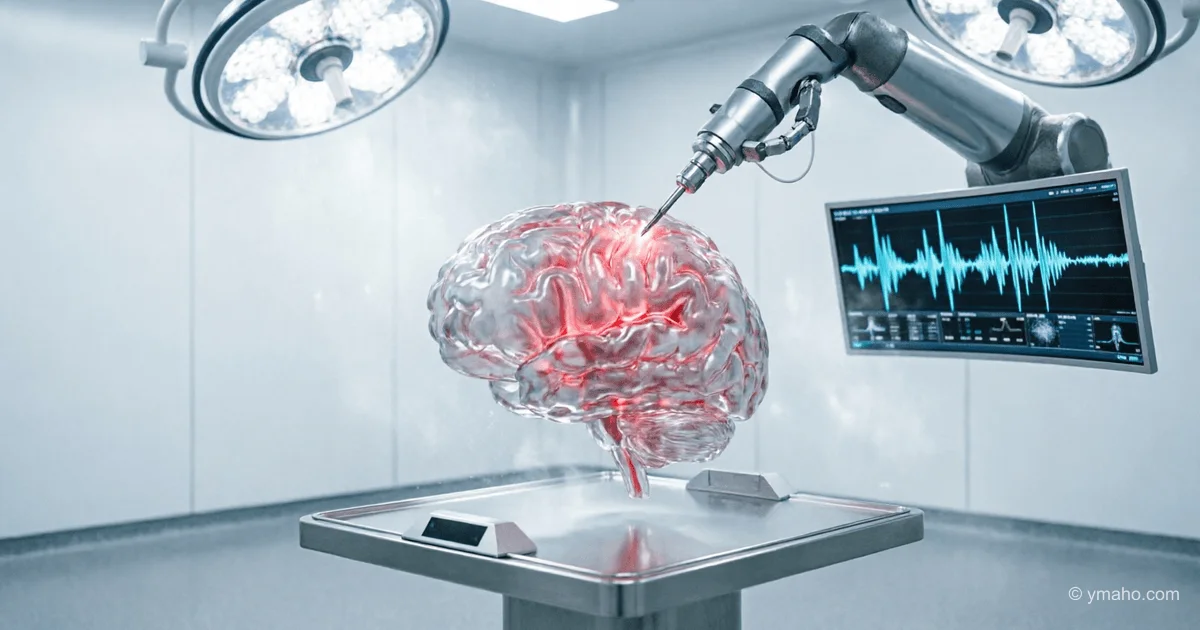
A New Era in Neurosurgery: Neuralink's Robot Learns to Fully Automatically Implant Chips into the Brain
Neuralink has unveiled a next-generation robot for brain-computer interfaces, capable of inserting electrodes thinner than a human hair without removing the dura mater, significantly speeding up and simplifying the procedure. The technology has already helped 20 paralyzed patients control devices with their thoughts.
A New Era in Neurosurgery: Neuralink's Robot Learns to Automatically Implant Chips into the Brain — Analysis of a Breakthrough
Introduction
In late April 2026, Neuralink introduced an upgraded surgical robot capable of automating key stages of brain chip implantation. This marks a shift for brain-computer interfaces (BCI) from one-off experimental surgeries to a standardized, potentially mass-market procedure. Unlike many previous announcements by Elon Musk, this presentation included concrete technical details: the robot can now guide electrodes through the dura mater without removing it. This is not just an engineering simplification — it represents a change in surgical paradigm, reducing trauma, infection risks, and paving the way for "in-and-out" procedures lasting 20 minutes.
Event Details and Timeline
The new modification of the R1 robot relies on several technological solutions. First, the system uses eight cameras and optical coherence tomography for real-time navigation through brain tissue, automatically avoiding blood vessels. Second, a manipulator with five degrees of freedom allows selecting different entry points on the skull. The main innovation is eliminating the need to open the dural membrane. Previously, a surgeon had to carefully cut this protective layer; now, the robot pierces it with an ultra-thin needle, barely compromising the barrier between the brain and the external environment.
The speed of the procedure is impressive: inserting one electrode thread takes 1.5 seconds, and the entire operation lasts about 20 minutes. For comparison, traditional deep brain electrode implantation takes hours and requires a team of highly skilled neurosurgeons. The new protocol resembles LASIK laser eye surgery in terms of standardization.
As of April 2026, Neuralink has implanted devices in 21 patients, including participants in the UK and Canada. Just a few months ago, that number was 12. Meanwhile, the company has invested over $16 million in a new plant in Austin, Texas, for mass production of "Telepathy" chips. The financial base was strengthened by a $650 million funding round at a $9 billion valuation.
Impact and Significance
The significance of automated implantation extends far beyond Neuralink's labs. First and foremost, it eliminates what Musk calls the "bottleneck of neurosurgical expertise." The number of neurosurgeons capable of performing such delicate operations is in the dozens worldwide. If each operation requires their personal involvement for several hours, scaling is impossible. The robot solves this: the surgeon remains for oversight, but the machine does the heavy lifting.
Second, it lowers clinical barriers. Preserving the dura mater reduces infection risk and simplifies post-operative recovery. This is critical for patients with neurodegenerative diseases and paralysis, whose bodies are often weakened and tolerate invasive procedures poorly. What was always a major neurosurgical operation is gradually becoming an outpatient-like procedure.
Third, the economics of BCI. As long as implantation costs hundreds of thousands of dollars and requires unique expertise, the market remains niche. Automation and standardization could reduce costs by orders of magnitude, opening access not only to clinical trial participants but to a much broader patient population. Analysts at Precedence Research forecast the global BCI market to reach $124 billion by 2034. Without automated surgery, that figure is unattainable.
Fourth, a regulatory precedent. Neuralink received "breakthrough device" status from the FDA for its Blindsight project to restore vision. A protocol where a robot performs surgery faster and safer than a human creates new standards for regulatory interaction. If the FDA accepts this model, it will open the floodgates for other companies.
Reactions from Key Players
The market reacted immediately. In January 2026, when Musk first announced automation plans, stocks of BCI-related companies surged in China and the US: shares of medical equipment manufacturers jumped 10-20%.
The investment community is also restructuring. Major venture capital funds and private investors are seeking indirect access to the emerging neurotechnology market. Markets Insider published a detailed review of ten public companies benefiting from Neuralink's progress — from portable MRI system maker Hyperfine to giants like NVIDIA, whose Holoscan platform is used by Neuralink's competitors. Notably, this list includes no direct analogs to Neuralink; all provide infrastructure, consumables, or computing power.
Competitors are not standing still. Synchron, backed by Jeff Bezos and Bill Gates, is developing a less invasive approach using electrodes inserted via the jugular vein. Precision Neuroscience is developing surface electrodes that do not penetrate the brain and has partnered with Medtronic. Separately, interest in ultrasound non-invasive interfaces is growing — Merge Labs spun off as an independent company to advance this technology.
In China, the BCI market is also booming. In 2025, national standards for BCI medical devices were released, and by 2026, several companies had entered clinical trials.
Forecast and Conclusions
Based on available data, Neuralink has indeed created a technological platform that could move BCI from "experimental medicine" to "serial medical device." Robotic implantation through the dural membrane is not the only, but a key element of this transformation.
However, reality is more complex than Musk's statements on social media platform X. As analysts at Neurofounders note, "high-volume production" in the context of invasive brain implants means not millions of devices per year, but rather hundreds or thousands, produced with reproducible quality and stable yield. This is not an "iPhone assembly line" but rather "precision medical robotics manufacturing."
Key questions remain open. First, long-term safety. Electrodes thinner than a hair may migrate, cause inflammation, or degrade over time. Data from patients after two to three years of implant use is still extremely scarce. Second, the fault tolerance of the robotic system itself. If a patient's brain has anatomical features not accounted for by the algorithm, who decides and how? Third, ethical concerns. The easier and safer implantation becomes, the more pressing the question: where is the line between medical use for paralysis and "enhancement" of healthy individuals?
From a market perspective, Neuralink remains a private company valued at $9 billion, with IPO rumors circulating since 2024. A successful transition to automated surgery could be the catalyst that takes the company public in record time.
In summary: April 2026 will go down in neurotechnology history as the moment when replacing a skull fragment and manually cutting the brain membrane ceased to be mandatory steps for BCI implantation. This is not "cyborgization of humanity" in the sci-fi sense. It is a pragmatic, engineering-driven step toward giving paralyzed patients access to a life-changing technology — without hours of open-brain surgery. And in the future, potentially restoring vision and hearing, as Neuralink increasingly asserts.
— Editorial Team









