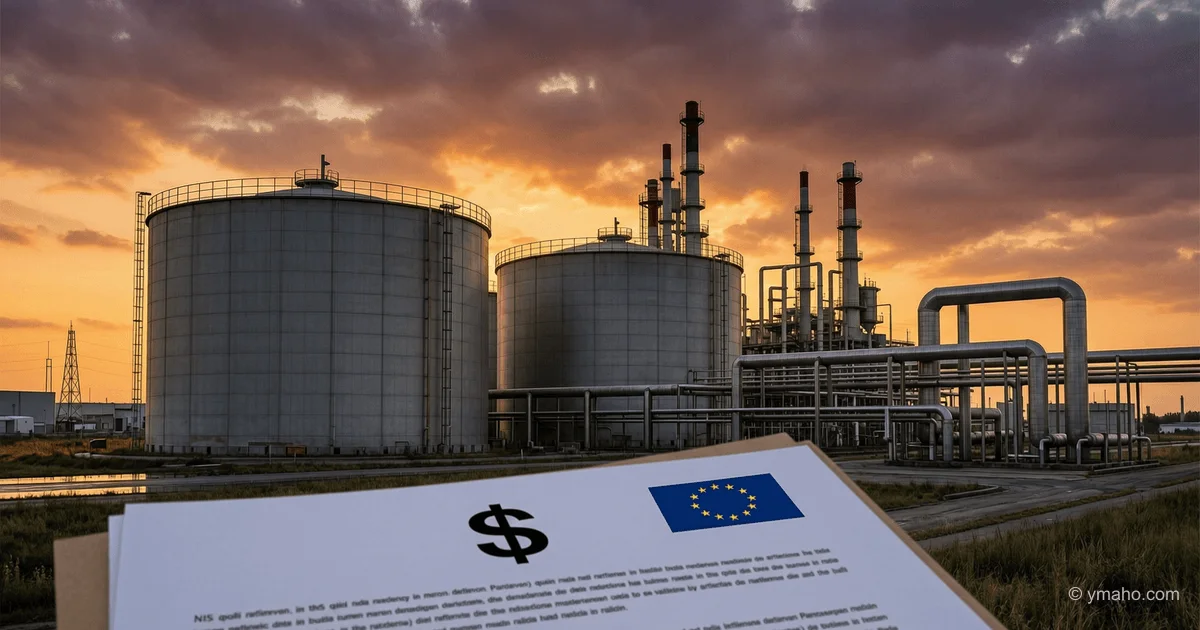
New Buyer for Gazprom's Assets in Serbia Emerges on the Market
Gazprom Neft and Gazprom's stake in Serbia's NIS has an unexpected contender, but the company denies negotiations, citing the existing deal with Hungary's MOL
The emergence of a new contender for Gazprom's stake in Serbia's NIS is not a classic M&A deal but a geopolitical tender involving the US, Hungary, and Serbia. The $2.35 billion offer from an unknown company, Senator, looks less like a market proposal and more like a pressure tool designed either to derail the already approved deal or to redraw the map of influence in the Balkans ahead of the OFAC deadline.
The Essence: What Is Really Happening
Formally, the plot is simple: Gazprom Neft and Gazprom must exit NIS under the threat of US sanctions. Hungary's MOL signed an agreement back in January, valuing the asset at €1 billion. However, on the morning of May 6, 2026, it emerged that the Serbian company KFT Senator Treasury G.T.7 Two LLC is ready to pay €2 billion—twice as much.
The real intrigue lies in the discrepancies. Senator's owner, Ranko Mimović, claims that the Russian side has "generally accepted" his offer. However, Gazprom Neft's press office issued a firm denial the same day: the deal is being prepared only with MOL, and the company is not conducting any other negotiations. This is a classic situation where public rhetoric directly contradicts insider signals, and the truth often lies in that gap.
Timeline and Context
The timeline of events is crucial. OFAC sanctions against NIS were imposed in October 2025. The window for the deal closes on May 22, 2026—the final date by which Russian shareholders must exit the asset. MOL signed a binding preliminary agreement in January 2026, simultaneously negotiating with the UAE's ADNOC about a possible minority partnership.
Senator, founded only last summer, claims it began the process of obtaining an OFAC license for the purchase as early as October 30, 2025. A logical question arises: why is a company with zero public history stepping into a deal of this magnitude only now, two weeks before the deadline? And why was Serbian President Vučić informed of Senator's plans only on April 21, even though the application to OFAC was submitted six months ago?
Who Wins and Who Loses
The main beneficiary of the uncertainty is the Serbian government. Belgrade owns 29.9% of NIS and intends to increase its stake by another 5%. Senator's inflated price creates a bargaining chip: Serbian authorities can negotiate with MOL for better partnership terms, including guarantees on fuel prices, investments in the Pančevo refinery, and the preservation of transit contracts.
MOL is the obvious loser in the short term. The Hungarian company has already factored the deal into its Balkan expansion strategy and likely secured financing for it. If Senator is real, MOL will either have to raise its offer by 100% or drop out of the race for a strategic asset.
Gazprom Neft wins either way. Regardless of the outcome, the Russian company gets money for an asset it would have had to sell anyway. The difference between €1 billion from MOL and €2 billion from Senator is colossal, but political logic comes into play: the deal with MOL has already been coordinated with the Kremlin and received the green light from Budapest-Moscow.
What the Media Are Not Saying
The first non-obvious insight: Senator may not be a private business but a front for state structures of Serbia or even third countries. A company founded "last summer" physically cannot consolidate €2 billion from market sources—no bank will provide a bridge loan to an entity with no assets, collateral, or credit history. Therefore, Senator is backed either by a sovereign fund or a political player.
The second point is the role of OFAC. The US regulator has Senator's request in "pending management review" status. This could mean that Washington is considering an alternative to the Hungarian deal. Politically, MOL is a company from a NATO and EU country, but Budapest's close ties with Moscow may concern part of the US establishment. A Serbian buyer, on the other hand, could be seen as a way to finally remove the refinery from Russia's sphere of influence.
The third insight is the timing. Senator's announcement came exactly two weeks before the OFAC deadline. This is a classic "deal-breaker at the last minute" tactic: if MOL fails to close by May 22, the license expires, and the field opens for new contenders. Senator is playing the long game, while MOL is constrained by time.
Forecast: The Next 30 Days and 90 Days
Next 30 days (by June 7, 2026). The May 22 deadline will be the moment of truth. Gazprom Neft will complete the deal with MOL because switching to Senator within two weeks is technically unfeasible (due diligence, compliance, and corporate procedures simply cannot fit into the schedule). OFAC will extend the license to close the transaction. Senator will remain in the game, but its offer will only be used as leverage against MOL regarding partnership terms with Belgrade.
Next 90 days (by August 7, 2026). After the deal closes, MOL will face harsh reality: it will have to negotiate with the Serbian government over share distribution and operational control. It is likely that during this period, details will emerge about who really stood behind Senator. If it was a proxy for Belgrade, a complex bargaining process will begin over increasing the state's stake beyond the desired 5%. If Senator was a front for an international consortium (e.g., Arab or Asian funds), MOL may get an unexpected minority partner instead of ADNOC.
Strategic conclusion: Serbia's oil industry remains a battlefield of geopolitical interests. The MOL deal is not commercial but political, and that is precisely why it will close on time. However, Senator's emergence has clearly shown that the Balkans remain an arena where business logic gives way to the interests of big players, and any deal here can be reconsidered at the last moment.
— Editorial Team









