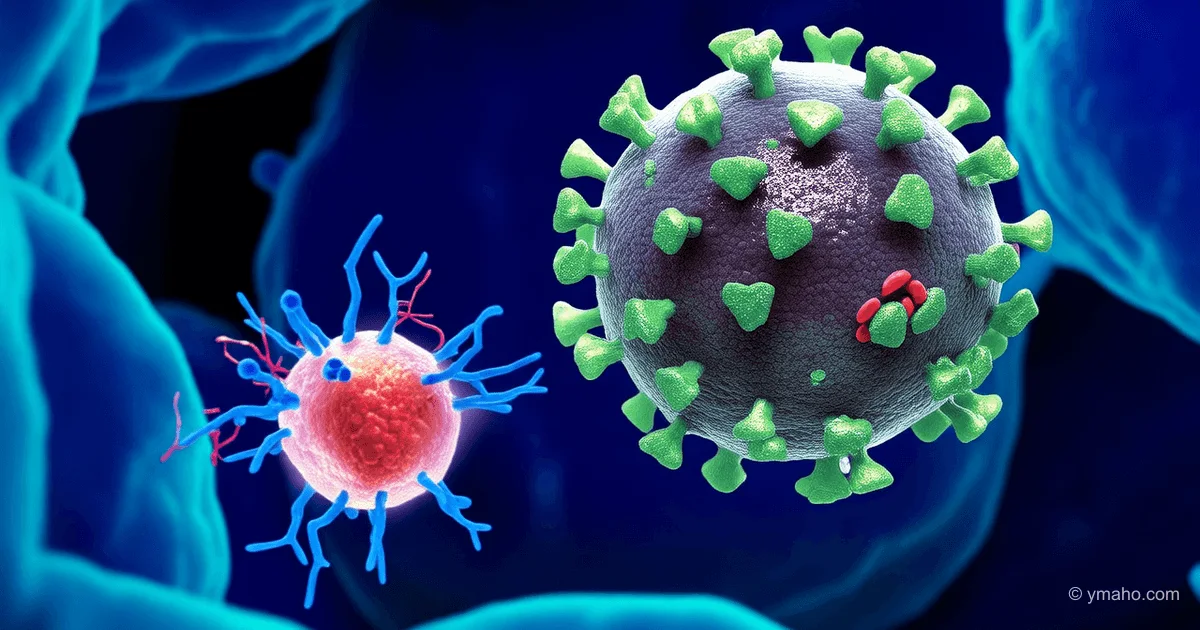
New Mechanism of HIV-1 Entry into Resting Immune Cells Discovered
Researchers have uncovered a previously unknown pathway by which HIV-1 can infect resting cells without activating them. The virus triggers a signal that opens the protective barrier around the cell nucleus, explaining the formation of a persistent latent reservoir of infection and opening new avenues for treatment development.
Trojan Signal: How HIV Opened the Nuclear Gate and Why Science Had to Rewrite a 40-Year-Old Dogma
On May 6, 2026, the journal Nature published a paper that overturns the fundamental understanding of HIV infection. Professor Claire Jolly's group at Queen Mary University of London described the CD4-LCK-CDK1 signaling mechanism through which the virus enters the nucleus of resting T cells without activating them. At first glance, this is purely fundamental science, laboratory molecular biology. But it is discoveries like this that pave the way to what pharma considers the Holy Grail: a cure for HIV.
The Core: What Is Really Happening
For decades, HIV has baffled scientists with a paradox reproduced in every lab. In a test tube, the virus categorically refused to infect resting CD4+ T lymphocytes, yet in patients' blood, infected cells of this type were found in abundance. The old dogma held that infection occurs only at the moment of cell activation, after which the cell returns to a resting state, already carrying the provirus in its genome. Jolly and her team showed that reality is more complex and more frightening: the virus itself creates permission to enter.
The specific mechanism works as follows: upon direct contact between an infected cell and an uninfected cell—so-called cell-to-cell spread—a CD4-LCK cascade is triggered, activating cyclin-dependent kinase CDK1. The kinase, in turn, phosphorylates nucleoporin proteins that make up the nuclear pore. The pore structurally remodels, its permeability temporarily changes, and the viral capsid—an object disproportionately large for normal transport—gains entry into the nucleus. At no stage does the cell enter the division cycle or display activation markers. This is why the immune system does not recognize it as infected. This is why antiretroviral therapy, targeting active processes, is powerless against the latent reservoir.
Timeline and Context
The discovery did not arise in a vacuum. Before the publication in Nature on May 6, 2026, several groups independently approached the answer. The German Research Foundation (DFG) had funded project 568772942 early in the year to study the regulation of HIV nuclear transport through T-cell activation, specifically highlighting the role of nucleoporin NUP62. In January, Professor Kai Deng from Sun Yat-sen University gave a lecture on mechanisms of latent reservoir formation. The University of Chicago simultaneously investigated lenacapavir—a new anti-capsid drug approved by the FDA that interferes precisely with the nuclear import process and destroys the capsid at the pore level.
Jolly's paper is the assembly point for scattered observations into a unified signaling concept. Super-resolution microscopy dSTORM allowed, for the first time, visualization of pore remodeling in real time. Quantitative assessment showed that the efficiency of nuclear import during cell-to-cell transmission increases manifold compared to infection by free viral particles.
Who Wins and Who Loses
Gilead Sciences is the main beneficiary, albeit not obviously. Lenacapavir, the first-in-class capsid inhibitor, received FDA approval for multi-drug resistant patients. But its mechanism of action—hyperstabilization of the capsid lattice leading to destruction at the nuclear pore—now gains new biological rationale. If porins are a dynamic structure rather than a static barrier, then compounds can be developed that selectively block CDK1-dependent remodeling. Gilead gains a scientific foundation to expand lenacapavir's indications from salvage therapy to functional cure. The market value of this expansion is between $2 and $4 billion annually if the drug becomes standard therapy for reservoir reduction.
ViiV Healthcare and GSK are at risk. Their portfolio is based on integrase inhibitors and NNRTIs that work at post-integration stages. If the point of action shifts to the nuclear pore level, their molecules become structurally obsolete. Not today, but within a 5-7 year horizon.
Academic laboratories working with super-resolution microscopy receive an influx of funding. The ability to visualize single pore complexes in real time has just proven its value as a tool for discovering new targets.
What the Media Isn't Saying
Medical and scientific media faithfully recounted the press release but overlooked three aspects.
First insight: the political context of funding. The work was carried out in the UK with support from the Wellcome Trust. This is no coincidence. The reduction of NIH grants in the US under the Kennedy Jr. administration has shifted the center of gravity for fundamental HIV research to Europe. Jolly's group used a Wellcome Early Career Fellowship—a British mechanism independent of the American political cycle. If the trend continues, by 2030 European laboratories will dominate publications on the HIV reservoir.
Second insight: a byproduct for oncology. CDK1 is a classic target for anticancer drugs. But the nuclear pore, it turns out, can be dynamically remodeled, and this same mechanism likely operates in the nuclear import of oncogenes. The study authors directly state that the discovered signaling cascade may be common to other viruses and possibly tumor cells. If confirmed, anticancer CDK1 inhibitors gain additional rationale, and pharma companies get a new angle for patent protection of old molecules.
Third insight is hidden in the methodology. The authors used a combination of live-cell kinetics, quantitative subcellular localization, and nanoscopic dSTORM reconstruction of NPC structure. Dr. Matt Whelan, academic head of microscopy at the Blizard Laboratory, specifically emphasized: "These approaches provided mechanistic evidence that no biochemical analysis could have provided on its own." In other words, the era of purely biochemical research in virology is ending. Laboratories without access to super-resolution microscopy will increasingly struggle to pass peer review in journals like Nature.
Forecast: Next 30 Days and 90 Days
Next 30 days (mid-June 2026):
A chain reaction in academia will begin. At least 5-7 laboratories—Boston University (Suryaram Gummuluru's group studying HIV transmission via dendritic cells), the German DFG consortium, Kai Deng's Chinese group—will publish comments or data confirming or challenging Jolly's model. Gilead, which has held back, will likely issue a statement linking lenacapavir's mechanism to the new NPC data.
90 days (mid-August 2026):
The first preprints will appear attempting to find small molecules that selectively block CDK1-dependent phosphorylation of nucleoporins without affecting the cell's mitotic cycle. The main challenge here is avoiding cytotoxicity: CDK1 is involved in cell division, and its total inhibition would yield an unacceptable safety profile. A breakthrough would be the discovery of an allosteric site specific to the CD4-LCK-CDK1 signaling pathway.
More practically significant: groups working on lenacapavir and other anti-capsid agents will begin designing phase 1/2 clinical trials with the endpoint "latent reservoir size." If reservoir reduction can be demonstrated in humans, the concept of functional HIV cure will move from hypothesis to reproducible clinical data.
Structural forecast:
The discovery changes the approach to the latent reservoir. The old model—"the cell was activated and returned to rest"—assumed the reservoir is static. The new model says: the reservoir is actively replenished through cell-to-cell contacts, and this process can be pharmacologically blocked. If CDK1-dependent pore modification is indeed a universal mechanism for cell-to-cell spread, then an inhibitor of this modification could become the first drug that not only suppresses HIV replication but prevents the formation of new latent cells. The years 2027-2028 will show whether the molecular biology of the nuclear pore translates into therapeutic reality.
— Editorial Team









