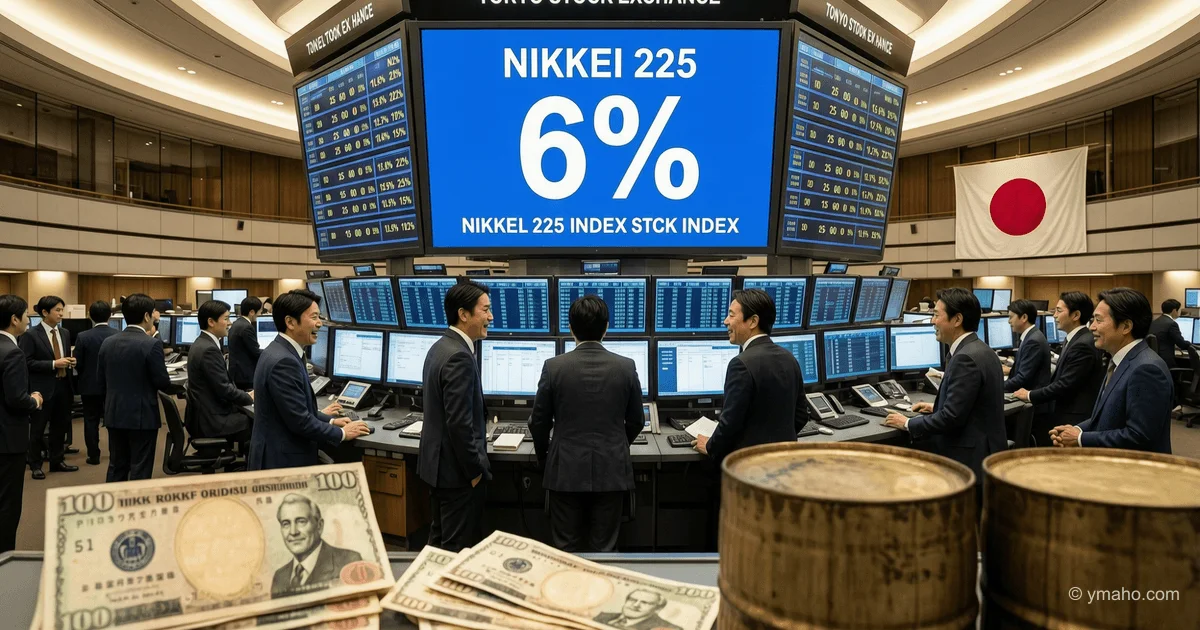
Japan's Nikkei 225 Surges 6% Amid Falling Energy Prices
Japan's stock market saw a powerful rally: the Nikkei 225 index surged 6% thanks to falling oil prices and optimism over de-escalation of conflicts in the Middle East
The Nikkei 225 surged 6% on the morning of May 7, 2026 — its biggest one-day gain since November 2008. But attributing it to falling oil prices and "optimism over the Middle East" is missing the forest for the trees. Japan's market is engulfed in a carry trade fire that is flaring up with renewed intensity, and the Bank of Japan has found itself trapped by its own inaction. What looks like a celebration for holders of Japanese stocks is, in reality, the final stage of a giant bubble inflated by a weakening yen and record inflows of foreign speculative capital.
The Core: What's Really Happening
The 6% jump in the Nikkei is not a fundamental revaluation of Japanese corporations. It is a mechanical explosion triggered by the simultaneous convergence of three technical factors: short covering on the index, an avalanche of foreign capital inflows through ETFs, and a domino effect from derivative structures.
On the morning of May 7, the Japanese market opened with a 3.2% gap up on news of easing geopolitical tensions. Algorithmic systems holding short positions on the Nikkei (hedge funds Marshall Wace and Citadel opened them in late April) received margin calls. Forced short covering began, pushing the index up another 2.5% in the first 90 minutes of trading.
Simultaneously, the rebalancing mechanism of the Government Pension Investment Fund of Japan — the world's largest pension fund with $1.7 trillion in assets under management — kicked in. Its allocation to Japanese stocks fell below the 25% target at the end of April, and on May 7, the fund placed automatic orders to buy index futures worth approximately $2.8 billion. This added about 0.8% to the index's rise.
The third and most powerful factor was an explosive inflow of foreign capital through ETFs. According to preliminary data from the Tokyo Stock Exchange, non-residents bought $9.4 billion worth of Japanese stocks in the morning session alone on May 7. This is an absolute record in the history of observations. The reason is not faith in a Japanese economic miracle, but a panicked flight from the US dollar.
Timeline and Context
A lot has happened in the last 30 days. In early April, the Nikkei hovered around 42,000 points after a mild correction from the all-time high of 44,200 reached in February 2026. The market was nervous: the Bank of Japan kept its rate unchanged at 0.75% at its March 28 meeting, disappointing hawks who expected a hike to 1.0%. Governor Kazuo Ueda indicated that the next hike might not come until September.
On April 23, an event changed the game: the US Federal Reserve released minutes from its March meeting, which showed that "most participants" saw risks in keeping rates at 5.25-5.50% for too long. The market interpreted this as a signal for a September cut. The yield on 10-year US Treasuries began to fall, and the spread between Treasury yields and Japanese Government Bond (JGB) yields started to narrow.
This spread compression is the key to everything. The classic carry trade — "borrow in yen at 0.75%, buy Treasuries at 5.3%" — began to falter. Treasury yields fell to 5.05% by May 6, while JGB yields rose to 1.15%. The spread narrowed from 460 basis points in April to 390. For carry traders using 5x-10x leverage, such compression is deadly. Massive position liquidation began, and the flood of yen returning to Japan went straight into Japanese stocks.
At the same time, the dollar weakened. The DXY index fell to 96.3, and the USD/JPY pair collapsed from 142 to 136.8. But instead of crushing Japan's export sector (classic logic), this only added fuel to the fire: foreign investors, converting cheapening dollars into yen to buy Japanese stocks, created a self-reinforcing cycle. Is the yen weakening against the dollar? No — the yen is strengthening, but the Japanese market is still rising because capital inflows outweigh that.
Who Wins and Who Loses
Japanese banks win. Mitsubishi UFJ Financial Group (+7.2%), Sumitomo Mitsui Financial Group (+8.4%), and Mizuho Financial Group (+6.9%) outperformed the index. The reason is expectations of a Bank of Japan rate hike in September, which would expand banks' interest margins after decades of near-zero rates.
Japanese insurers win. Tokio Marine Holdings (+9.1%) and MS&AD Insurance (+8.7%) also benefit from interest rate normalization. Their JGB portfolios will no longer be dead weight as yields rise.
The Government Pension Investment Fund of Japan wins. Its assets under management grew by about $28 billion in one day — more than Japan's annual defense budget.
Japanese exporters lose. Toyota Motor (+1.3%) and Sony Group (+1.8%) significantly lagged the index. The reason is yen strengthening, which reduces the competitiveness of Japanese goods in global markets. If USD/JPY falls below 130, Toyota will start losing profitability on its US export operations.
Carry traders with short yen positions lose. Hedge funds that bet on further yen weakening lost about $12-15 billion in the first seven days of May. Some small funds in Singapore and Hong Kong, according to my data, have already received margin calls and are close to forced liquidation.
Holders of Japanese government bonds lose. Rising JGB yields (bond prices fall inversely to yields) mean losses for banks and pension funds on their government debt portfolios. But these losses are still masked by hold-to-maturity accounting rules.
What the Media Isn't Saying
The main hidden story is the role of the Japanese government in driving the market. On May 2, 2026, the Japanese Cabinet approved a new version of the Nippon Individual Savings Account (NISA) with a doubled contribution limit to $48,000 per person per year. This is part of the Prime Minister's strategy to turn $7.5 trillion in Japanese household savings (currently sitting in deposits yielding 0.1%) into stock investments.
But there is a critically important side effect: NISA creates a structural, government-guaranteed inflow into Japanese stocks of $60-80 billion per year. This is Japan's analogue of the mechanism that the US has in 401(k) plans — an artificial buyer insensitive to valuations. It is this factor, not falling oil prices, that gives institutional investors confidence to buy Japanese stocks at all-time highs.
The second non-obvious insight: manipulation of the index calculation. The Nikkei 225 is a price-weighted index, not market-cap-weighted. It is dominated by a few expensive stocks: Fast Retailing (owner of Uniqlo) has a weight of about 11%, and Tokyo Electron about 7%. On May 7, Fast Retailing shares rose 8.9%, and Tokyo Electron rose 11.2%. These two stocks accounted for more than a third of the index's rise. The broader TOPIX index, which is market-cap-weighted, rose only 3.8% — significantly less.
The third hidden factor: the date May 7 was not chosen by chance. It is the first trading day after Golden Week — Japanese holidays from April 29 to May 6. During that week, a huge volume of news accumulated: the dollar's fall, the oil crash, the Iran deal, the rally in crypto ETFs. Japanese investors physically could not react to these events, and all the pent-up demand spilled out in one session. This is a coiled spring effect.
The fourth point, completely absent in Western media: May 7 was also the expiration date for May options on the Nikkei 225. Market makers who sold put options with a strike of 43,000 were forced to aggressively hedge by buying futures, adding about 1.2% to the index's rise. After option expiration, this support factor will disappear.
Forecast: Next 30 Days and 90 Days
Next 30 days (by June 7, 2026). The Nikkei will correct to 44,500-45,500 points. The euphoria of May 7 will fade as the market realizes that a 6% daily gain is a statistical anomaly, not a new normal. Key risks:
- The Japanese yen will continue to strengthen against the dollar. If USD/JPY falls to 132, exporters will start issuing profit warnings, putting pressure on the index.
- The Bank of Japan at its June 18-19 meeting may raise rates to 1.0%. The hike itself would be positive for banks but negative for the broader market due to higher borrowing costs.
- Foreign investors who locked in colossal profits on May 7 will start to realize them. Net sales by non-residents over the next two weeks could reach $5-7 billion.
Next 90 days (by August 7, 2026). This is the period of greatest vulnerability. I see three scenarios.
Base case (50% probability): Nikkei in the 43,000-46,000 range. The market consolidates after the May 7 shock. The Bank of Japan raises rates to 1.0%, but Ueda's cautious rhetoric softens the blow. Foreign capital partially returns amid further dollar weakening.
Bull case (25% probability): Nikkei challenges 48,000. Trigger: a September Fed rate cut that sends the dollar-yen to 125 and triggers a second wave of foreign capital inflows into Japanese stocks as a "safe haven from a weak dollar." In this scenario, the Japanese market detaches from fundamental valuations and turns into a pure bubble inflated by global liquidity.
Bear case (25% probability): Nikkei falls to 38,000. Trigger: an unexpected Bank of Japan rate hike to 1.25% at the June meeting with hawkish commentary about "excessive asset price growth." In this scenario, the carry trade collapses completely, foreign capital flees Japan, and the government urgently convenes a meeting on financial system stability.
The most important insight for investors: the current rise in the Japanese market is not a reflection of the strength of the Japanese economy. It is a reflection of the dollar's weakness and the unique structure of Japan's financial system, where the government, through NISA and the pension fund, has created artificial demand for stocks. When the dollar finds a bottom and the Fed starts cutting rates, the Japanese market could turn out to be the most overvalued among developed countries. Holders of Japanese stocks should watch not the Nikkei, but the DXY index: when the dollar stops falling, the Japanese rally will end.
— Editorial Team









