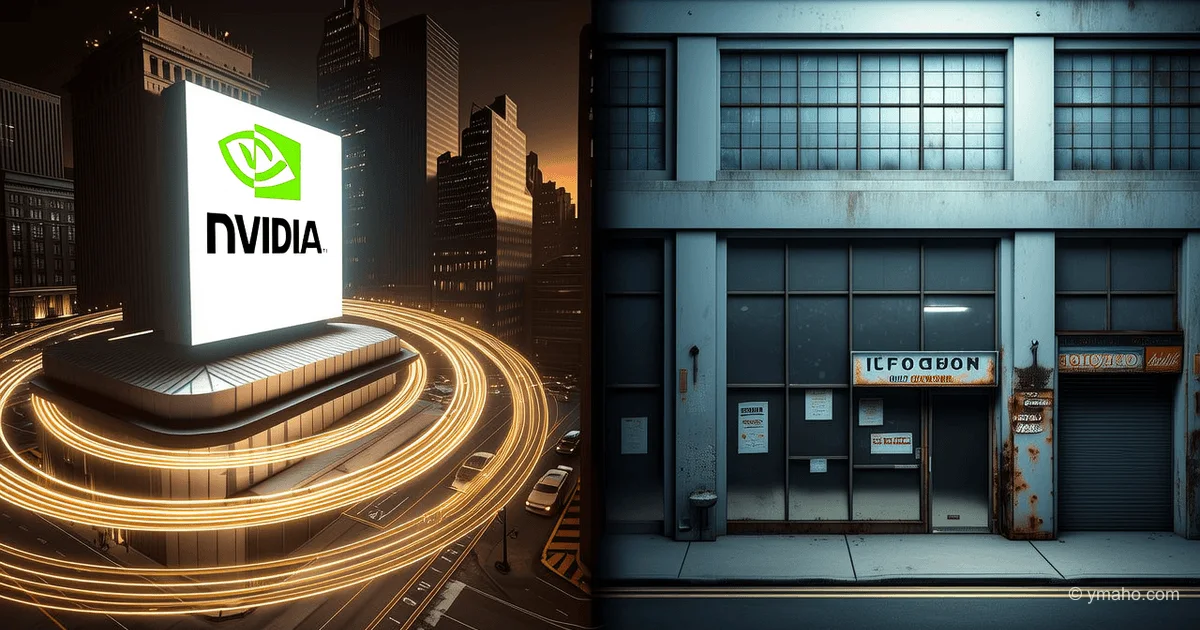
AI Chips Drive Market Up: Nvidia Adds $591 Billion in Market Cap in 4 Days
Shares of technology companies continued their rally: Nvidia's market value rose by $591 billion in just four trading sessions, exceeding the entire market cap of Oracle Corporation.
The $591 Billion Rally: Why Nvidia's Record Growth Is Not a Sign of Strength, but a Symptom of Global Market Vulnerability
Four trading sessions, 14% growth, plus $591 billion in market cap — Nvidia just created value exceeding the entire Oracle Corporation. This event on May 11-13, 2026, instantly made headlines worldwide. But it is presented in the standard "AI triumph" packaging, while far more alarming structural signals lurk beneath the surface. What looks like a rally of strength is actually a symptom of critical vulnerability in the entire market framework.
The Essence: What Is Really Happening
The paradox of May 2026: Nvidia adds half a trillion dollars in market cap precisely when fundamental conditions for risky assets are deteriorating at the fastest pace in three years. CPI inflation hit 3.8% on May 12 — a three-year high; the 30-year Treasury yield broke through 5% on May 13 for the first time since 2007; and the new Fed Chair Kevin Warsh has just been confirmed by the Senate with a mandate for policy tightening. In normal market logic, this should be a moment of flight from duration assets. Instead, Nvidia soars.
The surface-level explanation is insatiable demand from hyperscalers. Indeed, Meta confirmed capex of $125-145 billion this year, Amazon is approaching $200 billion, Alphabet and Microsoft are at historic highs. Bernstein analyst Stacy Rasgon notes: "investors recognize that the recent powerful capital expenditure commitments from major cloud providers mean no signs of slowing demand for Nvidia chips." Every dollar of these budgets passes through Santa Clara.
But the real essence of what's happening is not Nvidia's strength, but a structural deformation of the entire market. The S&P 500 has turned into a bet on three or four companies. Apollo Chief Economist Torsten Slok calculated: the top 10 companies in the index account for 34% of its weight, and their share of total index profits has doubled since 1996. Nvidia alone accounts for over 8% of the S&P 500. By buying a passive index fund, an investor today is not buying a broad market, but a concentrated position in the AI sector, with Nvidia as the largest component.
When such an asset surges by $591 billion in a week, it's not organic growth of the entire economy — it's the gravitational pull of capital into one point, leaving everything else exposed.
Timeline and Context
The chain of events leading to the record rally was built not over four days, but over several months, and its logic contradicts standard "bullish" narratives.
Throughout 2026, Nvidia lagged behind the semiconductor sector. The company's shares rose 18% year-to-date, while the PHLX Semiconductor Index soared 68%. This is a massive gap: investors actively expanded positions in adjacent segments — memory, equipment, optics, power systems, CPUs — recognizing that the AI wave is creating secondary and tertiary beneficiaries.
Then came the March GTC 2026. Jensen Huang took the stage and doubled the forecast: not $500 billion in cumulative orders for the Blackwell and Vera Rubin architectures, but $1 trillion by the end of 2027. The figure is so staggering that its physical meaning escapes most observers. The annual equivalent — roughly $500 billion — exceeds the entire global semiconductor industry's revenue for 2023 ($527 billion). One company, two architectures, two years — more than the entire industry that produces them.
This moment created a psychological turning point. The market realized: Nvidia is not a chip manufacturer; it is the infrastructure index of the AI economy. When capital begins to perceive a company as "mandatory infrastructure of the future," valuation metrics stop working. That's what happened with Cisco in 1999, and that's what is happening with Nvidia today.
The final trigger was preparation for the Q1 fiscal 2027 report (period ending April 26), due out May 20. Wells Fargo raised its price target; Susquehanna boosted long-term data center revenue forecasts to nearly $1 trillion for calendar 2027. On May 11-13, the market began aggressively front-running this report.
The most important nuance lost in the headlines: the Vera Rubin chips that will bring the lion's share of that $1 trillion in orders do not yet exist. TSMC is operating at capacity limits, HBM4 memory is in short supply, advanced packaging CoWoS has a multi-month backlog. Nvidia has collected $1 trillion in orders for products that have not been physically produced. This is either the greatest bet in supply chain history, or the clearest signal that the AI infrastructure boom runs on faith.
Who Wins and Who Loses
Winners:
Nvidia as a company gains not just market cap, but the status of a geopolitical asset. Control over the most critical infrastructure layer of the new economy is a position where normal market risks recede into the background. Shareholders with a low cost basis (institutions that entered before 2024) are booking historic profits.
Hyperscalers win indirectly: their aggressive capex, which under other circumstances would raise shareholder questions about profitability, is now validated by the market as a "necessary infrastructure race." Amazon, Meta, Microsoft, Alphabet get a blank check for multi-billion-dollar spending.
Adjacent semiconductor companies receive confirmation of the cycle's longevity. ASML, as the EUV lithography monopolist, becomes a second-order beneficiary: the more Blackwell and Rubin chips the market demands, the more EUV capacity TSMC needs.
Losers:
Investors who believe that a passive S&P 500 index gives them diversification. When Nvidia, Apple, and Microsoft together account for nearly a quarter of the index, and Nvidia adds $591 billion in a week, the index investor gets a concentrated AI position without even realizing it. When the AI cycle turns, the decline will be amplified for all passive holders, regardless of their intentions.
Fundamental investors who value companies using DCF models find themselves in a losing position. With 30-year Treasury yields above 5%, the discount rate should pressure long-duration growth stories. The Nvidia rally is the market's refusal to apply standard valuation logic to an "infrastructure index." But history shows such refusals are always temporary.
Sectors outside the AI orbit are structurally starved of capital. When one company creates half a trillion dollars in market cap in a week, that's capital flowing out of other segments — industrials, consumer, energy, small caps. The Nvidia rally is not the creation of new wealth, but its redistribution to a narrow cluster.
What the Media Isn't Saying
The first and most important untold story: $591 billion is market capitalization, not money. In real cash flows, Nvidia didn't receive a single cent of additional revenue from anywhere in four days. The increase in market cap is a change in expectations baked into the stock price, nothing more. When expectations are set at a rate of $150 billion per day, any disappointment will trigger a symmetric move downward. A market that creates an Oracle in a week can destroy it just as quickly.
The second hidden factor: Nvidia has $1 trillion in orders, but this is a cumulative pipeline two years out, not annual revenue. The annual equivalent of $500 billion means the company must grow roughly 10 times from its current annual run rate in about two years. This is an unprecedented scale of expansion for a company that is already the second largest by market cap in the world. Meanwhile, bottlenecks — HBM4 memory, CoWoS packaging, data center construction — are physical constraints that cannot be resolved by financial means. Analyst Chaim Siegel of Elazar Advisors warns: "Despite rising capex, bottlenecks in memory and data center construction persist. Demand is strong, but supply is limited, so growth rates could still slow."
The third non-obvious aspect is the macroeconomic context. The Fed under Warsh will keep rates high, and possibly raise them. The rise in 10-year Treasury yields during March already signaled expectations of tightening. AI infrastructure requires cheap capital — Jensen Huang forecasts $3-4 trillion in annual AI capex by the end of the decade. But with a Fed funds rate of 3.50-3.75% and Treasury yields above 5%, the cost of financing these investments is rising, and future profits are discounted more aggressively. This is a classic double whammy for growth stocks, which the market is currently ignoring — right up until it stops.
Forecast: Next 30 Days and 90 Days
30 days (by mid-June 2026):
The key event is Nvidia's earnings report on May 20. Wall Street expects a significant beat on revenue and profit. The problem is that expectations are already priced in: the $591 billion rally is the market front-running a positive surprise. Nvidia will need not just to beat consensus, but to provide guidance confirming the $1 trillion trajectory. Any indication that bottlenecks are actually constraining growth (and they are) could trigger profit-taking.
The June FOMC meeting on June 16-17 will add volatility. Warsh's rhetoric about a "regime change" at the Fed, including balance sheet reduction, will pressure long-duration assets. Nvidia, with its 40+ forward P/E (at current prices), is essentially a floating-rate bond dependent on the AI cycle. Rising real rates will hit it with a lag of a few weeks.
Nvidia's stock range for the next month: from $170 to $220, given current levels around $195-200. The decisive factor is not the earnings numbers, but the market's reaction to them.
90 days (by mid-August 2026):
By the end of summer, the fundamental contradiction now masked by euphoria will begin to emerge. On one hand, physical constraints — memory, packaging, data center power supply — will become more apparent as quarterly shipments lag behind orders. One AI campus today consumes energy comparable to a small town; scaling to gigawatts cannot happen infinitely fast.
On the other hand, the macroeconomic environment in August will likely be tighter than in May. If CPI remains above 3% and Warsh continues his hawkish course, Treasury yields could settle in the 5.0-5.5% range. For context: at a risk-free rate of 5%, a fair P/E multiple for a mature company is around 15-18x. Nvidia trades significantly higher. The gap between rate reality and growth asset valuations cannot widen indefinitely.
Analyst Chaim Siegel warns of the risk of a growth slowdown that could extend into next year. If Vera Rubin shipments in the second half of 2026 go slower than expected, the valuation correction will be swift and deep.
But the key insider takeaway remains: the Nvidia rally is not a sign of market health, but a symptom of structural fragility. When the entire S&P 500 depends on one company, and that company depends on one macro trend (AI capex), which in turn depends on rates and geopolitics, diversification becomes an illusion. Torsten Slok is right: the index is no longer diversified; it is a concentrated bet on the continuation of the AI cycle.
History teaches: when "mandatory infrastructure of the future" starts adding the value of an entire Oracle in a week, the cycle peak is closer than one would like to believe.
— Editorial Team









