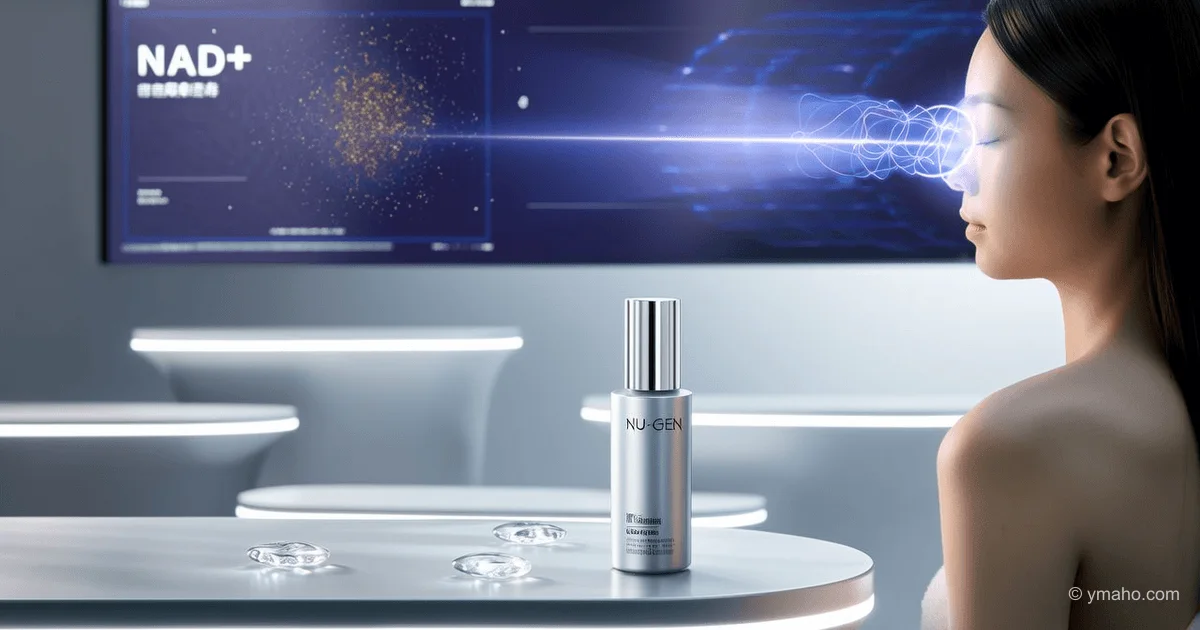
Obagi and Next Health Launch 'Skin Recharge Station' Tour with Focus on Cellular Energy
As part of a pop-up tour that kicked off in Los Angeles, visitors learn about the role of NAD+ in skin health and aging. Guests can get an Aura skin diagnostic and win NAD+ IV drips or the new NU-GEN serum.
Calcium game: why the NAD+ pop-up is not marketing, but a hunt for an $11.65 billion market
What's really happening
On May 14, 2026, Obagi Medical and Next Health launched the "The Skin Recharge Station" tour — a mobile pop-up that started in West Hollywood, continues in Studio City (May 16–17), and ends in Newport Beach (May 23–24). Visitors are offered Aura skin analysis, learn about the role of NAD+ in cellular energy and aging, receive samples of the new NU-GEN serum, and can win NAD+ IV drips.
It sounds like a standard beauty event. But behind it lies something much bigger: two companies from adjacent but still separate worlds — professional dermatological care and longevity medicine — are forming a strategic alliance to capture a market that will reach $11.65 billion by 2030.
The NAD+ market is growing at a CAGR of 16.1% and is valued at $6.48 billion in 2026. Next Health, founded by surgeon Darshan Shah, is building an empire of longevity clinics with a target of 150 locations and revenue of up to $5.7 million per location. Meanwhile, Obagi is launching the NU-GEN serum at $175 — one of the first products with direct NAD+ in its formula. Their pop-up is not about handing out samples. It's a reconnaissance mission at the intersection of two industries.
Timeline and context
The story of this partnership is being written right now, and its roots go back to 2023.
2023: Next Health opens its franchise. In three years, 71 licenses have been sold, 26 clinics opened, and founder Darshan Shah announces plans for 150 locations.
March 24, 2026: Obagi launches NU-GEN Cellular Renewal Serum — a product with direct NAD+, NMN, and niacinamide. Clinical studies show: +51% improvement in skin tone evenness at 12 weeks, +20% in firmness, up to -30% visible wrinkles, +42% hydration in 30 minutes. Price: $175 per 1 oz.
May 14, 2026: The Obagi × Next Health pop-up tour begins. Obagi CMO Justin Gioepe calls it "an educational experience at the intersection of clinic and consumer." Shah adds: "We've been delivering NAD+ systemically through IV drips for years. Now we have a topical application that supports the same cellular processes in the skin."
Parallel context: the global NAD+ market is exploding, longevity is no longer a niche topic for biohackers and is becoming mainstream, and the line between cosmetics and medicine is blurring. When a dermatological brand with a 35-year history joins forces with the most aggressive longevity franchise, it's not about cross-promotion. It's about creating a new category — "skin longevity."
Who wins and who loses
Winners — both sides of the partnership.
Obagi gains access to Next Health's client base — consumers who already pay $99–399 per month for health and are willing to spend $175 on a serum. This is not the standard Sephora audience that hesitates between three $50 products. These are people who understand biochemistry, are educated about the NAD+ concept, and are ready to pay. For Obagi, whose parent company Waldencast has a market cap of just $156 million with a gross margin of 67%, this partnership is a way to expand its addressable market without the cost of building a medical channel on its own.
Next Health gets exactly what every longevity clinic lacks: a daily, at-home product. An NAD+ IV drip is a procedure a client comes in for once a month. A serum is a product the client applies twice a day and thinks of the clinic each time. The pop-up perfectly bridges these two user experiences: "At the clinic, we charge you systemically. At home, you maintain the effect with this product."
Winners — manufacturers of cosmetic-grade NMN. The cosmetic-grade NMN market is valued at $11.88 million in 2025, with an average price of $2,479 per kilogram, margins of 30-50%, and a CAGR of 15.2%. Every product like NU-GEN that popularizes NAD+ in skincare expands this market for all raw material suppliers.
Losers — classic anti-aging brands without a "cellular" narrative. When consumers get used to the language of NAD+, NMN, and cellular energy, traditional anti-aging creams with retinol and peptides start to sound outdated. Obagi and Next Health are not just stealing market share — they are stealing the language the industry will use to talk about aging for the next ten years.
Losers — skeptics from the dermatological establishment. NAD+ in cosmetics is a controversial topic. The molecule is unstable and penetrates the skin with difficulty. Obagi claims to have solved this problem and is "one of the few brands that formulate with direct NAD+". But if the clinical data holds up, the skeptics' argument will evaporate, and early adopters who invested in NAD+ cosmetics now will reap the biggest rewards.
What the media isn't saying
Insight: this pop-up is not about selling a $175 serum. It's about preparing the consumer for a future where cosmetics are sold on a medical model, not a beauty model.
Today, Next Health sells NAD+ through IV drips. Tomorrow, with 150 clinics, it can sell Obagi cosmetics as "at-home therapy continuation" — with a doctor's recommendation, biomarker monitoring, and lab test integration. This is a model no classic beauty retailer can replicate. Sephora won't take a blood test. But a Next Health clinic will — it will show NAD+ levels before and after, and prescribe the serum as part of a protocol. The pop-up is a rehearsal for exactly that future.
Insight number two: the target audience is not the mass consumer, but potential Next Health franchisees.
Why a tour of three cities in California? Because that's where entrepreneurs willing to invest $1.69–2.26 million in opening a longevity clinic are concentrated. The pop-up serves as a demonstration for future partners: "Look, we're already collaborating with medical brands, we already have a product ecosystem, come join our business." With a franchise approval rate of 0.02%, Next Health needs not just clients — it needs qualified, affluent operators.
Insight number three: Obagi is solving a problem that all longevity clinics are silent about.
Longevity medicine is great at selling tests and IV drips. But it has no answer to the question: "What do I do at home between visits?" Supplements are too abstract. A serum with NAD+ is a concrete, tactile, daily product that fills this gap. Moreover, each application of the serum is a micro-touchpoint with the clinic brand. This is how consumer loyalty is built — loyalty that cannot be measured by standard beauty metrics.
Forecast
Next 30 days (until mid-June 2026):
The pop-up ends in Newport Beach on May 24. Within two weeks after that, Obagi will publish attendance and conversion data. If results exceed expectations, they will announce an expansion to New York and Miami. Next Health, for its part, will start actively bundling the NU-GEN serum as an "at-home complement" to NAD+ IV drips in its 26 clinics.
Expect a wave of user-generated content from pop-up visitors. The Aura skin analysis is an "instagrammable" procedure: it generates visual data that people want to share. This will provide organic reach that can't be bought with ad dollars.
Next 90 days (until mid-August 2026):
By the end of summer, we will see at least two more partnerships following the "cosmetic brand × longevity clinic" model. ChromaDex, which launched Tru Niagen Beauty in November 2025, will likely announce a collaboration with one of the clinical networks. The Obagi × Next Health alliance will become a template that others will start copying.
Key risk — regulatory. NAD+ in cosmetics is in a gray zone between a cosmetic ingredient and a drug. If the FDA decides that claims about "cellular energy" and "healthy aging" require drug approval, the category will face serious restrictions. Second risk — consumer skepticism. If users don't see results from a $175 serum, social media backlash could match the hype.
Strategic conclusion: the Obagi and Next Health collaboration is not just a joint pop-up. It is the first brick in building a new "skin longevity" vertical, where cosmetics, medicine, and biomarker data merge into a unified consumer experience. Those who understand this now will dominate in three years a category that doesn't even exist in marketing textbooks yet.
— Editorial Team









