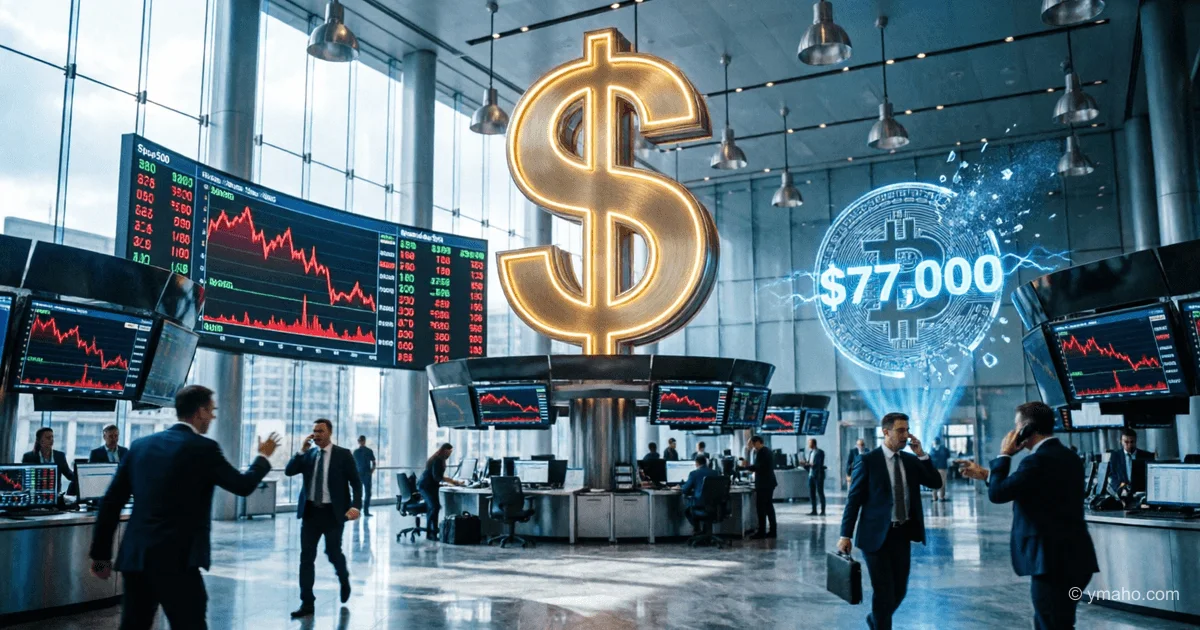
Oil Price Surge Triggers Stock Market Rout, Bitcoin Plunge, and Investor Flight to Dollar
Global stock market sell-off continues, US and European indices close in the red. Investors flee risk for safe havens: the dollar strengthens, US bond yields fluctuate, and bitcoin falls below $78,000 amid tightening monetary policy.
Analytical article: "Flight to Reality" — Why Markets Are Falling, Bitcoin Is Crashing, and the Dollar Is Rising
When oil prices break through the $100 per barrel ceiling, in a normal world oil company stocks should rise, investors should profit, and the economy should absorb the shock. But April 2026 has rewritten these rules. The global stock market sell-off continued, US and European indices closed in the red, bitcoin crashed below $78,000, and investors are panicking into the dollar — the only asset that continues to strengthen in this chaos. The paradox is that "black gold" is getting more expensive, but stocks are falling, and the cryptocurrency many called "digital gold" is behaving like high-risk tech junk. Welcome to the new reality, where old correlations no longer work and safety is measured not by yield but by liquidity.
Event Details and Timeline
The week of April 20–24 was one of the most volatile in financial market history. Events unfolded rapidly, and every new report from the Persian Gulf triggered a fresh wave of selling.
April 20 — Sell-off begins. The US market closed moderately lower after a strong rally in previous weeks. Investors began taking profits amid a new round of US-Iran tensions. Pressure on sentiment came from reports of renewed risks around the Strait of Hormuz and a sharp rise in oil prices above $100 per barrel. The Dow Jones closed with a symbolic decline of 0.01% (49,442.56 points), the S&P 500 lost 0.24% (7,109.14 points), and the Nasdaq Composite fell 0.26% (24,404.39 points). European markets also faltered: the Euro Stoxx 50 fell 0.3%, remaining below the psychological 6,000-point mark.
April 21–22 — Negativity spreads to Asia. Asian stocks fell in the wake of US markets, as tech stocks lost momentum amid stalled US-Iran peace talks. The stalled Washington-Tehran negotiations, combined with continued disruptions in the Strait of Hormuz, kept oil prices elevated above $100 per barrel, fueling inflation fears and reducing risk appetite. South Korea's KOSPI fell 0.4%, China's Shanghai Composite dropped 0.5%, and Hong Kong's Hang Seng declined 0.5%.
April 23 — Bitcoin crash. The largest cryptocurrency failed to hold above $80,000. At the peak of a brief rally, bitcoin reached $79,388, but then a gradual decline began. By the morning of April 23, the rate stood at $77,794, hitting a low of $77,464. This comes despite bitcoin falling to $72,900–74,500 in February — the lowest levels since April 2025. The market found itself in a trap: geopolitical tensions, including a US naval blockade off the coast of Iran and an Iranian boat attack in the strait, heightened uncertainty.
April 24 — Profit-taking continues. S&P 500 futures attempted to stabilize after Trump's announcement of an extended truce, but the overall picture remained bleak. The Russian market, which had previously tried to rise on expensive oil, also lost ground. By midday on April 21, the MOEX index was down 0.4% to 2,742.69 points, as the oil impulse weakened while the ruble remained strong.
Impact and Significance
What is happening in financial markets cannot be called a mere correction. It is a paradigm shift.
Stock markets — death of the old correlation. For decades, investors followed a simple formula: oil rises → buy oil stocks → profit. April 2026 buried this rule. As TKB Bank expert Mikhail Shitukhin notes, "When the Strait of Hormuz blockade pushed Brent above $100 per barrel in March 2026, the market's refrain was: 'Oil is rising — time to buy our oil producers.' Investors had been accustomed to this axiom for decades. Russian oil companies indeed received superprofits from exports, but their stocks... barely rose. Some even fell."
Why? First, the ruble strengthens alongside oil, so the exporter's ruble-denominated revenue does not grow as much as expected. Second, sanctions and logistics costs eat into profits. Third, the state's fiscal pressure — at high prices, a significant portion of superprofits goes to the budget.
In the US, the situation is no better. Tech stocks, which had driven the market's recent rally, came under pressure. Investors understand: high oil prices = high inflation = high rates = low valuations for tech companies, whose value depends on future cash flows discounted at high rates.
Cryptocurrency market — myth debunked. Bitcoin, which many positioned as "digital gold" and a safe haven, is behaving like high-risk tech junk in this crisis. While gold hits record highs, bitcoin falls to $77,000. Analysts warn: if BTC breaks the $76,000 level, it would mean that the $79,388 high was the peak of this phase, and the next rally would require either real progress on Iran or a change in the funding rate situation.
Bitpanda CEO Lukas Enzersdorfer-Konrad tries to frame the jump to $80,000 as "evidence of industry maturity," but the market says otherwise: funding rates have remained negative for 47 consecutive days — one of the longest periods of bearish derivative positions in history.
Currency market — dollar as the only refuge. Contrary to classic textbooks where investors flee to gold and bonds during crises, this time the choice fell on the US dollar. Since the conflict began, 10-year US Treasuries have fallen (yields rose from 3.96% to 4.26%), and gold has also been sold. Janney Montgomery Scott analysts explain: "The rush to the US dollar has suppressed traditional safe havens, leaving gold and Treasuries in the red."
Why the dollar? Because in a world where supply chains are breaking and settlements in alternative currencies are unstable, the US currency remains the only truly liquid instrument. As Advisor Perspectives notes, "Currency markets move on expectations more than anything else. Yes, interest rates, economic growth, and inflation affect the dollar, but expectations of these variables matter more."
Key Players' Reactions
Investors and analysts are trying to make sense of events, but there is no consensus — only fear and profit-taking.
Institutional investors are fleeing risky assets. Freedom Finance Global analysts note: "The market looks weaker than the day before because the oil impulse has noticeably weakened by midday, while the ruble remains strong. With this combination of factors, broad demand for stocks is not yet visible." Some players still hope for a diplomatic resolution, but incoming political signals remain contradictory and do not yet allow for confident pricing of a quick de-escalation.
The Russian market is caught in a double trap. Rising oil prices could support stocks, but a strong ruble and the risk of a new windfall tax are restraining investors. "Stocks will be more of a 'safe haven' within a falling market than a growth driver," Shitukhin concludes.
Crypto investors are panicking. Those who entered bitcoin as a safe haven for geopolitical crises are horrified to find their "digital gold" falling alongside the Nasdaq. Mike Novogratz, CEO of Galaxy Digital, warned that the decline could continue if selling pressure persists and no new growth catalysts emerge for the crypto market.
Central banks are frozen in anticipation. In Europe, published data showed that March inflation accelerated to 2.5% amid the energy shock. The Fed, apparently, will not cut rates in the foreseeable future, further pressuring markets.
Forecast and Conclusions
Financial markets are at a bifurcation point where old rules have stopped working and new ones have yet to form.
Scenario A (50% probability): "Chronic Tension." The conflict enters a "neither war nor peace" phase. Oil remains in the $90–110 range, inflation stays high, and rates remain unchanged. Stock markets will periodically bounce on truce news, but each subsequent bounce will be weaker. Bitcoin will likely test the $70,000 level and could go lower if institutional investors continue to withdraw capital. The dollar will remain strong.
Scenario B (30% probability): "New Escalation." A military incident in the strait with casualties leads to retaliatory strikes. Oil surges to $150 and above, stock markets crash 15–20%, bitcoin falls to $50,000–60,000. This is a classic "risk-off" scenario where only the dollar and possibly gold win.
Scenario C (20% probability): "Diplomatic Breakthrough." An unexpected agreement, lifting of the blockade, oil falls to $70–80. Stock markets could rise 10–15% in a matter of days, bitcoin returns above $90,000. But even in this case, confidence in supply stability will be undermined for years.
Conclusion: April 2026 will be the month investors remember as "the moment everything changed." The old axiom "oil rises — buy stocks" is dead. Bitcoin failed the test as a safe haven. The dollar remains the only refuge in a world where safety is measured not by yield but by the ability to withdraw capital at any moment. Tech companies, which were the growth leaders of recent years, have proven most vulnerable to the new regime of high rates and inflation. Investors accustomed to "easy money" will have to adapt to a new reality — a reality where geopolitics matters more than fundamental analysis, and liquidity matters more than yield. And in this reality, the only thing that remains predictable is volatility. It will be high, brutal, and likely prolonged.
— Editorial Team









