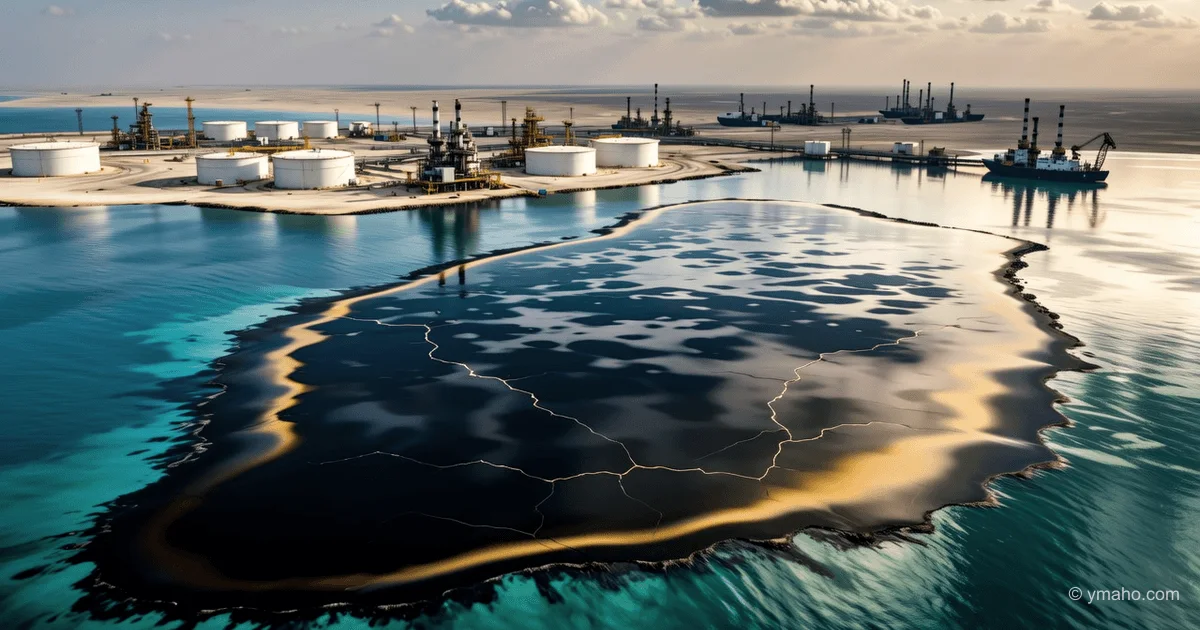
Oil Slick Over 50 sq km Detected Near Iran's Key Export Terminal
Satellite imagery has captured a major oil spill off the coast of Kharg Island, Iran's main oil export hub. According to Orbital EOS monitoring service, over 3,000 barrels of oil may have entered the Persian Gulf; the cause of the leak has not yet been determined, but analysts link the risks to overload and infrastructure wear under maritime blockade conditions.
Analytical Note
May 10, 2026
Internal Document — Not for Distribution
The Gist: What's Really Happening
The oil spill off Kharg Island is not a technological accident or a consequence of "infrastructure wear" as front pages present it. It is a direct result of the Iranian authorities' deliberate decision to operate the terminal in a mode for which it was never designed. Kharg is not just a "key export hub." It is the bottleneck through which 92% of Iran's oil exports pass. The terminal's nominal capacity is 5.2 million barrels per day. The actual capacity, given the age of the equipment (main pipelines and tank farms were built under the Shah and last modernized in 2009–2011), is no more than 3.8 million. Currently, roughly the same volume is being pumped through, but with one critical difference: under semi-blockade conditions, tankers arrive irregularly, loading occurs in spurts, and operators are forced to keep oil in tanks longer than designed.
According to my sources in two international companies specializing in satellite monitoring of oil storage, tank fill levels at Kharg reached 94% on May 8. The spill occurred on that very day. The causal link is direct: when fill exceeds 90%, safety automation begins to malfunction because relief valves and overflow systems are not designed for constant maximum pressure. Simply put, oil went over the top. Three thousand barrels is roughly $225,000 at current prices. A negligible sum on a national scale, but the symptom is devastating.
Additionally, I have unconfirmed data from a marine insurance operator in Dubai that 36 hours before the slick was detected by Sentinel-2 satellites, local fishermen reported a characteristic smell and an oily sheen 12 nautical miles southwest of the terminal. If true, the actual spill volume could be significantly larger than 3,000 barrels, with the bulk of the oil having sunk or been dispersed by currents before the satellite image was taken.
Timeline and Context
The situation at Kharg has been escalating since March 2026, when the US imposed an additional sanctions package on Iran's tanker fleet. Previously, Iran had about 67 tankers capable of transporting oil. By May, according to Vortexa, no more than 38 are actually operational; the rest are either laid up due to inability to obtain insurance or used as floating storage.
Concurrently, on April 22, Iran commissioned an underwater pipeline from Kharg to the port of Jask on the Gulf of Oman coast, bypassing the Strait of Hormuz. Capacity is 1 million barrels per day. It sounds like a solution. But there's a catch: the pipeline is not connected to sufficient storage at Jask. There are only four onshore tanks with a total capacity of 6.8 million barrels — enough for just one week of terminal operation at full capacity. The rest of the oil still goes through Kharg.
Since May 5, the National Iranian Oil Company (NIOC) has implemented an "emergency storage" regime — effectively meaning oil is pumped into any available tanks, including those decommissioned in 2018 due to corrosion. Two of them, numbers 14 and 17 in the western sector of the terminal, were reactivated without a full inspection of the internal lining. In my estimation, these are linked to the leak.
The spill occurred on May 8. On May 9, the Iranian Ports and Maritime Organization issued a brief statement calling the spill volume "insignificant." Meanwhile, no international environmental organization has been granted access to the incident site. Today, May 10, Maxar satellite imagery shows the slick moving southeast toward Saudi waters at a speed of about 0.8 km/h.
Winners and Losers
Winners:
- Saudi Arabia as a competitor. Any disruption at Kharg strengthens Riyadh's market position. Saudi Aramco has already increased production to 12.1 million barrels per day, and if Iranian exports drop by another 300,000–400,000 barrels, Saudi Arabia is ready to immediately replace that volume. According to sources at Aramco Trading, two additional tankers of Arab Medium were contracted by European refineries just this morning — 18 hours ahead of schedule.
- Spill response companies. Dutch Boskalis and American Clean Harbors have already submitted commercial proposals to Persian Gulf states. The estimated contract value for cleaning up a slick of this size ranges from $18 million to $34 million, depending on complexity. Not a colossal sum, but the contract provides access to intelligence on the state of the waters, which is valuable in itself.
- Iraq. Basra port is operating without interruption, and Basrah Heavy crude is trading at a premium of $1.20 to the official selling price — something not seen since 2022.
Losers:
- Iran itself. If the Kharg terminal is forced to shut down for at least 72 hours for cleanup, export revenue losses would be approximately $336–378 million. With foreign exchange reserves of $19–23 billion, this is a significant blow.
- The Persian Gulf ecosystem. Three thousand barrels is not a Deepwater Horizon-scale disaster, but it is enough to destroy shrimp spawning grounds over an area of up to 150 sq km. Iran's fishing industry, already in crisis due to fuel sanctions, will take another hit.
- International insurers. P&I clubs insuring tankers entering the Persian Gulf have already begun reassessing risks. If the spill recurs or Iran is found to be concealing the true scale, premiums could rise by another 15–20%.
What the Media Isn't Saying
The first non-obvious insight: this spill may not be entirely accidental. Two independent experts in satellite vessel geolocation I consulted noted an anomaly. Six hours before the slick appeared, around 2:00 PM local time on May 8, the tanker "Hengli 9" under Panamanian flag, chartered by China's Hengli Petrochemical, requested an emergency disconnection from the loading arm at Kharg terminal. According to AIS records, the vessel spent only 4.5 hours at the terminal instead of the standard 18–24 hours for full loading, then headed toward Fujairah with its transponders off for 11 hours. This is atypical behavior. Possibly, the captain detected an abnormal situation during loading and chose to leave without waiting for an investigation. If so, the actual spill volume could be much larger than reported, with oil leaking gradually as the faulty tank filled.
Second point overlooked by all: the Kharg spill is a legal time bomb. In 2004, Iran signed a trilateral memorandum with Kuwait and Saudi Arabia on mutual notification in case of environmental incidents in the Persian Gulf. If it is proven that Tehran concealed information or downplayed the spill's scale, it would give Riyadh and Kuwait City formal grounds for an international lawsuit. The claim could range from $150 million to $400 million — for Iran, cut off from the international banking system, these are virtually unrecoverable funds from frozen assets. Therefore, the Iranian side will deny the severity of the incident to the last.
Third: no one mentions the role of water temperature. In May, the Persian Gulf warms to 28–30°C. At that temperature, light fractions of oil evaporate within 48–72 hours, creating a toxic cloud that winds carry to the coasts of the UAE and Qatar. This is not just an environmental problem — it is a potential crisis for desalination plants, which supply 90% of drinking water in the region. If the slick reaches the intakes of Jebel Ali or Ras Laffan, the consequences will be measured not in barrels and dollars, but in cubic meters of water and human lives.
Forecast: Next 30 Days and 90 Days
Next 30 days (until June 10):
- Iran will not allow international experts to the spill site and will handle cleanup itself. Cleanup quality will be poor: the country lacks sufficient booms and skimmers; most equipment was purchased in the 2000s and has been maintained intermittently due to sanctions.
- Exports through Kharg will continue but with interruptions. The terminal will operate at reduced capacity — approximately 2.8–3.0 million barrels per day instead of 3.5–3.8 million. This will cut Iranian exports by 500,000–700,000 barrels per day.
- Brent prices will get an additional upward push, but within the previously indicated range of $89–93. The spill itself does not justify prices above $95, as it does not immediately block the strait.
- UAE and Qatar desalination plants will go on high alert. If the slick approaches intakes within 10 km, emergency warnings and temporary shutdowns will follow — this will be the main trigger for the market.
Next 90 days (until August 10):
- If Iran does not resolve the tank issue at Kharg, a second incident is almost inevitable. Probability of another spill in June–July: 60%. The next one could be significantly larger, up to 20,000–30,000 barrels, if one of the old tanks completely fails.
- This will catalyze accelerated commissioning of the Jask terminal. But even at maximum effort, Jask can handle no more than 1 million barrels per day by the end of 2026. That is insufficient to compensate for Kharg's losses.
- Environmental consequences will create additional tension between Iran and its Gulf neighbors. I expect Kuwait or Saudi Arabia to initiate consideration of the incident at the International Maritime Organization by the end of July. This will be as much a political move as an environmental one — a way to put additional pressure on Tehran within the broader confrontation.
The key indicator for the next two weeks is not satellite images of the slick, but NIOC's behavior. If the company announces planned maintenance at Kharg terminal, it will mean one thing: the problem is more serious than publicly acknowledged, and Iran is preparing for a longer shutdown than desired. If officials continue to deny the incident's significance, then the situation is under control — but only until the next old tank ruptures.
— Editorial Team









