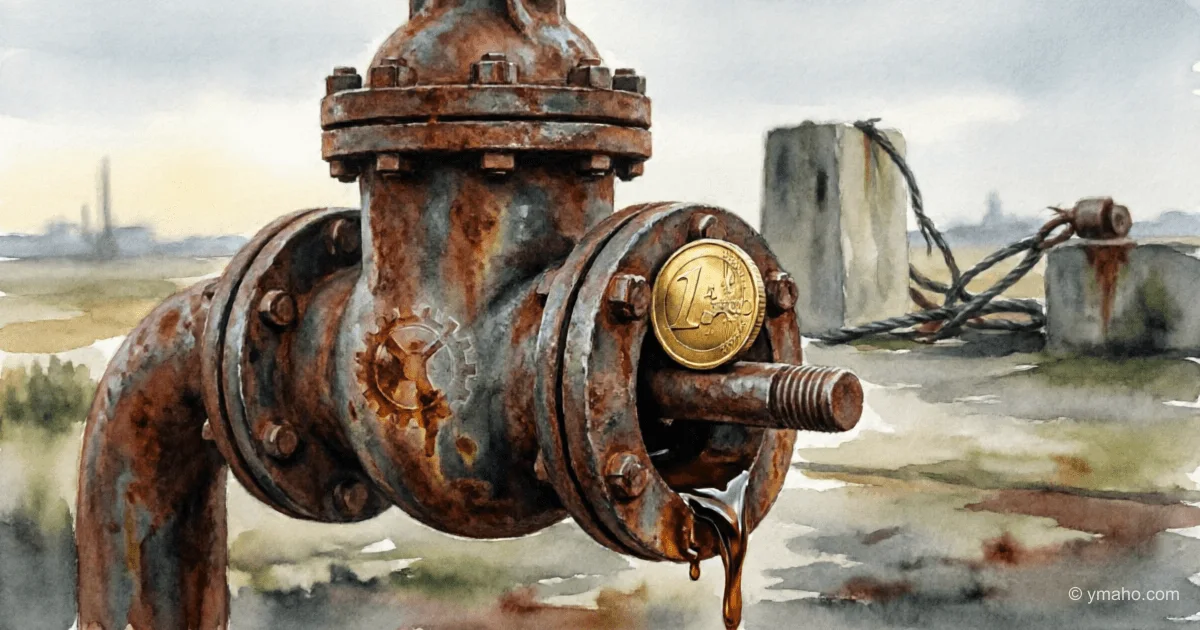
Europe Puts Oil Against Credit: How the 'Druzhba' Pipeline Repair Affects Aid to Ukraine and Markets
European countries may use oil pipelines as leverage in political games. The Czech Republic reported that Slovakia and Hungary agreed to support a major financial aid package for Ukraine and new sanctions against Russia—but only if Russian oil starts flowing again through the 'Druzhba' pipeline. This illustrates how physical resources—oil and gas—are directly tied to financial flows and international politics.
How a Pipeline Became a Political Tool
The 'Druzhba' pipeline is a vast network of pipes that has transported oil from Russia to Europe for decades. Think of it as the main water supply line for oil in Central Europe. In January, the Ukrainian section of this pipeline was damaged, halting oil deliveries. This immediately caused problems for Hungary and Slovakia, both heavily reliant on this supply.
In response, these countries blocked two key European Union financial decisions:
- A 90-billion-euro credit package for Ukraine.
- A new, twentieth round of sanctions against Russia.
Their logic was straightforward: restore oil deliveries to us first, then we’ll back your financial plans. It’s like someone holding the key to the storage room saying, "Give me what I need, and then I’ll open the door for everyone."
What Has Changed Now
Ukrainian President Volodymyr Zelenskyy announced that the damaged section of the 'Druzhba' pipeline has been repaired and is ready to resume operations. Czech Foreign Minister Petr Mácinka, after a meeting in Luxembourg, confirmed that Hungary and Slovakia are now prepared to lift their blockades—provided oil actually starts flowing again.
The European Union’s top diplomat, Kaja Kallas, stated that a decision on the credit for Ukraine will be made within the next 24 hours. This suggests the process could move very quickly.
Why This Matters for the World
This situation is more than just a regional dispute. It highlights several key mechanisms shaping the global economy:
- Resource-Finance Link: Access to physical resources (oil, gas) directly influences financial decisions (loans, investments). If a country isn’t getting oil, it can block billion-dollar financial flows.
- Politics as Bargaining: International support and sanctions have become bargaining chips. Hungary and Slovakia used their dependence on Russian oil as leverage to secure guarantees.
- Impact on Energy Markets: Restoring oil flow via 'Druzhba' could slightly ease pressure on European energy markets, even if volumes aren’t massive. It’s like adding a small but steady stream to an already large reservoir.
Key Takeaways
- The repair of the 'Druzhba' pipeline has become the condition for lifting financial blockades.
- The EU’s 90-billion-euro credit package for Ukraine could be approved in the coming days.
- A new round of sanctions against Russia also hinges on this outcome.
- This case is a clear example of how real-world infrastructure (pipes) controls virtual finance (credits).
What This Means for Ordinary People
Even if you don’t live in Europe, such deals affect global stability. When major financial flows depend on the condition of a single pipeline, it adds another layer of uncertainty. For consumers, it could mean slightly more stable energy prices in the region. For businesses, it’s a signal that political risk now includes the physical state of infrastructure. Ultimately, this shows how interconnected the world has become: a broken pipe in one country can delay billions of euros meant for another.
— Editorial Team









