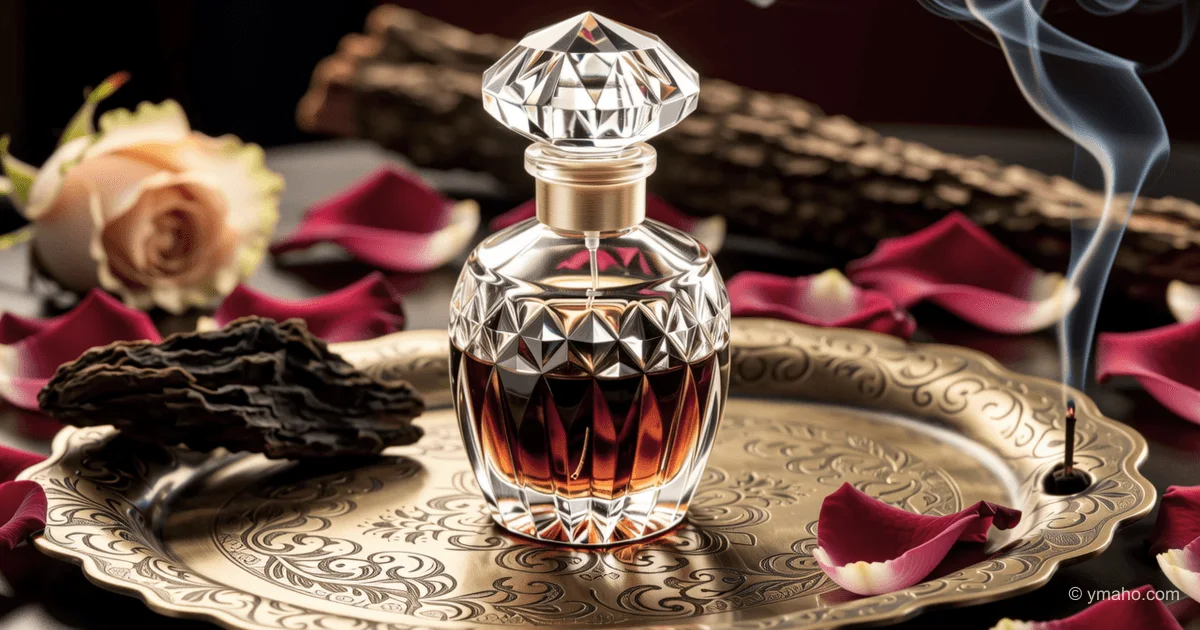
Enduring Fragrances with Oriental Notes as a Tool for Adult Sensuality
The trend for "fragrance stability" is championed by Melanie Grant: she has been loyal to Armani Privé Rose D'Arabie, with notes of Damask rose and oud, for over 10 years. Heavy oriental fragrances, inspired by Middle Eastern perfumery, are establishing themselves as an olfactory signature for women 35+.
The Essence: Olfactory Monogamy as a Market Anomaly
Melanie Grant's admission that she has been faithful to Armani Privé Rose D'Arabie for over a decade is not a lyrical aside about loyalty. It is an indicator of a profound structural shift in luxury perfumery that marketing departments are not yet ready to name out loud: the market of fragmentation and novelty, which has fed the industry for decades, is cracking under the pressure of the "olfactory signature." A woman 35+ no longer collects 15 bottles for different moods. She invests in one that becomes her biological extension.
The paradox: the global luxury perfumery market is growing with a projected CAGR of 6.9% and is expected to reach $414 billion by 2032. But this growth is increasingly driven not by purchase frequency, but by a rise in average transaction value. Consumers buy less often but spend radically more. Rose D'Arabie by Armani Privé costs between $300 and $400 per bottle. A client who sticks with it for a decade generates $3,000–$4,000 for the brand over ten years, with virtually zero acquisition costs. This is a subscription model, not a perfume model. The industry is only beginning to realize this.
Chronology and Context: From Fragrance Wardrobe to Olfactory DNA
Perfume culture in the 2000s and 2010s was built on the concept of a "fragrance wardrobe": citrus in the morning, oud in the evening, vanilla for a date. It was a fast-fashion model borrowed from Zara: many, cheap, seasonal. Bloggers unboxed 20 bottles a month, consumers subscribed to fragrance services like Scentbird for $16.95 a month. This model seemed eternal.
The turning point came around 2022–2023, when inflation and market saturation coincided with neuroscientific research. A research group led by Professor Joe Woon Chong from Sungkyunkwan University (South Korea), in collaboration with Texas Tech University, demonstrated using EEG that when a fragrance is congruent with brand identity and the consumer's self-perception, a "deep emotional connection" is formed, measurable as brand resonance. When the fragrance does not match, there is short-term pleasure without long-term memory. In other words, frequent fragrance changes do not create loyalty.
Generation X, with its demand for stability and authenticity, was the first to pick up on this signal. Melanie Grant is an ideal case. Her loyalty to Rose D'Arabie is not conservatism. It is neurobiologically rational behavior: her limbic system has "appropriated" Damask rose and oud as part of her identity. Changing her fragrance would not be like updating her wardrobe; it would be like amputating a part of herself.
Who Wins and Who Loses
Winners — Middle Eastern and Middle East-oriented brands. Armani Privé (created under the influence of the region's aesthetics), Amouage (Oman), Kajal, Arabian Oud — all build their portfolios around oud, frankincense, and Taif rose. Market research shows that the Middle East & Africa region is the fastest-growing for luxury perfumery, and the longevity of Middle Eastern fragrances (8–12 hours vs. 3–4 for French floral waters) perfectly aligns with the "fragrance stability" trend.
Also winning are niche brands with limited distribution. Rose D'Arabie is not found in every airport. This exclusivity protects the consumer's investment: your scent won't become the "elevator smell" a month after purchase.
Losers — brands built on the concept of "scent of the season." Marc Jacobs Daisy (and its 25 flankers), Escada with its limited summer editions — these models are fading against oriental heavy-hitters. The 35+ consumer is moving away from "frivolous" notes toward those classified in perfumery as "base-note heavy": sandalwood, amber, iris, oud. This is not a matter of taste. It is a matter of identity.
Mass-market brands trying to imitate oriental notes also lose. For $25, you cannot get real oud, which costs $30,000 per kilogram of pure oil. The consumer detects the synthetic trail and returns to niche.
What the Media Are Not Saying
Non-obvious insight: the trend for "fragrance stability" creates a colossal vulnerability for the consumer. Reformulations caused by IFRA (International Fragrance Association) regulatory restrictions on allergens are a reality that retailers keep quiet about. Over ten years, Rose D'Arabie may have undergone 2–3 silent reformulations. A loyal client may suddenly discover that "their" scent is no longer the same. The scandals around the reformulations of Le Labo Santal 33 and Chanel No. 5 are harbingers. When a woman builds her identity around a single bottle, a reformulation is not just a formula change. It is an identity crisis.
The second silence: the rise of oriental fragrances correlates with a cultural shift that Western media avoid naming. This is not just a "fashion for oud." It is the "Easternization" of the luxury consumer: Middle Eastern aesthetics of hospitality, clothing, and perfumery are penetrating the Western premium segment through Arab tourists and investors buying up European luxury brands. Rose D'Arabie is a product of this cultural diffusion, but Vogue Australia will never say it outright.
Third: stability with one fragrance for ten years is behavioral loyalty that devalues the work of launches. If every Generation X client finds "their" scent by age 35 and sticks with it for a decade, the industry will lose billions on new launches. Therefore, brands deliberately shorten the life of even successful fragrances through reformulations and discontinuations. Customer loyalty is a threat to quarterly revenue.
Forecast: The Next 30 Days and 90 Days
In the next 30 days, we will see brands begin to mimic "fragrance stability" through marketing campaigns like "Find Your Signature Scent." This will be a repackaging of the old in-store consultation model into a new narrative: instead of "try everything," it will be "find the one." Buyers at Sephora and Violet Grey are already being retrained from "recommend three" to "find one."
Within 90 days, there will be growth in the secondary market for discontinued fragrances. If consumers fear losing "their" scent due to reformulation, they will start buying backup bottles of old versions on eBay and in perfume communities. Prices for vintage first-release Rose D'Arabie could soar to $700–800. This will create a gray market that brands do not control — and that will become a headache for Armani.
At the same time, we will see the first instance of a luxury brand offering a "lifetime guarantee of formula stability" via subscription. For example: $500 per year ensures your fragrance will not be reformulated, and you receive an annual supply. This would turn perfumery into a SaaS model, which sounds crazy now, but for Generation X, who value stability, it could be a killer offer.
The final irony: an industry built on novelty and change has encountered a consumer who wants constancy. Oriental fragrances are the perfect tool for this constancy because they themselves are "slow": oud unfolds over hours, amber does not dissipate for days. This is the olfactory opposite of fast fashion. And Melanie Grant, unknowingly, with her ten-year romance with Rose D'Arabie, has pointed the market toward its future: not 50 bottles on the vanity, but one that has become part of the self. The luxury perfumery market will grow to $414 billion by 2032, but not through the number of units sold, but through the price of loyalty. And the brands that understand this first will gain not just a customer, but a lifelong devotee. The rest will be left with illusions sprayed over a hundred flankers.
— Editorial Team









