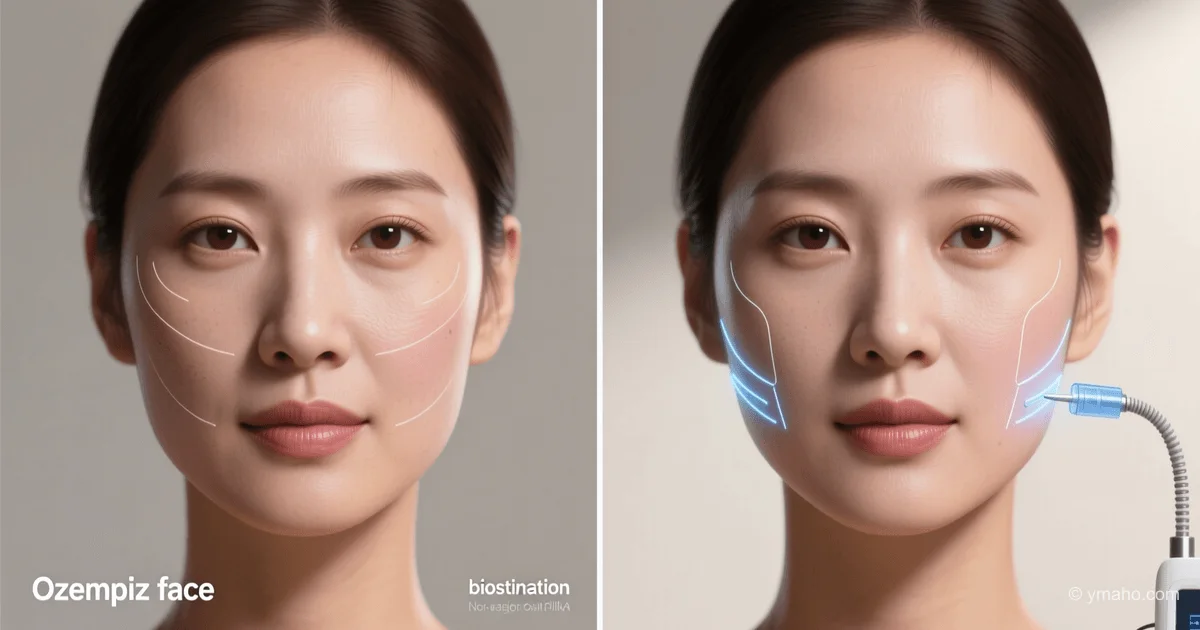
Aesthetic Correction of GLP-1 Side Effects (Ozempic Face)
The mass craze for rapid weight loss drugs (GLP-1 agonists) has spawned a new aesthetic demand for correcting "Ozempic face." Treatment protocols are shifting toward biostimulation and restoration of structural skin density, rather than simple volume filling.
From "Ozempic Face" to a New Aesthetic Paradigm: How GLP-1 Therapy Redefines Correction Protocols
Introduction
The term "Ozempic face" became firmly entrenched in the lexicon of aesthetic medicine in 2023, but 2026 marks a turning point in understanding this phenomenon. What was initially dismissed as a side effect of weight loss drugs is now viewed as a complex systemic issue affecting not only facial volume but also skin quality, fibroblast metabolism, and hormonal balance.
The mass adoption of GLP-1 receptor agonists (semaglutide, tirzepatide) for weight correction has created an unprecedented aesthetic demand. According to a Google Trends study conducted in early 2026, searches for "Ozempic face" surged by 4600% between 2021 and 2024. A survey at the annual American Academy of Dermatology (AAD) conference in Denver in March 2026 revealed that approximately 52% of patients taking GLP-1 drugs expressed concern about facial changes.
The key shift in 2026 is this: aesthetic correction protocols have moved from simple volume replacement to comprehensive restoration of structural skin density and biostimulation. In this article, we break down the mechanisms behind "Ozempic face," the timeline of awareness, industry response, and new therapeutic approaches.
Event Details and Timeline
Stage 1: Term Emergence and Initial Reaction (2023).
The term "Ozempic face" was coined by dermatologist Paul Jarrod Frank to describe the tired, gaunt appearance of patients after rapid weight loss. Initially, the change was attributed solely to loss of subcutaneous fat—with rapid weight loss, volumes diminish unevenly, most notably in the medial cheeks, temporal, and periorbital areas, leading to hollowing, gravitational ptosis, and jowls.
Stage 2: Scientific Reassessment (2024-2025).
A key breakthrough occurred when researchers discovered that GLP-1 receptors are expressed not only in the pancreas but also on the surface of adipocytes in dermal white adipose tissue (DWAT) and on adipose-derived stem cells (ADSCs). In 2024, a mini-review in the journal Endocrine proposed several mechanisms of accelerated skin aging under the influence of GLP-1RAs.
Stage 3: Confirmation at Major Forums (2025-2026).
In 2025 at the IMCAS congress (International Society of Aesthetic and Plastic Surgery) and in 2026 at AAD, data were presented showing that about 52% of patients on GLP-1 therapy are concerned about their appearance, with cost and fear of unnatural results cited as barriers to treatment. In January 2026, a study in the Journal of Cosmetic Dermatology documented a correlation between every 10 kg of weight lost and a 7% loss of midface volume.
Stage 4: Paradigm Shift in Therapy (2026).
By spring 2026, the professional community reached a consensus: "Ozempic face" is not just fat loss. It is a systemic reduction in the skin's regenerative potential, accelerated dermal aging, and decreased bone density. Consequently, the focus shifted from hyaluronic acid fillers (which simply "fill" voids) to biostimulators and comprehensive tissue support.
Impact and Significance (for the World, Industry, Society)
Impact on Scientific Understanding of Skin Aging:
The discovery of GLP-1 receptors on skin cells revolutionized the understanding of the link between metabolic health and appearance. Stimulation of these receptors on adipose stem cells reduces their ability to produce cytokines that protect fibroblasts from oxidative stress. This leads to fibroblast apoptosis and, consequently, decreased collagen production.
Additionally, GLP-1RAs reduce glucose uptake by precursor cells, causing ATP deficiency and increasing reactive oxygen species production. A third mechanism is reduced estrogen production by dermal adipose tissue, further accelerating collagen degradation through activation of matrix metalloproteinase-1. In other words, "Ozempic face" is not merely a volume deficit but true biological skin aging at the cellular level.
Impact on Industry and Economy:
The aesthetic services market is undergoing structural reorganization. Demand for combined protocols is rising. Physicians note that standard procedures (e.g., conventional RF lifting) do not yield adequate response in depleted tissues, necessitating gentler yet more stimulating regimens. Clinic economics are also changing: patients no longer come for a single procedure but engage in long-term management.
Impact on Perception and Psychology:
A new paradox emerges: people lose weight for health and beauty but face unexpected aesthetic losses. This creates demand not only for correction but also for prevention. Patients increasingly want to know how to prevent the problem, not just how to fix it.
Key Players' Reactions
Scientific and Clinical Community:
At AAD 2026 in Denver, extensive survey data from 406 healthcare professionals showed that the number of patients on GLP-1RAs increased by over 100% in one year, with 70% being women aged 30–49. Researchers concluded that this is a completely new patient cohort for aesthetic clinics, requiring a special approach.
Cosmeceutical and Device Manufacturers:
Specialized products are emerging. In January 2026, Dermatology Times published data from a 12-week clinical trial of Vol.U.Lift cream, which showed a 20.1% increase in skin and subcutaneous thickness and a 23.2% improvement in elasticity in patients with "Ozempic face." This demonstrates that even topical agents can be effective for a systemic problem.
Institutes and Congresses:
At the IMCAS 2026 congress, a dedicated session on metabolic medicine and aesthetics was held. The key takeaway: a proactive, personalized strategy combining regenerative aesthetics, peptide therapy, and hormonal support is needed.
Experts in Device-Based Cosmetology:
Russian specialists, such as physiotherapist Lilianna Myslovich, propose multimodal protocols combining picosecond lasers, microneedling RF, and LED therapy with cosmeceuticals containing exosomes and exobiotics.
Forecast and Conclusions
What lies ahead in the coming years for correcting the consequences of GLP-1 therapy?
- Shift Toward Prevention. The concept of "proactive" aesthetics, proposed in the IMCAS program, will become standard. Biostimulators (such as hyperdiluted CaHA or PLLA) will be prescribed not post factum but immediately after starting GLP-1 therapy to maintain the collagen scaffold during weight loss.
- Changing Priorities in Injection Protocols. Hyaluronic acid fillers will remain in the arsenal but will cede ground to biostimulators as first-line agents. Reason: fillers provide volume but do not treat dermal atrophy. Biostimulators (CaHA, Sculptra) trigger neocollagenesis and restore tissue density.
- Development of Combined Device Protocols. Given reduced tissue metabolism, aggressive parameters are contraindicated. Gentle synergistic protocols win: laser + RF + photobiomodulation + exosomes.
- Growing Interest in Peptide and Hormonal Support. At the IMCAS congress, the inclusion of additional peptides (BPC-157, GHK-Cu, senolytics) and hormone therapy in management protocols for patients on GLP-1RAs is discussed. The future lies in synchronizing metabolic and aesthetic medicine.
- Smart Topical Agents. Creams with multi-component formulas capable of increasing dermal thickness (like Vol.U.Lift) will become widespread as an affordable, non-invasive alternative or complement to injections.
Conclusion:
"Ozempic face" has triggered a profound rethinking of the relationship between metabolic health and skin. The aesthetic medicine industry has responded to this challenge by abandoning simplistic approaches in favor of complex, multi-layered strategies combining regenerative biostimulators, device technologies, and systemic support. We are entering an era where aesthetic outcome is not masking but true biological tissue restoration. And GLP-1 therapy, for all its challenges, has become a powerful catalyst for this progress.
— Editorial Team









