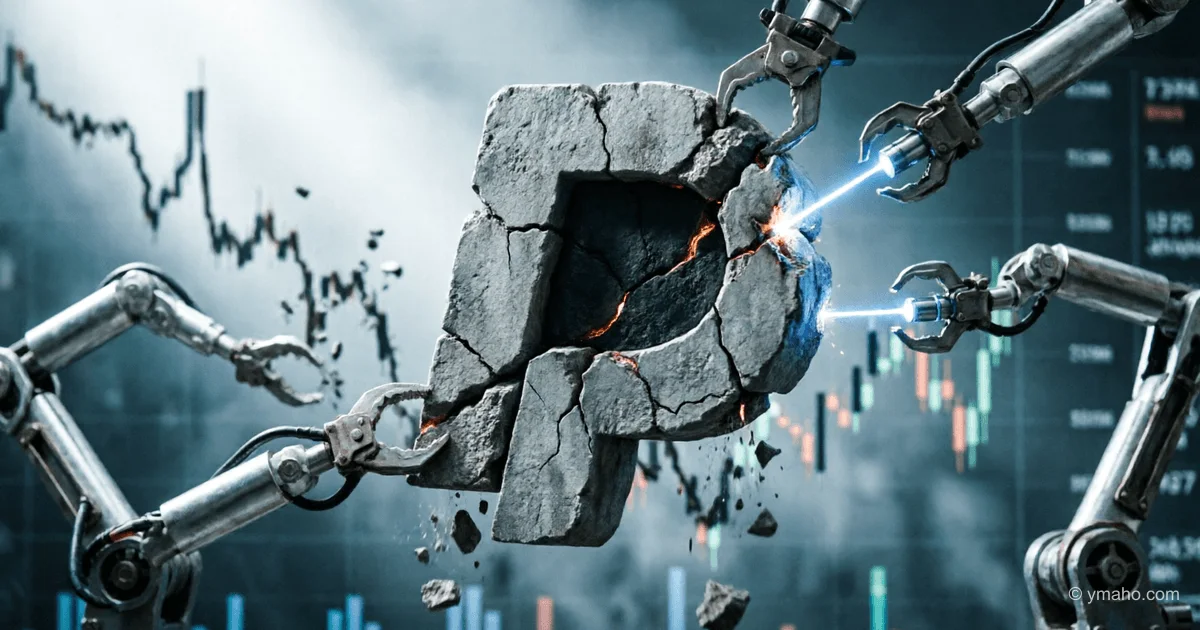
PayPal shares fall on news of accelerated AI adoption and cost-cutting program
Fintech giant PayPal has announced the accelerated integration of artificial intelligence into its processes, accompanied by plans for significant cost optimization. Investors reacted negatively to the potential large-scale internal reforms.
What is being presented as "accelerated AI adoption" is in fact a tough attempt by the new CEO to save the company from falling into oblivion. The market saw through this maneuver in seconds: shares crashed not on news of a technological breakthrough, but because behind the facade of "digital transformation" lies a desperate struggle for survival amid the total contraction of a once legendary business.
The essence: what is really happening
This is not technological progress. It is an emergency amputation under the guise of the trendy term "AI." The new CEO Enrique Lores, who moved from HP, is not just "accelerating digitalization" — he is exposing decades of accumulated technological backwardness and process duplication. PayPal is now a cumbersome mechanism losing the most profitable part of its business: branded checkout growth was only 2%, while total payment volume grew by 11%. This means the company is earning less and less from its main product, ceding ground to simpler and cheaper solutions like Stripe.
The market sensed trouble immediately. PayPal reported better-than-expected Q1 2026 results: revenue reached $8.35 billion against expectations of $8.05 billion. However, the Q2 forecast was so weak that shares fell nearly 10% in pre-market trading on May 5, 2026. This is a classic case where investors see management cutting costs because they don't know how to grow revenue. The stated goal is to save $1.5 billion over 2-3 years, but without a clear plan to restore growth, it is perceived as strategic capitulation.
Timeline and context
The crisis has been brewing for a long time, but key events have compressed into recent weeks. In late April 2026, Lores, who took office only in March, announced a radical reorganization of the company into three divisions: Checkout Solutions & PayPal, Consumer Financial Services & Venmo, and Payment Services & Crypto. Formally, it increases accountability. In reality, it is a dismemberment in the face of threats from activist investors.
Then, on May 5, three news items exploded simultaneously, amplifying the bomb effect. First, the Q1 report with its mixed content. Second, the announcement of accelerated AI integration, coinciding with similar moves by other industry pillars: Block cut 50% of its workforce, Coinbase 14%. PayPal, according to Bloomberg, plans to cut about 20% of staff (over 4,500 jobs) in the coming years. Third, a terrifying warning: Q2 profit will fall by about 9%. The stock price collapsed.
Who wins and who loses
Winners:
- Enrique Lores, the new CEO: in the short term, he gets a blank check for any unpopular reforms. Any layoffs and profit declines can now be blamed on the "heavy legacy" and "inevitable pain of AI transformation."
- Competitors (Stripe and Block): while PayPal writhes in attempts to centralize and automate processes, these more agile and tech-savvy competitors aggressively eat away market share in serving online businesses.
- Activist investors: the stock's decline of more than 80% from its 2021 peak has created ideal conditions for pressure. Restructuring could lead to the spin-off of the most valuable asset — Venmo, whose value may exceed the entire company's current market cap.
Losers:
- PayPal employees: insiders talk of impending layoffs of thousands of jobs. AI agents are replacing not only coders but also entire layers in customer support and risk management, creating a toxic atmosphere inside the company.
- The branded checkout business itself: the focus shifts to mass processing services (PSP) and crypto. The unique "PayPal button," losing profitability, takes a back seat. If Lores kills it entirely for the sake of automation, the company risks losing its identity.
What the media are not saying
Headlines are full of the words "Artificial Intelligence," but they are silent about the main personnel signal. The appointment of Mr. Lores is a change of philosophy. The former CEO was a "software" person; Lores is a pure "hardware" guy and supply chain specialist. The media miss that his true mission is not to accelerate code deployment but to turn PayPal from an "internet service" into a utilitarian "financial highway" for robots (Agentic Commerce).
A second non-obvious point: the reform is happening against the backdrop of abandoning the fight for premium customers. The focus on cost cutting and reorganizing Braintree implies a hidden capitulation to Apple Pay and Google Pay in the convenient retail online payments segment. PayPal is no longer trying to be the "wallet of the future" for humans — it wants to be an invisible pipe for machines.
A third insight is the Venmo catastrophe. Venmo is a gold mine that PayPal has never learned to use. Spinning it off into a separate division is pre-sale preparation. Lores made it clear that PayPal will become a technology platform, and Venmo's social aspect does not fit into that scheme.
Forecast: next 30 days and 90 days
30 days (by June 6, 2026):
We will see the first wave of layoffs and the official launch of the "AI transformation" department. Shares will continue to fluctuate in the $45-55 range as the market analyzes whether buyers will emerge for the entire asset. The key risk is an immediate exodus of key developers who disagree with the "cloud migration at any cost" policy.
90 days (by August 6, 2026):
Lores will be forced to show his hand on Venmo monetization. If there is no news of a sale or spin-off, shares will fall further amid stagnation. The company will finally focus on crypto processing. By the end of the quarter, it will become clear: the "AI revolution" at PayPal is not about creating a new ChatGPT for finance, but a banal digitization of accounting and basic support, accompanied by severe social stress for the team. PayPal is not moving into the future; it is trying to hold on in the industrial era of financial rails.
— Editorial Team









