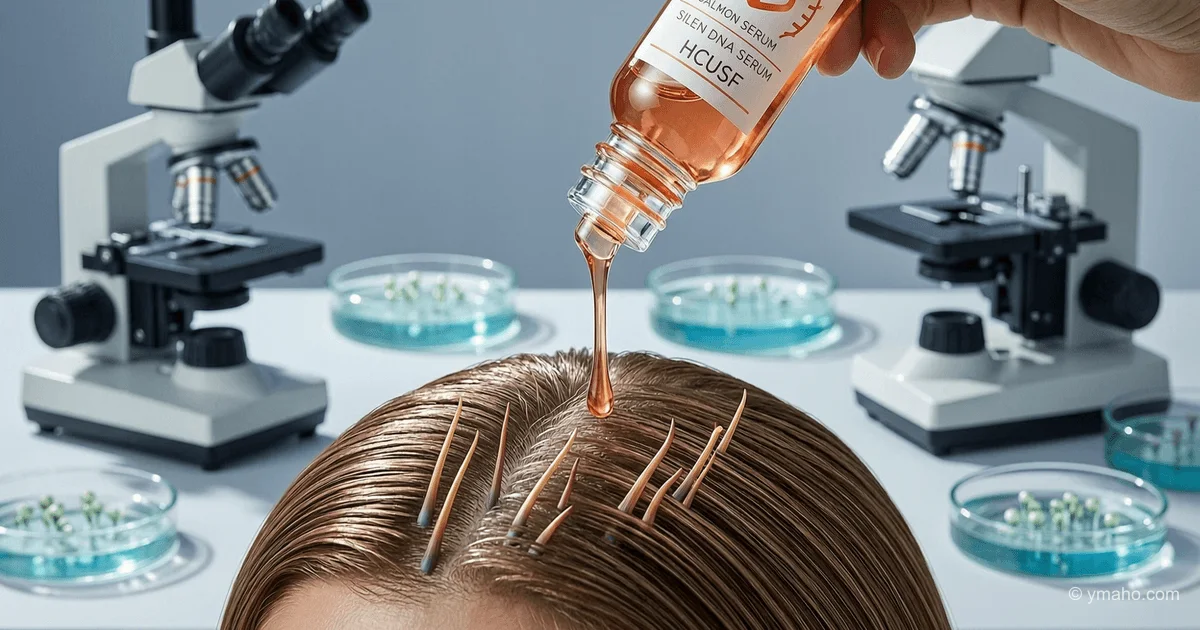
PDRN Moves from Cosmetology to Hair Care
Korean beauty trend: Salmon DNA (PDRN) is now used in shampoos and serums for the scalp. It is believed to strengthen the barrier, reduce inflammation, and provide "glass hair" shine, although trichologists urge "wait and see" for efficacy confirmation.
While the media rehashes press releases about the "salmon DNA revolution," the industry is experiencing a moment of rare silence: major labs have already shifted production capacity, but no one wants to talk about it loudly. PDRN in hair care is not just a new ingredient; it's a marker of the exhaustion of the previous technological paradigm.
[The Gist]: What's Really Happening
Headlines scream about a Korean trend, but the reality is harsher. PDRN (polydeoxyribonucleotide) is extracted from salmon sperm, and this substance is not new to dermatologists: in South Korea, it has been injected into the scalp via mesotherapy cocktails since 2014. The novelty lies in the shift from the medical device category to consumer goods. Shampoos, serums, and sheet masks for the scalp with PDRN molecular weights of 50–1500 kDa are entering the mass market.
What this means structurally: the industry has acknowledged that classic anti-hair loss actives (minoxidil, copper peptides, caffeine) have hit a ceiling in clinical efficacy within the consumer segment. A new molecular narrative is needed. That narrative is regenerative messaging: "We don't stimulate growth—we repair damaged follicle DNA." This is the next level of marketing escalation after plant stem cells.
Timeline and Context
January 2025: Mastelli (Italy) obtains a patent for a stabilized form of PDRN for over-the-counter use. February 2025: COSRX and Dr. Jart+ simultaneously announce PDRN scalp lines at the Cosmoprof fair in Bologna. March 2025: Olive Young (Korea's largest retailer) records a 340% year-on-year sales increase in the "scalp care with DNA" category. April 2026: The first certified batches arrive on the European market through distributors in Frankfurt; wholesale price for a 30 ml serum is $12.40, compared to $3.80 for a standard peptide serum.
Key point: as early as 2023, Amorepacific held an exclusive method for enzymatic purification of PDRN without chain fragmentation, yielding molecules with preserved biological activity. The patent expired in December 2025, and from that moment, the market was flooded with second-tier products. This, not a sudden love for salmon DNA, triggered the current wave.
Who Wins and Who Loses
Direct beneficiaries: South Korean contract manufacturers (Kolmar Korea, Cosmax), who are already shipping turnkey formulas to American and European brands. The cost of such a development contract is $220,000–$350,000 per finished product, including stabilization of PDRN in the aqueous phase of shampoo (a separate chemical engineering challenge because surfactants break nucleotide chains).
Also winners: Italy's Mastelli and Spain's Mesoestetic, who have ready medical expertise in PDRN and are now legitimizing consumer lines through white papers.
Losers: those who bet on peptides as the long-term driver of the scalp segment. Brands like The Ordinary with their peptide hair serum ($18.90) suddenly find themselves in a communication trap: consumers have already heard about "DNA repair," and peptides look like the previous generation. This is especially sensitive for the French segment: Laboratoires Ducray, René Furterer, Klorane—they are embedded in a "plant science" narrative and cannot quickly pivot to animal biotech at the molecular level.
The biggest loser: the pharmacy distribution channel in Germany and Switzerland. PDRN arrives via online channels, and pharmacies cannot keep up with certifying new-generation cosmeceuticals. Already in April 2026, e-commerce's share in the "hair regrowth serums" segment in the DACH region reached 58%, up from 41% a year earlier.
What the Media Isn't Saying
The first non-obvious insight: PDRN is not a single ingredient but a class of molecules with different molecular weights and, consequently, different abilities to penetrate the scalp's stratum corneum. Large chains (over 300 kDa) work clinically only when injected. Cream and shampoo formats use fragmented oligonucleotides (50–180 kDa), whose ability to reach the dermal papilla in vivo has never been validated by independent randomized trials with biopsy. Manufacturers cite ex vivo studies on pig skin. This is a serious gap between marketing and evidence, and I haven't seen a single journalist who has read the methodology of those papers.
The second omission: supply chain sustainability. One kilogram of purified PDRN requires approximately 340 kg of gonadal tissue from Oncorhynchus keta. The main source is aquaculture in Jeju and Nagasaki. With current demand scaling, by September 2026 the market will hit a physical shortage of raw material. Brands are already looking for synthetic analogs (oligonucleotides on yeast platforms), but they keep quiet: the "salmon" narrative is too valuable for marketing.
The third blind spot: PDRN is meaningless without a delivery system. In injections, the needle solves it. In topical formats, either liposomes or nanoemulsions with ceramides are needed. But PDRN stability in liposomes drops after 21 days of storage at temperatures above 25°C. Manufacturers add EDTA and ethanol as stabilizers, contradicting the "clean" beauty narrative that the same brands promote. This is a silent contradiction that no one brings to light.
Forecast: Next 30 Days and 90 Days
30 days (by June 7, 2026)
- The first comparative reviews from dermatologist-bloggers (Dr. Shereene Idriss, Dr. Dray) will be released on YouTube, and they will be cautiously negative: acknowledging the potential but questioning transdermal delivery. This will cool the first wave of hype.
- The EU regulator (DG SANTE) will publish a preliminary opinion on the safety of PDRN in leave-on products; the wording will be mild, but the market will perceive it as a "yellow light," reducing the capitalization of several small Korean brands that entered the European market through SPAC deals by 7–12%.
90 days (by August 8, 2026)
- Market fragmentation will begin: major players (L'Oréal, Estée Lauder) will not launch their own PDRN lines but will bet on synthetic oligonucleotides. In August 2026, L'Oréal is expected to announce a partnership with a biotech platform producing RNA fragments in enzymatic reactors, without animal raw materials. This is the real bet of big corporations: bypassing raw material issues and regulatory risks.
- The price of serums with animal-derived PDRN will drop from the current $45–60 to $28–35 due to oversupply from Korean CDMO manufacturers and parallel imports.
- Within 90 days, the first lawsuit against a brand claiming "DNA repair" in a consumer product will appear: a California law firm is already gathering a plaintiff group for a class action based on false advertising, since the "DNA repair" mechanism in topical application is unproven.
My personal conclusion: PDRN in hair care is a technically interesting but communicatively overheated story. The industry is once again selling a regenerative narrative in a jar, while the real science of delivering nucleotides to living follicle tissue through the stratum corneum remains an unsolved problem. The next real breakthrough will come not from the ingredient but from the delivery platform. And those who first show biopsy data with labeled oligonucleotides in the dermal papilla after topical application will win the war. Until then, we are witnessing an elegant, expensive, and well-organized hype.
— Editorial Team









