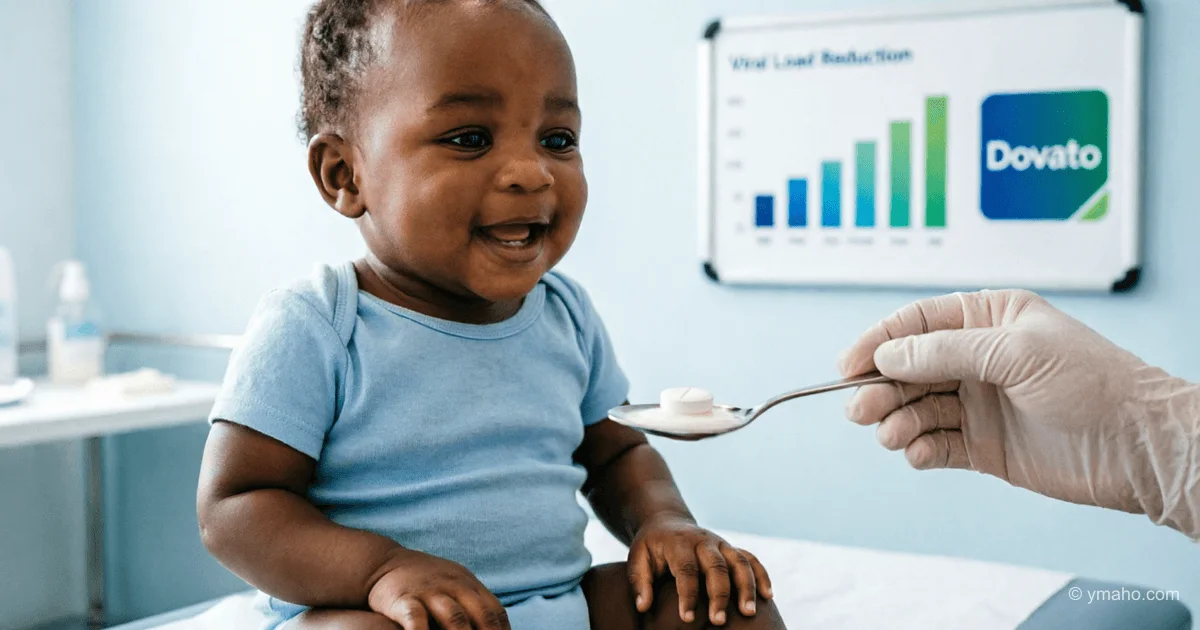
ViiV Healthcare Files for Pediatric Formulation of Dovato to Treat HIV
ViiV Healthcare has submitted applications to the EMA and FDA for the registration of dispersible Dovato tablets for children with HIV aged 3 months and older weighing at least 6 kg. The goal is to bridge the gap in access to modern antiretroviral therapy for children.
Pediatric Dovato: Why ViiV's Filing Is About Geopolitics of the HIV Market, Not Just Medicine
When ViiV Healthcare announced on May 11, 2026, that it had simultaneously filed applications with the FDA and EMA for dispersible Dovato tablets for children aged three months and older weighing at least 6 kg, most observers saw it as a routine label expansion. Formally, that's what it is: an adult drug adapted for children, a soluble form instead of swallowable tablets—the standard path for pediatric development. But beneath the surface of this regulatory event lies a high-stakes game involving corporate restructuring, global inequality in access to therapy, and a fundamental shift in the philosophy of antiretroviral treatment.
The Core: What's Really Happening
The pediatric Dovato application is not an altruistic gesture by ViiV but a strategic maneuver to capture the last untapped segment of the HIV market. Children with HIV represent a microscopic commercial opportunity (about 1.4 million patients worldwide, of whom only 55% receive therapy compared to 78% among adults) but a colossal reputational asset. The adult HIV market has long been divided among Gilead with its Biktarvy, ViiV with its dolutegravir line, and Merck with Doravirine. All new drugs must fight for market share in fierce competition. The pediatric segment is the only space where territory can be claimed without direct confrontation with competitors.
But that's just the first layer. The deeper significance of the application is creating a "lifetime therapy." A patient starting on dispersible tablets at three months of age will transition to film-coated tablets in adolescence and remain on the ViiV brand for decades. This is vertical integration of loyalty, known in pharma as lifecycle extension—extending the product's life cycle beyond patent protection. Patents on dolutegravir begin expiring in 2027-2028. Pediatric exclusivity in the US will give ViiV an additional six months of protection per indication, and in Europe, up to two years of supplementary protection certificate extension. This is not philanthropy. It is cold-blooded patent strategy.
Timeline and Context
To understand the timing, rewind three months. In March 2026, the largest ownership restructuring of ViiV Healthcare in a decade was completed: Pfizer exited the joint venture, selling its 11.7% stake to Japan's Shionogi for $1.875 billion. Shionogi increased its stake to 21.7%, while GSK—ViiV's parent company—retained a controlling 78.3% and received $250 million in special dividends. This was not just a change of signage. Pfizer's exit removed the main internal brake on risky investments—Pfizer historically viewed ViiV as a cash cow and resisted investments in niche projects like pediatric development.
Shionogi is a different type of shareholder. The Japanese company created dolutegravir, receives royalties from sales, and is deeply interested in market expansion. For Shionogi, the pediatric application is a way to increase royalties before generics erode adult sales. Within two months of the deal's closing, the applications were filed. This is not a coincidence; it's a direct cause-and-effect relationship.
The clinical basis is the D3/Penta-21 study, sponsored by the PENTA Foundation with support from ViiV. PENTA is a European network of pediatric HIV researchers with access to patients in Africa, Asia, and Latin America. The data underpinning the application includes pharmacokinetic modeling but not large-scale efficacy trials—they use a bridging approach, where adult efficacy is extrapolated to children after confirming adequate drug exposure. This is acceptable to the FDA and EMA but raises questions about long-term safety in low-weight children, especially regarding renal toxicity—a known risk of tenofovir-containing regimens that Dovato avoids but is not entirely free from.
Who Wins and Who Loses
ViiV/GSK/Shionogi wins—that's obvious. At a Dovato price of about $20,000 per year in the US and $800–1,200 per year in countries with voluntary licensing, even 100,000 pediatric patients (less than 10% of untreated children) would generate additional revenue of $80 million to $200 million per year. That's modest for a company with sales around $8 billion, but the margin on pediatric HIV drugs is close to 85%—generic components cost pennies to produce.
Children with HIV in sub-Saharan Africa win—they account for 85% of all pediatric cases worldwide. The dispersible form solves a problem clinicians call "crush-and-mix": currently, doctors and parents must crush adult tablets, leading to dosing errors in 30–40% of cases. A standardized pediatric form with clear weight ranges is a matter of survival, not convenience.
Surprisingly, generic manufacturers lose. When ViiV files for a pediatric form with the FDA and EMA, it triggers pediatric exclusivity tied to the composition patent. For Cipla and Mylan, which planned to launch generic dolutegravir/lamivudine in 2028, the pediatric form extends protection until mid-2029. A one-year delay in a $2.5 billion market is a serious blow.
Then there's Gilead. Their drug Biktarvy (bictegravir/emtricitabine/tenofovir alafenamide) lacks a pediatric form for children under two years. ViiV is at least 18–24 months ahead of the competitor, and if Gilead doesn't accelerate its pediatric program, Dovato could become the de facto first-line standard for children—and doctors rarely switch a working regimen.
What the Media Isn't Saying
Here's the key non-obvious fact you won't read in press releases: the dosing of the dispersible Dovato form for children is based not on full Phase III efficacy clinical trials but on pharmacokinetic bridging from adult data. This means the FDA and EMA will approve the drug because the law allows efficacy extrapolation if the disease and mechanism of action are the same in adults and children. But dolutegravir metabolism in a three-month-old infant is radically different from an adult: UDP-glucuronosyltransferase enzymes are immature, renal clearance is different, and fat mass is minimal. Safety data in children under one year is based on a sample of 30–40 patients, not the hundreds required for adult approval.
This doesn't mean the drug is dangerous. But it does mean post-marketing safety studies will be critical, and ViiV will need to collect real-world data, especially on neurotoxicity—dolutegravir causes insomnia and headaches in 3–5% of adults, and these side effects are virtually unstudied in children.
The second layer that goes unmentioned: the Rome Action Plan, cited by ViiV's Chief Medical Officer Jean van Wyk, is a 2019 document created under the auspices of the Vatican, bringing together pharma companies, regulators, and religious organizations. It is non-binding and regularly criticized by activists for slow implementation. Mentioning this plan in the press release is a signal not to the medical community but to political structures: "we are fulfilling our global health commitments." It's part of the negotiating position with the WHO and UNICEF, the largest purchasers of pediatric ARVs for developing countries.
Forecast: Next 30 Days and 90 Days
In the next 30 days, I expect formal acceptance of the FDA application for review (NDA filing acceptance) and a date set for the advisory committee meeting. The FDA's standard review timeline for pediatric applications with priority status is 8 months, but ViiV will request a priority review voucher based on unmet medical need—and given the lack of alternatives, it will likely receive it. This means an FDA decision by late 2026 to early 2027.
The EMA traditionally takes 2–4 months longer, but there's a nuance: the European regulator will request a Pediatric Investigation Plan (PIP) from ViiV, and its approval could be delayed if the EMA requires data on long-term neurocognitive development in children. ViiV understands this and, according to my information, is already preparing a protocol for a ten-year observational study to start immediately after approval.
In the 90-day perspective, an important event will occur: ViiV will announce the price of the dispersible form for low-income countries. This is a politically sensitive moment. If the price is above $100 per year per patient, activists will raise a fuss. If below $50, ViiV will set a precedent that hurts revenues from other drugs. I expect a compromise around $75–85—low enough for positive PR, but high enough to cover costs.
The most interesting scenario is that Gilead will try to accelerate its own pediatric Biktarvy program through collaboration with African research networks. If that happens in the next 90 days, we'll see a rare spectacle: an arms race not for a multi-billion oncology market but for a modest pediatric segment where profits are in the tens of millions. But in HIV therapy, control of the first line means control of the patient for decades. That's why ViiV is in a hurry. And that's why Shionogi paid nearly $2 billion for the right to join this race. The stakes are higher than the headlines suggest.
— Editorial Team









