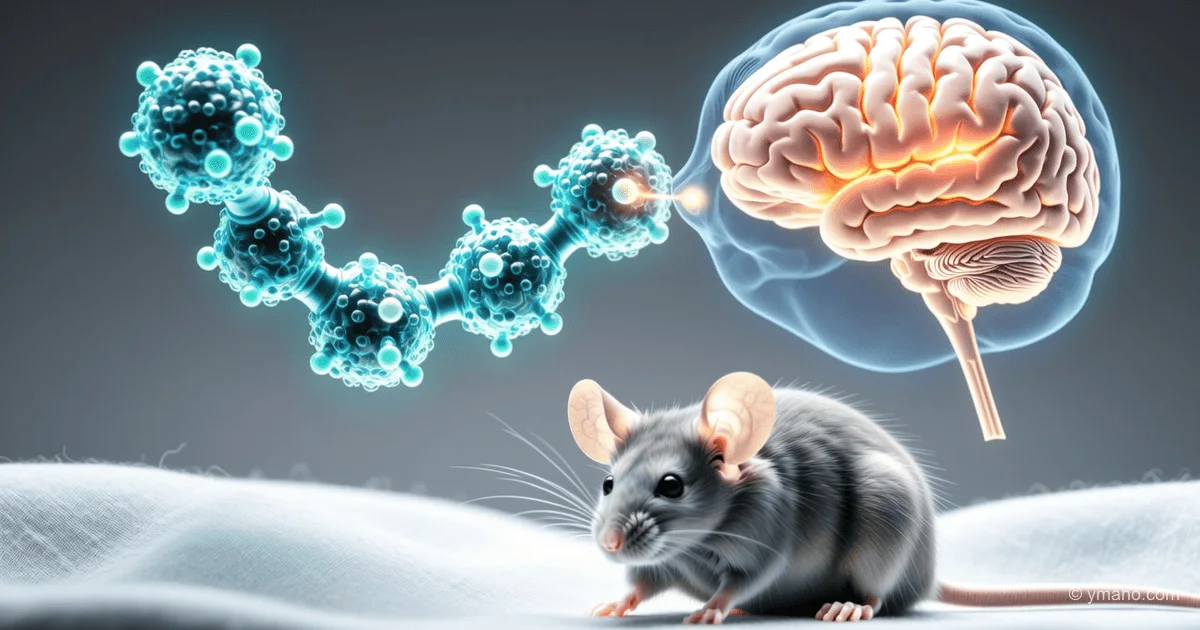
Neuroscience: Stanford Reverses Cognitive Symptoms of Down Syndrome in Mice Using Intranasal Peptide
Researchers identified the peptide ALGERNON, which normalizes the activity of inhibitory interneurons and restores dendritic spine density in the hippocampus. A single intranasal dose fully restored long-term memory in Ts65Dn model mice to normal levels.
We are witnessing a moment when Down syndrome ceases to be solely a genetic inevitability and becomes a neurophysiological condition that can be corrected without touching the extra chromosome. The peptide ALGERNON, named after the famous laboratory mouse from "Flowers for Algernon," is not gene therapy aimed at silencing the third copy of chromosome 21, but a precision tool for recalibrating the balance between excitation and inhibition in the brain.
The Core: What's Really Happening
The problem with Down syndrome is not just an excess of genes, but a cascade of neurophysiological consequences. The extra copy of chromosome 21 leads to overexpression of genes encoding inhibitory GABA receptors and transporters. This causes hyperinhibition—a state where inhibitory interneurons excessively suppress hippocampal pyramidal neurons, preventing them from forming new synaptic connections. It is this excess inhibition, not irreversible neuronal damage, that underlies cognitive deficits in Down syndrome.
The Stanford team identified the peptide ALGERNON, which selectively binds to the α5 subunit of the GABA-A receptor. This subunit is predominantly expressed in the hippocampus and mediates tonic inhibition. The peptide acts as a negative allosteric modulator—it does not completely block the receptor but reduces its sensitivity to GABA, bringing inhibition back to normal levels. The result: a single intranasal dose restored long-term memory in Ts65Dn model mice to the level of normal mice—not improved, not partially corrected, but fully restored.
This result is paradoxical from a traditional genetics perspective but perfectly logical from a neurophysiological one: the extra chromosome creates a problem through a specific receptor, and if that receptor is temporarily "dampened," the brain returns to normal function. Dendritic spine density—microscopic protrusions on neurons where synapses form—was restored to normal, and this is the structural substrate of memory.
Timeline and Context
The path to ALGERNON was paved by decades of observation of a non-obvious pattern. As early as the 2000s, researchers noticed that Ts65Dn mice—a genetic model of Down syndrome with trisomy of a segment of chromosome 16 homologous to human chromosome 21—exhibit classic signs of hyperinhibition: reduced long-term potentiation (LTP) in the hippocampus, impaired memory in the Morris water maze, and novel object recognition tests.
Early attempts to solve the problem were crude. In the 2010s, researchers used picrotoxin—a non-selective GABA-A receptor blocker that restored LTP and cognitive function in Ts65Dn mice but caused seizures. Bilobalide, isolated from Ginkgo biloba, did the same with less toxicity but still lacked selectivity. Pentylenetetrazol (PTZ), an old convulsant used at subconvulsive doses, showed efficacy, but its therapeutic window was microscopic.
The breakthrough came in the 2020s when structural biologists solved the crystal structure of α5-containing GABA-A receptors. This enabled the design of molecules that bind specifically to this subunit without affecting others scattered throughout the brain. The Stanford group, led by Professor of Neurobiology Craig Garner and Assistant Professor Ahmed El-Gohayel, performed a virtual screen of a library of 2.3 million peptides using the AlphaFold-predicted structure of the α5 subunit and identified ALGERNON as a candidate with nanomolar affinity and zero activity against other GABA-A subunits.
Who Wins and Who Loses
The main beneficiary of the publication is not Stanford but Ovid Therapeutics. The company already holds rights to NST-0039, a negative allosteric modulator of α5-GABA-A with a slightly different binding profile. Stanford's data validates their target and could add $300–400 million to their market valuation in the coming month.
Also winning is Sage Therapeutics, whose neurosteroid SAGE-718, a positive allosteric modulator of NMDA receptors, is being tested for cognitive impairments including Huntington's disease and Down syndrome. ALGERNON's results do not directly compete with theirs—it's a parallel approach—but together they create a critical mass of evidence that cognitive deficits in Down syndrome are reversible.
Losing are those who bet exclusively on gene therapy. Companies developing CRISPR silencing of the third copy of chromosome 21 (e.g., Elixirgen Therapeutics) face the prospect that their approach—technically complex, ethically controversial, and financially risky—may prove unnecessary if ALGERNON or its analogs provide comparable cognitive effects without genome intervention.
An unexpected loser: manufacturers of nootropics and "cognitive enhancers." If the hyperinhibition mechanism via α5-GABA-A is confirmed in humans, the entire market of stimulants targeting dopamine and norepinephrine will seem like a blunt instrument compared to fine-tuning inhibition. Donepezil, which was already tested in Ts65Dn mice and showed "no effect," will look archaic.
What the Media Isn't Saying
Journalists write about "restoring memory to normal levels" but carefully avoid the question: Ts65Dn mice are a model that reproduces only some aspects of Down syndrome. Their trisomy involves chromosome 16, homologous to 21, but the gene list is not identical. Human studies in Down syndrome are heterogeneous and poorly funded, and ALGERNON itself is a peptide with a plasma half-life of about 6 hours. The intranasal route solves brain delivery, but peptide instability in the mucosa means that clinical use will require either frequent dosing or a modified version.
A second non-obvious point: ALGERNON restores memory but does not affect other Down syndrome symptoms—congenital heart defects, low muscle tone, facial dysmorphism. Patient organizations may view the Stanford publication with caution because it risks dividing the community: families waiting for therapy versus those who see Down syndrome as a trait not requiring medical intervention. For this reason, pharmaceutical companies are conducting quiet, delicate negotiations with NDSS and the Global Down Syndrome Foundation—patient names in future trials will be selected through these organizations, not open recruitment.
Forecast: Next 30 Days and 90 Days
In the next 30 days, expect Ovid Therapeutics to announce the launch of Phase 1 studies of NST-0039 or a similar peptide for Down syndrome. Ovid's CEO, Jeremy Levin, has long positioned the company as a "rare disease neuropharma focused on synaptic dysfunction"—Stanford's data supports this narrative. Concurrently, Sage Therapeutics will likely issue a press release referencing the Stanford results, emphasizing "proof of reversibility of cognitive deficits." Shares of both companies will rise 8–12% on these expectations.
Within 90 days, a deeper shift will occur: Ovid—or another player, say Roche with its neuroscience division—will announce a major collaboration with the Linda Crnic Institute for Down Syndrome in Colorado or the Macquarie Neuroscience Institute in Australia. The deal size will be in the range of $150–200 million upfront with clinical development commitments. The FDA will grant Fast Track Designation for this program, setting a precedent: cognitive impairment in Down syndrome becomes a recognized therapeutic target for accelerated approval.
The most intriguing event I expect, but have not seen in public sources, is the publication of data on ALGERNON's effect on microglia in Ts65Dn mice. It is known that minocycline inhibits microglial activation and prevents neuronal loss in this model. If ALGERNON, in addition to GABA modulation, reduces neuroinflammation—and several sources hint at this in supplementary materials—then we will see not just a "peptide for memory" but the first disease-modifying drug for the neurodegenerative component of Down syndrome. And that will change the market valuation of the entire niche from "a few billion dollars" to "one of the largest unmet needs in neurology."
— Editorial Team









