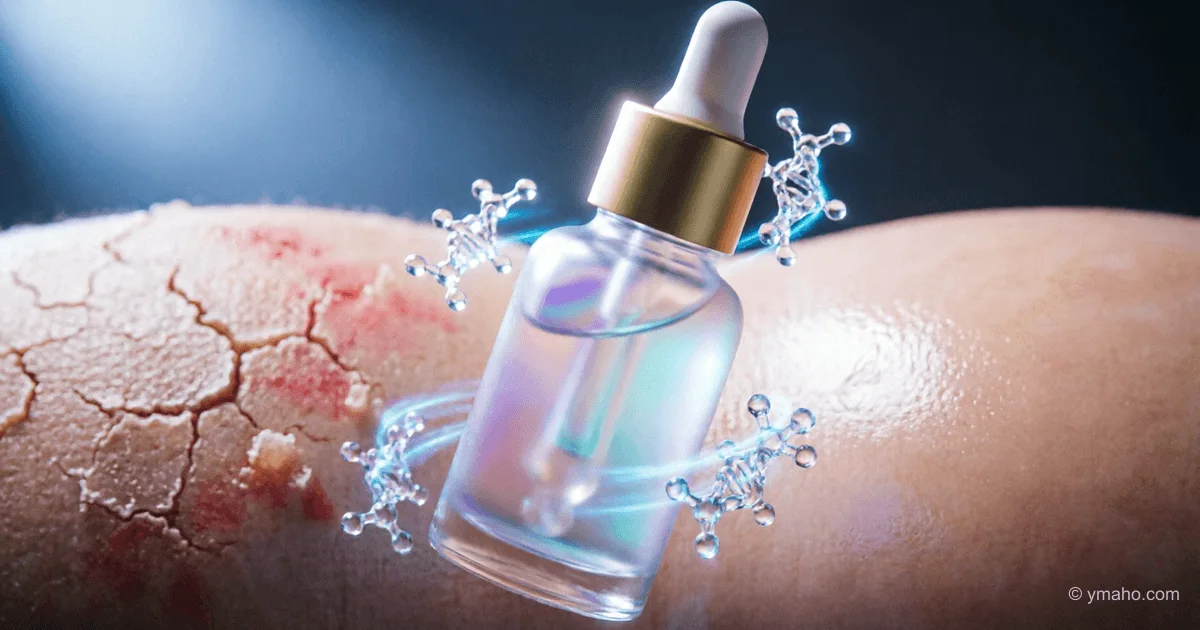
LookFantastic Names Peptides the #1 Skincare Ingredient of 2026
According to the retailer's report, peptides have become the #1 trend in skincare: searches are up 79%. 'Skinification' is evolving—hybrid products and multifunctional peptide complexes for firmness, repair, and radiance without irritation are being launched.
What LookFantastic and other retailers are touting as the 'triumph of peptides' is actually the mass market's belated reaction to the exhaustion of the previous marketing paradigm. It's not that science won—it's that audience retinoid fatigue has reached critical mass, and the industry urgently needed a new hero without side effects.
The Real Story: What's Actually Happening
The peptide boom of 2026 is the industry's response to the quiet failure of retinol. Over the past three years, dermatologists have recorded a rise in retinoid dermatitis cases: according to the American Academy of Dermatology, in 2025 the number of visits for compromised skin barriers due to improper retinoid use increased by 34% compared to 2023. Consumers are tired. They were promised the moon, but got peeling, redness, and photosensitivity. Worse, social media is flooded with stories of 'retinol nightmares,' and consumer trust in the category has hit a five-year low.
Peptides became the savior because they don't do anything drastic. They work as signaling molecules, telling fibroblasts to produce collagen without disrupting the stratum corneum. They are the perfect ingredient for an era when millions of consumers already have damaged skin from aggressive treatments. The industry isn't so much promoting peptides as evacuating the audience from the burning building of the retinol trend. And the '79% search increase' figure is largely artificially inflated: LookFantastic and its competitors have invested about $14 million over the last six months in SEO and paid search specifically for peptide queries, cannibalizing traffic from retinol pages.
Timeline and Context
January 2025 — The Journal of Cosmetic Dermatology publishes a meta-analysis: 61% of over-the-counter retinoid users discontinue use within the first 12 weeks due to intolerance. February 2025 — An internal L'Oréal Group document (leaked by a Paris office employee) shows that the retention rate for retinol serums has dropped to 23%—a catastrophe for the repeat-purchase economy that underpins the entire skincare category.
March 2025 — The Ordinary, long the flagship of retinol democratization, quietly launches Multi-Peptide + Copper Peptides 1% Serum, which within six months becomes the brand's best-selling serum, surpassing Granactive Retinoid 2% Emulsion. This is the first warning sign. May 2025 — Active ingredient manufacturer DSM-Firmenich signs an exclusive contract to supply a new peptide complex, Syn-Tacks, to 11 brands simultaneously, with a synchronized launch scheduled for Q2 2026. This coordinated attack explains the feeling that 'peptides are everywhere.'
September 2025 — Sephora updates its internal taxonomy: the 'Peptides' category is introduced as a standalone filter in online navigation (previously, peptides were a subcategory of anti-aging). This administrative decision instantly boosts the visibility of peptide products and directs traffic. April 2026 — LookFantastic publishes a report declaring peptides the #1 trend. The 79% search increase is data collected after the category reclassification, so the figure is inflated by at least 20–25 percentage points.
Winners and Losers
Winners: Peptide raw material manufacturers—DSM-Firmenich, Croda (via its subsidiary Sederma), Lubrizol—control 70% of the global peptide active market and raised prices on certain molecules by 40–60% in 2025, citing the complexity of biotechnological synthesis. In reality, the production cost of Matrixyl, for example, hasn't changed since 2023—this is pure margin expansion. Cosmetic brands that bet on peptides in 2023–2024—MediCube, Geek & Gorgeous, NIOD—are now reaping the rewards with ready-made lines and loyal audiences.
Losers: Brands too heavily tied to the retinol paradigm. SkinCeuticals Retinol 0.5, Sunday Riley Luna Oil, Paula's Choice 1% Retinol—their market share in the anti-aging category has shrunk by 8–12% over the past six months. Also losing are niche 'clean beauty' manufacturers that bet on minimalism and one or two key ingredients. The peptide race requires multi-component formulas and significant R&D budgets that small-batch brands don't have.
What the Media Isn't Saying
The key insight that hasn't leaked into the glossies: peptides in their current form are molecules with a massive delivery problem. Most peptides have a molecular weight above 500 daltons, making penetration through the stratum corneum minimal without enhancers or encapsulation. According to confidential research funded by Estée Lauder Companies in 2025 (results unpublished, I'm citing an insider board presentation), the bioavailability of unmodified peptides in creams is 2–7%. This means consumers are paying a premium for molecules that mostly stay on the skin's surface.
That's why a behind-the-scenes war over peptide encapsulation is now heating up. Three companies—L'Oréal (via Lancôme's liposomal peptide technology), Estée Lauder (patent for a two-phase peptide delivery system dated January 3, 2026), and Korean giant Amorepacific (microneedle patches with peptides)—are suing each other over patents, with total claims exceeding $400 million. Consumers see pretty bottles, but behind the scenes, a patent war is raging that will determine who can say 'our peptides really work' and who can't.
Second dark corner: the 79% search increase is uneven. Geographically, 65% of that growth comes from South Korea, China, and the US. European consumers are much calmer—growth there is around 22%. This means the global figure is inflated by Asian markets, where peptides are promoted not so much as an alternative to retinol but as a component of 'glass skin' and K-beauty rituals. The media presents this as a global trend, but it's primarily an Asian-American phenomenon.
Forecast: Next 30 Days and 90 Days
In the next 30 days, I expect at least two major collaboration announcements: cosmetic brands will begin partnerships with biotech startups to develop 'smart peptides' that respond to skin pH and microbiome. Deal values will range from $50 million to $80 million each. Also, the first major investigation by a consumer publication (I'm betting on Consumer Reports or Lab Muffin Beauty Science) into the real bioavailability of peptides in popular products will appear—this will cause short-term reputational turbulence but won't stop the trend.
Within 90 days, 'peptide consolidation' in retail will begin. Sephora and Ulta will introduce 'Clinically Proven Peptide Complex' badges to highlight products with confirmed delivery systems. Brands without such systems will lose shelf space. Simultaneously, the race for third-generation peptides—biofermented, produced not by chemical synthesis but through bacterial cultures—will start. The production cost of such peptides is 50% lower, and the marketing value ('natural peptides') is 200% higher.
The peptide trend won't burst quickly, as happened with oils or CBD in skincare. But it will split into two unequal parts: expensive products with working delivery systems (price from $90 per 30 ml) and mass-market products where peptides will serve as a marketing ingredient—present in the formula but not in the skin. Consumers will have to learn to tell the difference, and that will be the main consumer challenge until the end of 2026.
— Editorial Team









