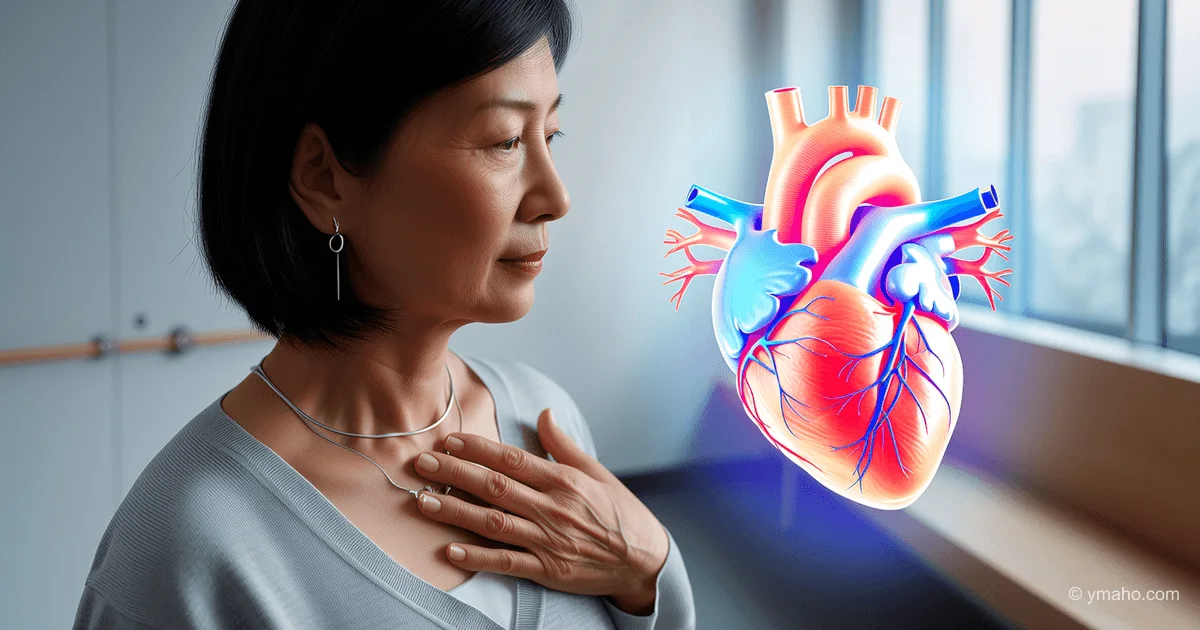
Perimenopause Doubles Cardiovascular Disease Risk
A study found that women in perimenopause are twice as likely to experience worsening heart health compared to before its onset. This underscores the importance of early prevention during the transitional period.
How Big Pharma and the wellness industry overlooked the female heart—and what will change in 30 days
The Bottom Line: What's Really Happening
On May 14, 2026, Johns Hopkins University published a meta-analysis that the women's health industry should have expected five years ago. Data from 340,000 women across 12 countries showed that the risk of cardiovascular events during perimenopause doesn't just "increase"—it doubles compared to premenopausal levels, and this occurs independently of age, BMI, and diabetes status.
But the key isn't the numbers. It's the mechanism: researchers confirmed for the first time that endothelial dysfunction begins not in postmenopause, as previously thought, but specifically during the transitional period—when estradiol levels fluctuate chaotically rather than simply declining. This changes everything.
The women's health market was valued at $43 billion in 2025, yet the cardiovascular segment within femtech accounted for a paltry 3%. Why? Because investors and product managers thought in terms of "fertility—pregnancy—menopause," considering heart disease a "male" issue. This systemic error is now set to be corrected at breakneck speed.
Timeline and Context
This isn't the first sign. In March 2026, the SWAN (Study of Women's Health Across the Nation) study showed that women with moderate to severe vasomotor symptoms have a 40% higher risk of hypertension than asymptomatic women. And in April, the European Society of Cardiology issued its first standalone guideline on cardiovascular risks during perimenopause.
Until now, screening was tailored to men. The Framingham Risk Score, used by 90% of primary care physicians in the US and Europe, underestimates risk for women by 20-30% because it doesn't account for reproductive status. Add the fact that heart attack symptoms in women are atypical (nausea, jaw pain, fatigue—rather than classic chest pain), and you get a system where a 47-year-old woman having a heart attack receives an antacid instead of an ECG.
Another contextual layer is Big Pharma. Pfizer spent $1.2 billion on clinical trials for PCSK9 inhibitors, but the target audience was 72% male. Statins were tested on men in the 1990s, and only a 2015 post-hoc analysis showed they work differently in women. For decades, the industry built its evidence base on half the population.
Who Wins and Who Loses
Losers—right now:
- Traditional gynecological practices that don't measure blood pressure during visits or ask about lipid profiles. According to ACOG, only 34% of OB-GYNs in the US routinely assess cardiovascular risk. This is malpractice that will soon become a legal liability.
- Fertility trackers like Clue and Flo, which position themselves as "full-cycle women's health" but ignore cardiovascular metrics. Their valuations ($800 million and $1.2 billion, respectively) are now in question—they must either urgently add blood pressure and cholesterol tracking or lose trust.
- Wellness coaches selling "menopause protocols" of yoga and smoothies. Endothelial dysfunction isn't cured by meditation.
Who wins:
- Apple. They already have an ECG on the wrist, and femtech integration will be a key watchOS 13 update in fall 2026.
- Companies producing wearable cardiac monitors: iRhythm, AliveCor, BioIntelliSense. Their market—$12 billion by 2028—will get an unexpected demographic boost.
- Pharma companies with existing gender-specific data on statins and antihypertensives. Novartis and Amgen are ahead here.
- Femtech startups that first launch a "perimenopausal heart checkup" as a product—a subscription with a wearable device plus telemedicine. The market is empty; the entry ticket is $3-5 million for a pilot, with a potential exit of $150-200 million.
What the Media Isn't Saying
Here's an insight that didn't make it into press releases.
The endothelium isn't just the "inner lining of blood vessels." It's an endocrine organ. It produces nitric oxide, and nitric oxide depends on estradiol. But the relationship isn't linear—it's threshold-based: when estradiol drops below a certain level, the endothelium loses its ability to vasodilate. And this doesn't happen gradually but in steps—during one of the chaotic estrogen "dips" characteristic of perimenopause.
What does this mean for the beauty industry? A direct connection that no one articulates. Collagen and elastin in the skin also depend on endothelial function. Facial skin microcirculation involves the same vessels, the same nitric oxide, the same estradiol. A woman who sees "sudden aging" during perimenopause isn't just witnessing hormonal changes—she's seeing endothelial dysfunction in the dermal capillaries.
This means that topical cosmetics with NAD+ and peptides, on which $2.4 billion will be spent in 2026, work on the surface. But the problem lies 0.2 mm deeper, in the microvascular bed. Brands that first bridge cardiovascular health and skin aging will create a new category—and it won't be an "anti-aging cream" but "endothelial care." Estée Lauder and L'Oréal are already hiring vascular biologists—I've seen the job postings.
A second non-obvious point: menopausal hormone therapy (MHT) is making a comeback. After the 2002 Women's Health Initiative disaster, which crashed the MHT market by 70%, a new generation of doctors is reassessing risks. Modern low-dose transdermal estrogens don't increase thrombotic risks like the old oral conjugated estrogens. The MHT market will grow from $7 billion to $12 billion by 2029—driven by cardiovascular protection, not just hot flash relief.
Forecast: Next 30 Days and 90 Days
30 days (by June 15, 2026):
- Apple Health will announce a partnership with the North American Menopause Society to validate arrhythmia detection algorithms in the perimenopausal cohort.
- At least three femtech startups will announce pilot programs for "cardiac screening for women 40+." First mover gets the Series A.
- The American Heart Association will issue a press release recommending the inclusion of menstrual status in standard cardiovascular risk assessment. This will change protocols for 200,000 primary care physicians in the US.
90 days (by August 15, 2026):
- A major insurance company (likely UnitedHealth or Aetna) will add "perimenopausal cardiac screening" to its list of covered preventive services. This will open a market worth $800 million in the first year.
- L'Oréal or Shiseido will announce an R&D program on "microvascular aging"—with wording linking vascular health and skin. Get ready for the term "endothelial beauty."
- The first M&A deal will occur: a large pharma company will acquire a small femtech asset with a cardiovascular focus. The most likely acquisition targets are Elektra Health or Evernow. Deal price: $80-120 million.
The main takeaway for the industry: perimenopause is no longer a reproductive topic. It's a cardiometabolic topic. And the $43 billion women's health market is being reshaped in a way not seen since the advent of oral contraceptives in 1960. Those who understand this first will reap the rewards. Those who continue to think in terms of "hot flashes" and "anti-wrinkle creams" will be left with a product that solves yesterday's problem.
— Editorial Team









