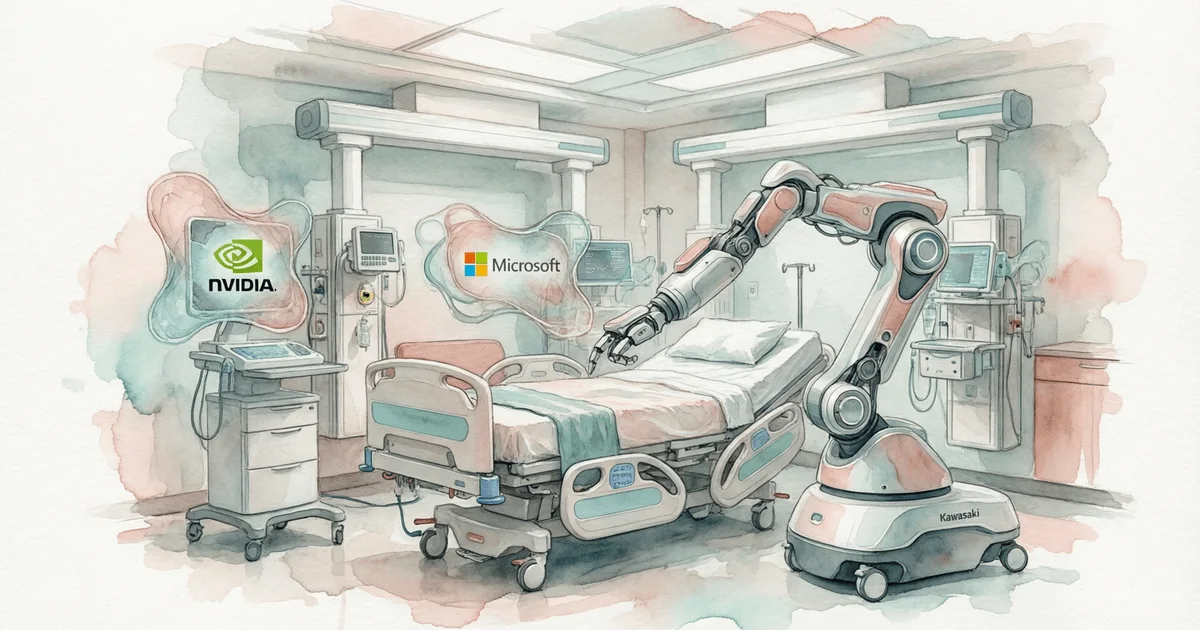
The Dawn of Physical AI in Medicine: Kawasaki, NVIDIA, and Microsoft Create a Robotic Hospital Assistance Center
A new alliance, the Physical AI Center, will develop "physical AI" for patient care. The focus is on creating a "turnkey hospital" service, including robotic systems for transportation, surgery, and postoperative care, marking AI's transition from analytics to real physical actions in hospital wards.
When AI grows arms and legs: Why Kawasaki, NVIDIA, and Microsoft are deciding the fate of medical robots right now
Analytical review from an industry insider
May 25, 2026
\[The gist]: What's really happening
Folks, forget about ChatGPT writing stories and Midjourney drawing pictures. On May 21, 2026, in San Jose, California, an event occurred that marks AI's transition from a virtual sandbox to the physical world, where the cost of a mistake is a human life.
Japanese industrial giant Kawasaki Heavy Industries opened the Kawasaki Physical AI Center San Jose. And this is not "just another R&D center." It is the first consortium in history where heavy robotics (Kawasaki), generative AI (NVIDIA), cloud infrastructure (Microsoft), sensor systems (Analog Devices), and business software (Fujitsu) have come together.
The essence of the strategy: "Physical AI" refers to autonomous systems that not only analyze data but act in the real world, perceiving the environment through sensors and making decisions on the spot. In medicine, this means the end of an era when a robot was controlled by a surgeon via a joystick. It is the beginning of an era when a robot understands what is happening in the operating room and helps make decisions.
And the first goal is not autopilots or factories (though they are on the list too). The first goal is a full-cycle hospital: from the reception desk to the operating room and the rehabilitation ward.
\[Timeline and context]
Why is this happening on May 22, 2026, and not a year ago? Because three technological factors have converged:
- Maturity of generative AI (NVIDIA Omniverse). Previously, to teach a robot to walk down a corridor or hand over instruments, every centimeter of the path had to be programmed. Now NVIDIA provides a physical world simulation technology — a robot can "train" in a virtual copy of the hospital a million times before being turned on in a real ward.
- Catastrophic labor shortage. The demographic gap in the US, Europe, and Japan has reached a critical point. Kawasaki directly cites "aging society and labor shortage" as the reason. There are physically not enough nurses to transport IV drips and turn bedridden patients.
- Kawasaki's existing hardware. They already have the hinotori surgical robot (Japan's answer to Da Vinci), the Nyokkey service robot, and the FORRO logistics robot. Until now, they just stood in hospitals as expensive toys. Now AI will give them "brains."
A telling moment is the market reaction. Kawasaki's shares surged on the news of the partnership. Investors believed that the "old factory conglomerate" is transforming into an AI-robotics company.
\[Who wins and who loses]
Winners:
- NVIDIA (Jensen Huang). This is the most elegant move to monetize AI through the "real world." Huang personally participated in the concept, stating that "the next frontier of AI is understanding the physical world and moving safely alongside people." NVIDIA sells not chips, but a simulation platform without which Physical AI cannot be trained.
- Yasuhiko Hashimoto (CEO of Kawasaki). His bet on transforming from a manufacturer of motorcycles and ships into an AI company looks brilliant. The 100 billion yen (about $650 million) in additional robotics investments announced in May are now paying off through collaboration with market leaders.
- Hospital network operators (HCA, Kaiser Permanente). They will get a real tool to reduce operating costs. One robot working 24/7 replaces 3-4 nurses in medication delivery.
Losers:
- Intuitive Surgical (Da Vinci). Yes, their surgical systems are the gold standard, but they are "dumb" — the robot does not understand what it is cutting. The Kawasaki hinotori, combined with NVIDIA, will gain computer vision and elements of autonomy (e.g., automatic camera holding or voice-activated tool changes). This is a direct hit to the premium segment.
- Small medical robotics startups. If you have a "smart cart" or a "robot orderly" but are not embedded in the NVIDIA Omniverse and Microsoft Azure ecosystem, you are dead. Venture capitalists will stop funding "hardware" without "brains."
- Junior medical staff (orderlies, attendants). History shows that robots first take the most routine and heavy work. Kawasaki does not hide that the goal is to help where there is a shortage of people. But those who remain will simply be robot operators paid hourly at half the current rate.
\[What the media isn't saying]
Now here is the inside scoop you won't find in press releases.
Problem: "Terminator" in the ICU — a legal and ethical time bomb.
When a robot controlled by Physical AI causes harm — and it will (knock over an IV drip, pinch a tube, cut the wrong artery) — who is to blame? Kawasaki, which built the "hands"? NVIDIA, whose AI made the wrong decision? Microsoft, whose cloud lagged for 100 milliseconds? The doctor who let the robot operate autonomously?
Insider info: Quietly, lawyers from Kawasaki, NVIDIA, and Microsoft are drafting indemnification clauses that will shift risks to the hospital and insurance company. This is a "death blow" for insurers. Until now, they insured human errors — a clear, statistically predictable quantity. Insuring errors from a "black box" (a neural network with billions of parameters) is something no one knows how to do. I predict that the first serious accident involving medical Physical AI will lead to a $50-100 million lawsuit and a temporary suspension by the FDA of all autonomous systems until a special regulation is developed.
Second point: Data is the new oil, and now robots will collect it.
The entire system is built on robots constantly collecting data about patients, rooms, and actions. NVIDIA and Microsoft will gain access to real medical tracks (sensor data, video, audio) on a scale never seen before. This will allow them to train even more powerful models but creates enormous risks of PHI (Protected Health Information) leakage. Hospitals that sign up for this are essentially leasing their data to Big Tech for decades.
\[Forecast: Next 30 days and 90 days]
Next 30 days:
A "talent hunt" will begin. Kawasaki will announce the hiring of top AI engineers in San Jose with salaries starting at $300k per year. NVIDIA and Microsoft will issue invoices for initial integration work. Stock prices of partner companies will continue to adjust upward.
Next 90 days (end of August 2026):
Expect the first public demo of the integrated system. Most likely at one of the clinics in California (partners of Microsoft or NVIDIA). A "seamless story" will be shown: a patient enters, is scanned by a reception robot, then a transport robot takes them to hinotori, and an assisting robot hands over instruments. This will be a teleconference with great fanfare.
Main risk: Cultural shock. Doctors and nurses, especially older generations, may sabotage implementation. The US nurses' union (National Nurses United) is already discussing a petition against autonomous robots behind the scenes. If they make a public statement, the FDA may slow down the certification process.
Forecast: May 22, 2026, is the "Lincoln moment" for medical robotics. Just as the launch of the first iPhone changed telephony, the Physical AI Center will change hospitals. In 5 years, a "hospital without autonomous robots" will seem as strange as an "office without the internet" today. But along the way, there will be casualties, scandals, and lawsuits. And the first one will happen within the next 2 years, as soon as a robot makes a mistake. Bookmakers, take your bets.
— Editorial Team









