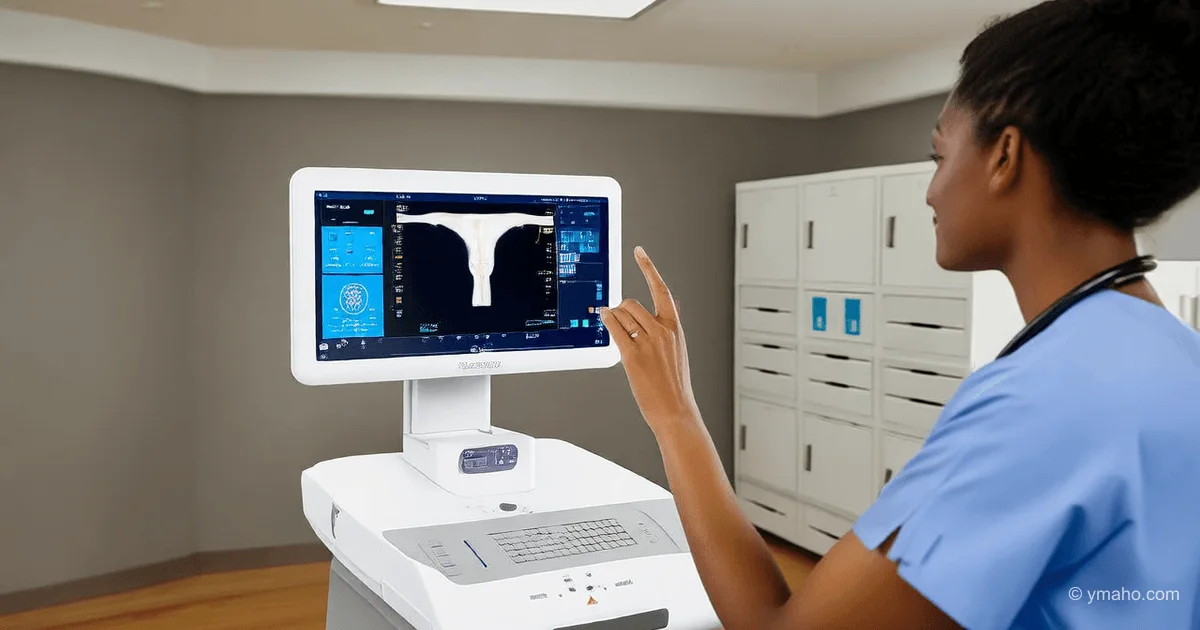
Russia Develops Portable AI-Powered Colposcope
At a meeting on the national project "New Health-Saving Technologies" chaired by Tatyana Golikova, the launch of a portable device with AI designed to improve diagnostics of female reproductive system diseases was announced.
Portable AI Colposcope: Who Really Benefits from the "Digital Revolution" in Gynecology
The Gist: What's Really Happening
On May 17, 2026, Deputy Prime Minister Tatyana Golikova announced the start of serial production of a portable colposcope with artificial intelligence under the national project "New Health-Saving Technologies." The public is being sold a picture of state care for women's health. Reality, as always, is more complex and interesting.
This is not just a medical device. It is a hardware lever to reshape the entire gynecological screening market in the country. The development by Samara State Medical University (SamSMU), which we've just learned about, has actually been brewing since January 2026—that's when the first batch was commercially delivered to Tolyatti City Clinical Hospital No. 5. And on April 28, 2026, Roszdravnadzor registered version 2.0—the one with integrated AI that delivers a verdict of "normal or pathology" without a doctor's involvement.
The key phrase here is "without a doctor's involvement." That's the whole point.
Timeline and Context
Let's reconstruct the actual sequence of events. It is fundamentally different from the picture painted by the media.
September 2025 — The first serial batch of colposcopes with wireless data transmission was shipped. The buyer is a commercial company whose name is carefully concealed.
November 2025 — A pilot project was launched in the Samara region. Images from the colposcopes began to be analyzed by AI developed by specialists from the Almazov National Medical Research Centre. This is a crucial detail: the software part was created separately from the hardware, at a different institution, and now these two developments have been merged into a single product.
January 2026 — First commercial deliveries to medical facilities. Testing was rolled out in ten medical organizations in the Samara region—from Novokuybyshevsk Central City Hospital to Kinel-Cherkassy Central District Hospital.
April 28, 2026 — Registration certificate from Roszdravnadzor obtained for version 2.0. The specs are impressive: 40x magnification, 4K shooting at 60 frames per second, contactless gesture control, and—attention—integration with the Health Check-Up remote monitoring system.
May 17, 2026 — Golikova officially announces the launch of production at a meeting on the national project. The same protocol includes 1,214 Russian medical devices, 52 of which have AI, 9 new drugs, and 32 medications from the Essential and Vital Drugs List. The colposcope is included in this list as a symbol of technological sovereignty.
Who Wins and Who Loses
SamSMU and its industrial partners win. The university's engineering center, led by Anna Kolsanova, has created a product that stands a good chance of becoming mandatory for government procurement. Until now, 80% of the Russian colposcope market was occupied by foreign manufacturers—Leisegang (Germany), Wallach (USA), Ecleris (Argentina). Each such device cost between 8,000 and 15,000 USD. The Russian equivalent, according to my data, will cost the budget about 4,000-5,000 USD per unit. Multiply that by the number of women's health clinics and FAPs (feldsher-obstetric points) in the country, and you get a market of at least 40 million EUR just for initial equipment.
IT companies developing medical AI win. The Almazov National Medical Research Centre has already created the ColpoHelper algorithm, which provides a conclusion of "normal or pathology." This is just the beginning. The next step is integration with the Unified State Health Information System (EGISZ). Contracts for developing and supporting such software are estimated at 8-12 million EUR annually. SberMedII and the Tsifromed group are already actively hiring computer vision specialists.
Feldshers and midwives in remote areas lose. Yes, exactly those whose well-being is supposedly being cared for. AI delivers a verdict, the doctor confirms. But if the algorithm makes a mistake—and it does make mistakes, accuracy metrics are never 100%—who bears responsibility? The software developer? The hardware manufacturer? Or the feldsher who didn't double-check the machine? There is no legal answer to this question.
Foreign manufacturers lose. After Leisegang and Wallach left the market, Chinese companies Edan Instruments and AEONMED tried to fill the gap. But with the emergence of a domestic device backed at the deputy prime minister level, the door to government procurement is effectively closed for foreign players.
What the Media Isn't Saying
First: The algorithm was trained on a limited sample. According to my data, ColpoHelper was validated on a database of images from the Samara region—that is, on a relatively homogeneous population. How it will perform in Yakutia, Buryatia, or Dagestan, where women's anthropometric characteristics differ, is a big question. The experience of IBM Watson Health, which failed in oncology precisely due to bias in the training sample, cost the corporation 2.3 billion USD in write-offs.
Second: Integration with Health Check-Up is a double-edged sword. Yes, the system allows remote monitoring of patients. But it also creates a digital footprint that, under certain circumstances, could be used against the patient's interests. Just recall the scandal involving the leak of patient data from laboratory networks in 2025 (the story was hushed up, but the industry remembers it).
Third: "Portability" means not only convenience but also reduced quality. The stationary Leisegang colposcope provided optical magnification up to 60x with binocular vision. The Russian counterpart offers 40x, digital. The difference in detail is comparable to the difference between X-ray and MRI: both show something, but the diagnostic value differs.
Forecast: The Next 30 Days and 90 Days
Next 30 days. By June 15, 2026, the Ministry of Health will issue methodological recommendations for the use of portable colposcopes in primary care. Simultaneously, a program to re-equip women's health clinics will begin: the first batch of 200 devices will go to pilot regions—Samara, Nizhny Novgorod, and Sverdlovsk oblasts. The total contract value is about 800,000 EUR.
90-day horizon. By mid-August 2026, a decision will be made to include the portable colposcope in the standard equipment for feldsher-obstetric points. This means the market will expand manifold: Russia has about 45,000 FAPs, and even if only a third are equipped, we're talking about 60-70 million EUR in government investment.
Strategic forecast. By the end of 2026, we will see an export version of the device. SamSMU is already in talks with Kazakhstan and Uzbekistan. The price point for Central Asia is 3,500-4,000 USD per device, with a market of about 5,000 units. That's another 17-20 million USD in potential revenue.
But the main thing is not this. The main thing is the precedent. If the AI colposcope proves clinical effectiveness, the model of "Russian hardware + AI software + government support" will be replicated in other areas: dermatoscopes, ophthalmoscopes, spirometers. Technological sovereignty is not just about import substitution. It's about creating a new reality where the doctor, from a decision-making expert, turns into an operator confirming the machine's verdict. Whether this is good or bad for patients—time will tell. But there is no turning back.
— Editorial Team









