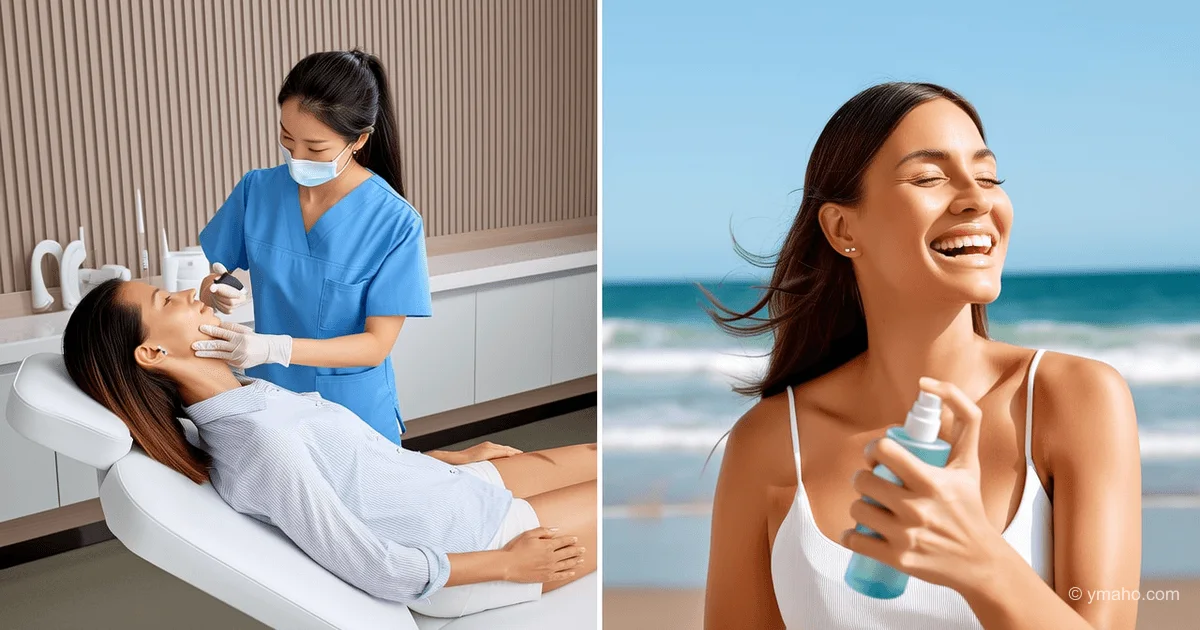
The Trend for Post-Procedure Care and 'Smart' SPF Protection in Cosmetics
At the NYSCC Suppliers' Day 2026 exhibition, a new trend for accelerated recovery products after aesthetic procedures was presented. A boom in sensory sunscreens with advanced UV filters is also expected.
How aesthetic medicine created a $1.8 billion market that traditional cosmetics don't see
The Essence: What's Really Happening
NYSCC Suppliers' Day 2026 — the largest B2B exhibition of ingredients and formulations in North America — will take place in New York on May 19–20. But the main news came not during the event, but a week before its opening. Industry insiders already know: two categories that were once considered niche are moving to center stage — post-procedure care after aesthetic interventions and next-generation sensory SPF protection.
This is not just "another exhibition with new creams." It's the moment when ingredient giants — BASF, Givaudan, Evonik, Univar, Inolex — are simultaneously betting on the same trend. When the five largest raw material suppliers simultaneously present solutions for skin recovery after procedures and "smart" UV filters, it's a signal. A signal of where the industry will direct $16 billion in R&D investments over the next five years.
The essence is simple: aesthetic medicine is growing explosively, and post-procedure care is its weak link. And whoever closes this gap first will capture a market worth $1.8 billion by 2032.
Timeline and Context
The history of this trend has been written since the mid-2010s, when laser cosmetology, chemical peels, and microneedling RF lifting ceased to be the domain of Hollywood stars and went mainstream. By 2025, the global post-procedure care market reached $1.2 billion. The average unit price is $180. This is not mass-market. This is a professional segment with margins that traditional cosmetics can only dream of.
In parallel, the SPF drama unfolded. The US FDA had not approved new sunscreen filters since 1999 — a quarter of a century. The American market was stuck in the last century, while Europe and Asia used modern photostable filters like bemotrizinol. In 2025, the FDA finally proposed allowing bemotrizinol in concentrations up to 6%. In 2026, this decision is expected to be finalized. This will open the floodgates.
At Suppliers' Day 2026, this became crystal clear. Givaudan brings PrimalHyal 300 — a medium molecular weight hyaluronic acid specifically designed to accelerate skin recovery after procedures. Evonik showcases Vecollage Fortify P — a type III collagen peptide that, according to the company, reverses the equivalent of six years of visible aging in 60 days. Inolex presents LexFeel Sunlight MB — a natural alternative to silicones for mineral sunscreens, solving the white cast problem. BASF bets on K-beauty ingredients. Supergoop, in a keynote presentation, explains how to turn SPF from a seasonal necessity into a daily ritual.
These are not isolated launches. This is a collective industry pivot.
Who Wins and Who Loses
Losers — right now:
- Traditional cosmetic brands without medical positioning. When a consumer after laser rejuvenation looks for "recovery," she goes to a dermatologist or pharmacy, not Sephora. Mass-market loses the most solvent audience.
- Manufacturers of old SPF formulas built on 1990s filters. Once bemotrizinol receives FDA approval, everything that was on the market before it will be perceived as outdated.
- Salons and clinics that do not offer their own post-procedure care line. They lose repeat sales and control over the outcome. The patient goes home and uses what she bought at the supermarket — then blames the clinic for poor results.
Who wins:
- Givaudan Active Beauty. Their PrimalHyal 300 is not just an ingredient, but a ready-made marketing narrative: "accelerated recovery after procedures." Clinics and brands will build entire lines around this molecule.
- Supergoop. The company that built a brand on the idea that SPF can be pleasant gets the perfect moment: the market is finally ripe for their philosophy.
- Dermatological brands like SkinCeuticals, iS Clinical, ZO Skin Health. They are already at the intersection of medicine and cosmetics. For them, post-procedure care is a natural line extension.
- Inolex and other manufacturers of natural silicone alternatives. The demand for sustainability and clean formulas has reached sun protection. Whoever has a biodegradable SPF ingredient will dictate terms.
What the Media Aren't Saying
Here's an insider insight that didn't make it into press releases.
Post-procedure care is not just "cream after a peel." It's a fundamentally different paradigm of skin interaction, and it will soon absorb traditional anti-aging. Why? Because aesthetic procedures create controlled damage. Fractional laser rejuvenation creates microscopic columns of thermal necrosis in the dermis. Microneedling RF creates hundreds of microchannels. Chemical peels create controlled burns.
During recovery after such treatments, skin permeability increases 15–20 times. This is a window of opportunity for active delivery that cannot be created with any patches or microcurrents. Ingredients applied within the first 48 hours after a procedure penetrate 4–7 times deeper than through intact skin.
What does this mean for the industry? It means post-procedure care is not a standalone category but a Trojan horse. Through it, professional concentrations of actives that were previously only available in a dermatologist's office enter the consumer's routine. Givaudan, Evonik, BASF understand this. They are not just selling ingredients — they are selling a new model of cosmetic consumption: "procedure + home care = result."
The second non-obvious point concerns SPF. Everyone talks about bemotrizinol being a breakthrough. But no one talks about why approval took 26 years. It's not about FDA bureaucracy. It's that sunscreen filters in the US are regulated as over-the-counter drugs, not cosmetics. This means each new filter must undergo clinical trials comparable to pharmaceuticals. The cost of bringing one filter to the US market is $40–60 million. That's what blocked innovation.
Now that the FDA is approving bemotrizinol, the door opens for a whole class of new filters. European Tinosorb S, Mexoryl XL, and others will get an accelerated track. This will change not only the American but also the global market: manufacturers will be able to make unified formulas for the whole world, rather than separate versions for the US and the rest.
Forecast: Next 30 Days and 90 Days
30 days (until June 15, 2026):
- May 19–20: NYSCC Suppliers' Day at the Javits Center. Nearly 700 exhibitors. Main announcements: Givaudan's PrimalHyal 300 presentation, Evonik's Vecollage Fortify P, dsm-firmenich's Parasol Shield, Inolex line. Supergoop and L'Oréal will give keynote presentations, and their theses will spread through industry media.
- Major dermatological brands will publish press releases about collaborations with ingredient suppliers presented at the exhibition. Expect announcements from SkinCeuticals and iS Clinical.
- One of the mass-market giants (likely Neutrogena or CeraVe) will hint at launching a post-procedure care line in partnership with a network of dermatology clinics.
90 days (until August 15, 2026):
- The FDA will publish the final decision on bemotrizinol. Approval is expected with a concentration limit of 6%. dsm-firmenich shares will rise 5–8% within a week of the announcement.
- The first products with bemotrizinol on the US market will appear not from Supergoop, but from EltaMD or La Roche-Posay — brands with medical distribution. They prepared in advance.
- Givaudan will announce the first commercial partnership for PrimalHyal 300 with a network of aesthetic clinics. The contract value is in the range of $15–25 million for the first year.
- The post-procedure care category on Amazon will grow 22–25% quarter over quarter. The marketplace will become the main channel for independent brands in this segment.
The main takeaway: we are witnessing the birth of a new ecosystem around aesthetic medicine. Previously, it was: procedure — and that's it. Now, the procedure is only half the product. The other half is recovery, and it costs as much as the procedure itself, if not more. Brands that understand this first will build a business at the intersection of cosmetology and dermatology with margins unattainable for traditional cosmetics.
— Editorial Team









