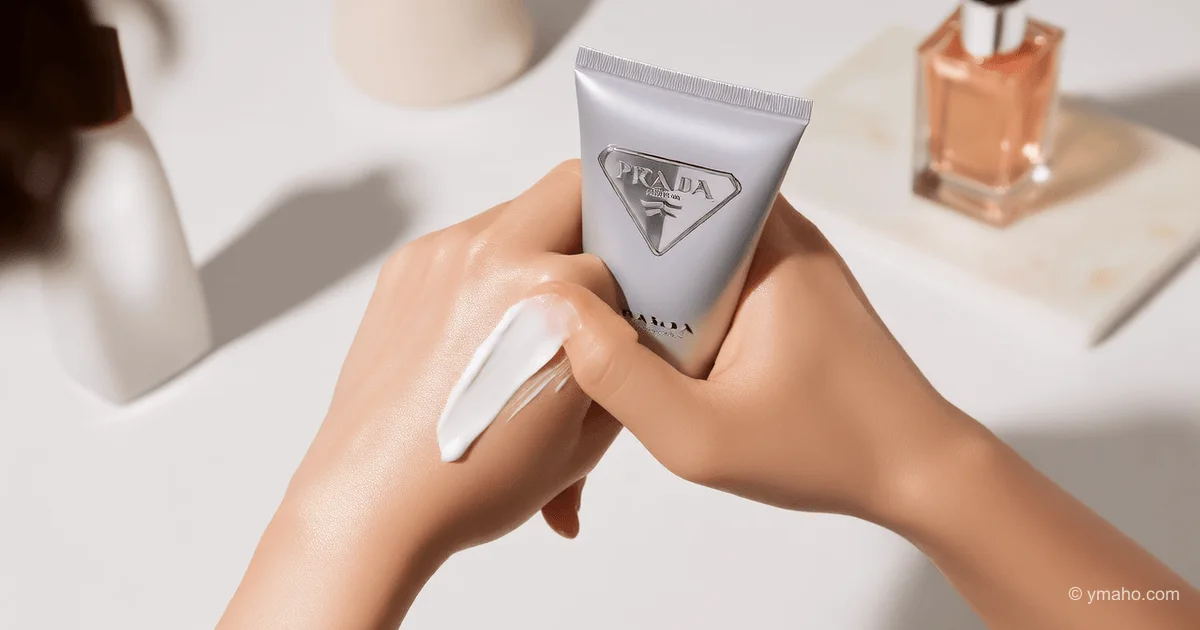
Prada Launches Perfumed Hand Cream with Paradoxe Scent
In summer 2026, Prada Paradoxe Hand Triple Care Hand Cream will be released, combining serum-level care with niacinamide and shea butter and the recognizable scent of the iconic perfume, acting as a beauty accessory.
Prada Paradoxe Hand Cream: How L'Oréal Turns Perfume Hype into a Goldmine of Care Accessories
The Gist: What's Really Happening
In June 2026, Prada Beauty launches Prada Paradoxe Hand Triple Care Hand Cream — a hand cream with the recognizable scent of the iconic Paradoxe perfume, niacinamide, and shea butter in its formula. At first glance, it's just a luxury accessory, a beautiful detail. But that's only the tip of the iceberg.
Underneath lies one of L'Oréal Group's most effective business tools. Prada Beauty operates under a licensing agreement with L'Oréal, and launching such a product reveals the strategy the group has been methodically implementing since 2021. The hand cream is a "gateway ticket" into the premium brand. Priced at 8,030 yen (about 52 EUR or 55 USD), it becomes the most affordable product in the Prada Beauty lineup. The mechanism is simple and proven: Chanel already did it with La Crème Main, Dior with Miss Dior hand cream, Hermès with the Les Mains Hermès collection. Now L'Oréal is turning this machine for Prada.
Timeline and Context
2021. L'Oréal and Prada sign a long-term licensing agreement to create and distribute beauty products. The group immediately signals its ambition — to go beyond perfumery and build a full-fledged luxury cosmetics brand.
2023. Launch of Prada Beauty with a focus on makeup and skincare. Systematic assortment building begins, but without perfumed body care.
October 2025. Prada Hand Triple Care Hand Cream is released — the first version without a specific scent. This is a test launch: L'Oréal checks if consumers are ready to pay for "just a cream" from Prada.
April 2026. Pre-sale of Paradoxe Hand Cream starts in Japan as part of a limited-edition set with a lip balm. Japan is chosen deliberately — it's the largest luxury hand care market in Asia, where hand care culture is almost ritualistic.
June 19, 2026. Official launch of Paradoxe Hand Cream in Japan on Prada Beauty's own channels. The formula is identical to the October version, but now the cream carries the DNA of the brand's main perfume hit.
July 3, 2026. Full-scale launch at all retail outlets in Japan. Global rollout follows within a month.
Who Wins and Who Loses
L'Oréal Group wins. The licensing model is a margin machine. L'Oréal pays Prada royalties (usually 5-8% of wholesale sales) but gains full control over production, distribution, and marketing. The cost of the cream at L'Oréal's volumes is no more than 4-6 EUR per 50 ml. Retail price is 52 EUR. Retail channel margin is 40-50%. Even after royalties, L'Oréal's operating profit on this product exceeds 60%.
Prada Group wins. Without investing a cent in development and production, the brand gets several things at once. First: a new entry point into the world of Prada for a younger audience. Second: expansion of the brand's presence in the consumer's daily life. Bag, phone, keys, hand cream — now Prada sits on the desk, not just on the perfume shelf. Third: a steady stream of royalties without any operational risks. A pure win-win from a business architecture perspective.
Perfume retailers win. Sephora, Douglas, Isetan Beauty get a product that generates traffic and has higher conversion than perfume because the price barrier is lower. Plus, hand cream is an ideal impulse buy at the checkout.
Niche hand care brands lose. L'Occitane, Aesop, Byredo, Diptyque — all built their positioning around naturalness, sensory experience, and ritual. When Prada enters this territory with a formula containing niacinamide and shea butter, and a scent crafted by top perfumers, the "niche" advantage melts away. Consumers find it easier to choose a familiar logo than to delve into a niche brand's DNA.
Mass-market hand care loses. Nivea, Neutrogena, Vaseline — their hand creams cost 3-5 USD. But a consumer who buys Paradoxe Hand Cream won't return to mass-market. They get used to the sensory experience, the scent that lasts an hour, the feeling of ritual. Thus, the luxury segment nibbles away at mass-market share from below — through "affordable entry."
What the Media Isn't Saying
First: the formula repeats the October cream, the only difference is the fragrance. The full ingredient list of Paradoxe Hand Cream has already been published by retailers. Niacinamide, shea butter, iris root extract, allantoin, hyaluronic acid — this is a solid but completely standard set for luxury hand care. Moreover, the exact same base is used in the non-perfumed version of Prada Hand Cream. The difference is a few milliliters of Paradoxe fragrance composition and a price 3-5 EUR higher. L'Oréal is essentially selling the same product twice.
Second: "dermatologically tested, suitable for sensitive skin" is a standard L'Oréal formulation, not a unique advantage. The formula contains a whole bouquet of potential allergens: linalool, geraniol, coumarin, limonene, citronellol, bergamot oil. These components give the Paradoxe scent its recognizable character, but they also make the cream unsuitable for people with reactive skin and a tendency to contact dermatitis. A consumer with sensitive skin, trusting the "suitable for sensitive skin" label, may experience irritation — because perfumed care for sensitive skin is almost always counterintuitive.
Third: the launch in Japan is not just respect for the market, but cold calculation. Japan is a country where gift culture and hand care have centuries-old traditions. The limited-edition set of cream + lip balm for 13,750 yen (about 85 EUR) is positioned as the perfect gift. Also, Japan is a testing ground for price ceilings. If a 52 EUR cream works here, it will definitely work in Europe and the US. The results of the Japanese launch will be used to calibrate the global strategy.
Forecast: Next 30 Days and 90 Days
Next 30 days (June 19 – July 19, 2026). Paradoxe Hand Cream will appear on the shelves of Japanese retailers — Isetan Beauty, @cosme SHOPPING, Tokyo pop-up stores of Prada Beauty. The limited-edition set with lip balm will sell out within the first two weeks thanks to collectors and Prada's loyalty audience. I estimate sell-out of the first batch at 15,000-20,000 units in Japan, generating about 800,000 – 1 million USD in revenue at launch.
90-day horizon (through mid-August 2026). The cream will appear in Europe and key travel-retail locations — airports in Dubai, Singapore, Frankfurt. Travel-retail is especially important: passengers in duty-free are less price-sensitive and more prone to impulse purchases. Paradoxe Hand Cream fits this format perfectly — compact, recognizable, affordable.
Strategic forecast. By the end of 2026, L'Oréal will release at least two more SKUs in the Paradoxe body care line — likely a body lotion and a shower oil. Then expansion to other Prada scents: Luna Rossa, Infusion d'Iris, Candy. Thus, L'Oréal will build an empire of perfumed body care under the Prada umbrella — exactly as already done for Armani, Yves Saint Laurent, and Valentino.
Key insight: Prada Paradoxe Hand Cream is not about the cream. It's about how luxury conglomerates turn perfume hype into a lifelong contract with the consumer. Whoever buys the cream today will buy the perfume tomorrow, the body lotion the day after, and a travel set in a month. And the entry ticket costs only 52 EUR. This is a brilliant business model: democratic luxury that subtly hooks the consumer onto the brand. And Prada is just one name on L'Oréal's long list. Next in line is Valentino.
— Editorial Team









