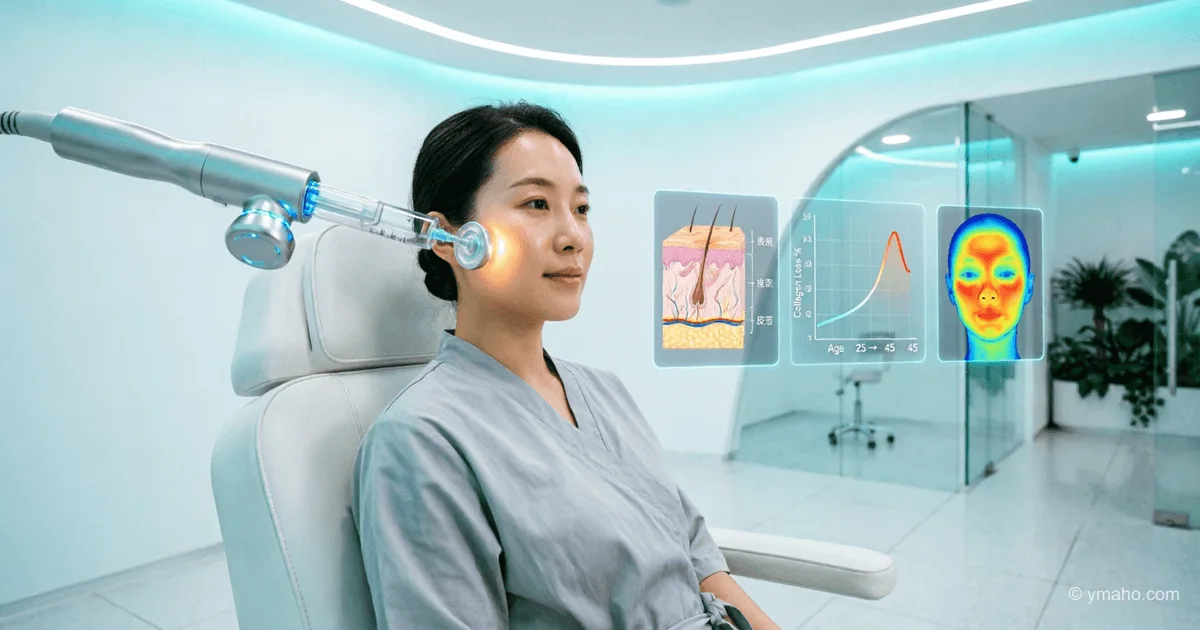
Predictive AI in Cosmetology and Personalized Protocols
Artificial intelligence has become the standard for skin diagnostics, allowing us to see deep layers and predict changes. Procedures are becoming hybrid (device + injections) to solve as many issues as possible in a single visit with zero downtime.
From Diagnosis to Prediction: How Predictive AI and Hybrid Protocols Are Changing Aesthetic Medicine
Introduction
Not long ago, a visit to a cosmetologist looked like this: the doctor visually examined the skin, sometimes with a magnifying lamp, and based on a subjective assessment, prescribed procedures. The result largely depended on the specialist's experience and intuition, and the patient had no way to look into the future and see how their skin would look in a year or after the proposed treatment.
Today, in 2026, this paradigm is crumbling. Artificial intelligence has become not just a buzzword, but a standard for diagnostics in aesthetic medicine. The main trend of the year, set at the largest industry congresses, is predictive analytics: AI not only sees the current state of the skin but also predicts changes, recommends protocols, and simulates results.
At the same time, there is a convergence of treatment methods: procedures are becoming hybrid, combining device technologies and injections in a single session. The goal is to solve as many problems as possible with zero downtime, so the patient leaves the clinic with results, not with swelling and bruises.
In this article, we will explore how AI is transforming diagnostics and prediction, what the new generation of hybrid protocols is, how the industry is reacting to these changes, and what awaits us in the near future.
Event Details and Timeline
Stage 1: First Steps of AI Diagnostics (2020–2023).
The first computer skin analysis systems could basically assess the number of wrinkles, pigmentation, and pores. They used simple pattern recognition algorithms but suffered from low accuracy and a lack of learning ability.
Stage 2: Data Accumulation and First Breakthroughs (2024–2025).
Companies began collecting huge datasets of clinical images. The first AI models trained on thousands, then millions, of skin photos emerged. Diagnostic accuracy approached expert level. For example, the Skinsight platform by Amorepacific and MIT was trained on over 450,000 cases of skin diseases.
Stage 3: Predictive Analytics and Personalization (2025–2026).
A key shift occurred when AI learned not just to diagnose but to predict. Models were developed that predict biological skin age from photos, as well as aging trajectories. A study published in Nature Communications showed that the AI tool FaceAge, which assesses facial aging rates, can predict survival in cancer patients. At the IMCAS 2026 congress in Paris, AI was placed at the forefront—main sessions were dedicated to AI-supported diagnostic systems, outcome prediction, and advanced image analysis.
Stage 4: Hybridization of Procedures (2026).
The next frontier was the integration of AI with device platforms and the emergence of hybrid devices. At the KIMES 2026 exhibition in Korea, Huons Meditech introduced Dermashine Duo RF—the first 2-in-1 hybrid device combining motorized injection delivery and radiofrequency (RF) treatment in a single unit. This allowed combining two procedures into one session, reducing treatment time and increasing efficacy through method synergy.
Impact and Significance (for the World, Industry, Society)
Impact on the Industry and Clinical Practice:
Predictive AI is fundamentally changing patient management. Previously, doctors reacted to existing problems; now they can anticipate them. AI models analyze not only the current skin condition but also exposome factors—UV radiation, humidity, temperature, mechanical stress—to predict future changes.
Moreover, as demonstrated by a study from Grupo Boticário, AI can evaluate the effectiveness of cosmetic products at the molecular level. Using machine learning, scientists developed a model that predicts biological skin age from proteomic profiles. Application of quinoa bioester for 30 days shifted the proteomic age of participants' skin by 11–16 years compared to the control.
Hybridization of procedures solves the problem of "piecemeal treatment." Previously, a patient would come for injections, then, a few weeks later, for RF lifting. Today, Dermashine Duo RF performs injection and immediately RF treatment. Clinical observations confirm: drug leakage decreased, and results surpassed injections without RF.
Economic Impact:
The economic effect is obvious: fewer visits, reduced overall treatment time, increased efficiency. For clinics, this means higher throughput and patient loyalty. For patients, it saves time and money.
CES 2026 marked the final transition of the beauty industry from traditional cosmetics to a technological ecosystem at the intersection of healthcare, data science, and wellness.
Impact on Society and Perception:
As noted by Anna Dycheva-Smirnova, an international expert, AI is changing the language of the industry: beauty is abandoning the rhetoric of miracles in favor of the language of measurements—temperature of exposure, speed, time, dynamics of changes. Consumers no longer believe abstract promises; they want to see numbers, graphs, and confirmed dynamics. Buying a cream becomes an investment with guaranteed ROI.
However, a counter-trend also emerges: the more advanced the technology, the more valuable live human communication and empathy become. Cosmetologist Anna Lene emphasizes that AI cannot create a genuine therapeutic bond.
Reactions of Key Players
Global Congresses and Scientific Communities:
IMCAS 2026 in Paris placed AI at the center of the agenda, holding sessions on AI-supported diagnostic systems, outcome prediction, and image analysis. The congress also showcased advanced imaging technologies, including high-precision multiphoton microscopy and 3D volumetric skin analyzers.
Device and Platform Manufacturers:
- Huons Meditech (Korea) introduced Dermashine Duo RF—a hybrid device combining injections and RF in one unit. 20,000 units have been installed worldwide, and the company plans expansion into Japan and Southeast Asia.
- Amorepacific, in collaboration with MIT, developed Skinsight—a platform for skin analysis using a sensor patch and AI, capable of assessing aging signs in real time. The company is also working on a smart mirror with Samsung.
- Quantum Orbit Labs presented Longos Sense—a device combining five technologies (RF, LED, ultrasound, thermo-, cryotherapy) and AI analysis that generates a personalized protocol in seconds. AI accuracy is comparable to a dermatologist consultation.
- Byome Labs (France) developed Byome Derma—a point-of-service for skin microbiome analysis in less than 3 minutes, quantitatively assessing 25 biological parameters.
Research Institutes:
The Society of Cosmetic Chemists held a webinar in March 2026 with Haut.AI CEO Anastasia Georgievskaya, dedicated to objective image analysis and predictive modeling of outcomes for cosmetic and dermatological procedures.
Russian Market:
Russia is also undergoing a technological shift. The LUUK app analyzes cosmetic ingredient lists from photos using AI, the brand Polubvi has implemented an algorithm for selecting peptide care based on selfies, and Magnit Kosmetik is scaling the BeautyScan service.
Forecast and Conclusions
What awaits us in the coming years at the intersection of AI, hybrid technologies, and aesthetic medicine?
- Full integration of AI into the diagnostic process. Smart mirrors and skin scanning systems will become standard both in clinics and at home. AI will not only diagnose but also predict individual aging trajectories, selecting prevention protocols.
- Growth of the hybrid device market. "2-in-1" devices (injection + RF, laser + ultrasound) and "5-in-1" (Longos Sense) will become mainstream. Clinics will invest in platforms that allow comprehensive treatment in a single visit.
- Personalization at the microbiome level. Technologies like Byome Derma will enable real-time skin microbiome analysis and offer hyper-personalized formulas.
- Store as a mini-factory. Robotic on-site serum mixing systems (like SmartSKN) will become the norm in premium and mass markets. Consumers will receive a product created for their current epidermal condition, even accounting for city air humidity.
- Preservation of the human role. Despite technological advancement, the doctor's key role transforms: from procedure performer to creator of a personal aesthetic strategy, where AI is a powerful tool, not a replacement. Empathy, clinical thinking, and the art of aesthetic harmony will remain unique human competencies.
Conclusion:
2026 has become a point of no return for aesthetic medicine. Predictive AI has turned skincare from a realm of guesswork and subjective assessments into an exact, measurable science. Hybrid protocols have made treatment more effective, faster, and more comfortable for patients. The industry has moved from promises to evidence, from masking problems to predicting and preventing them. The future that science fiction writers once wrote about has already arrived—and it is personalized, technological, and, most importantly, it works.
— Editorial Team









