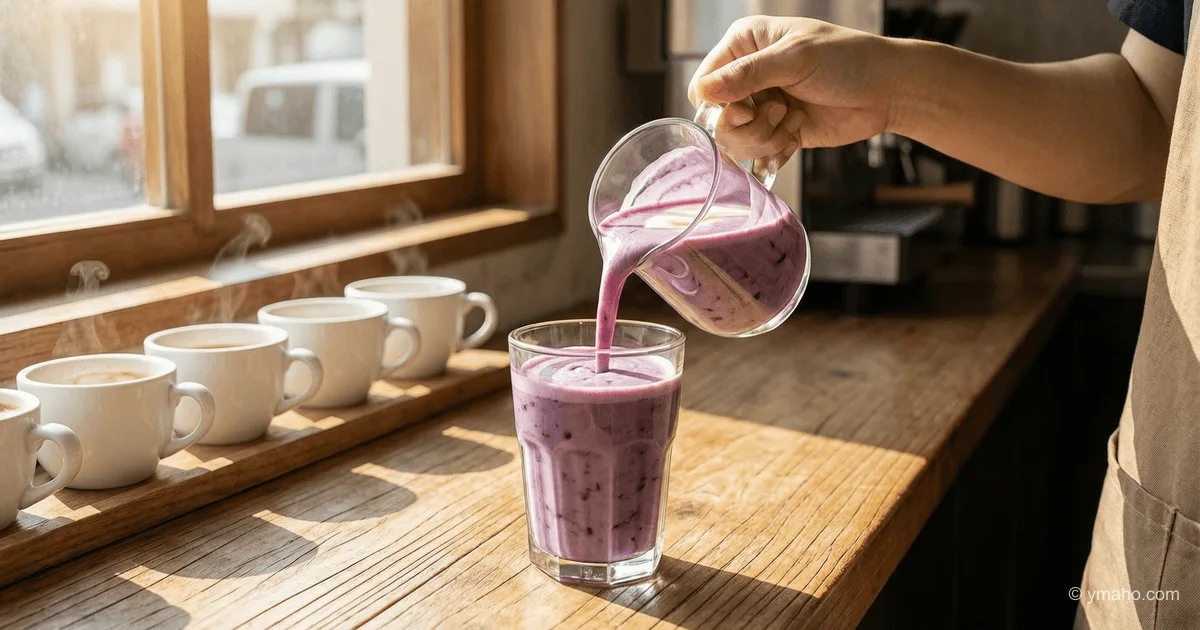
Purple Yam Ube Coffee Is Becoming Trendy
Drinks with added Philippine purple yam have flooded social media. Dietitians note that ube contains fiber and antioxidants, but the drink's health benefits depend on the amount of added sugar and cream.
Instagrammable root vegetable: how purple yam became the perfect business product — and why its scarcity is more profitable than abundance
The gist: what's really happening
Purple yam ube coffee, which has flooded social media this spring, is not a gastronomic phenomenon. It's a perfect market construct where three forces converge: the visual hunger of social platforms, audience fatigue with matcha, and the harsh economics of scarcity. What the media present as a "new superfood" is actually a textbook case of supply management in the age of viral consumption.
Ube drinks have appeared on the menus of 95 US restaurant chains, and mentions of the root vegetable on American menus have grown by 230% over four years. Starbucks, after testing limited offerings in 2025, expanded its spring 2026 lineup to include Ube Matcha Latte and Ube Vanilla Macchiato. Peet's Coffee launched an Iced Vanilla Latte with ube topping. Audience interest on social media has reached such a fever pitch that research firms report: 49% of British consumers are ready to buy an ube drink immediately after seeing it on social media — a conversion rate any direct sales product would envy.
The key here is not the root vegetable itself, but the trend's architecture, built on three pillars: visual virality, safe novelty, and controlled supply.
Timeline and context
Ube has a centuries-old history in the Philippines, but its Western biography spans just a few years. Datassential has tracked the flavor since 2017, when it appeared only in authentic Filipino bakeries. In 2022, Baskin-Robbins released a limited-edition Ube Coconut Swirl ice cream — the first major mass-market validation of the trend. In March 2026, according to Datassential, a record month for limited-time offers featuring ube in major chains was recorded.
The sharp spike in interest in February-March 2026 was no accident. It was preceded by a matcha shortage in 2025, which forced coffee chains to urgently seek a visually competitive alternative. Ube, with its bright purple color, mild nutty-creamy flavor, and zero habit-forming threshold, proved the ideal candidate. Unlike matcha, with its bitter profile that requires time to "acquire the taste," ube is instantly likable.
Concurrently, in April 2026, the government of Camarines Sur province in the Philippines passed a special ordinance declaring ube a priority agricultural crop with a program to create a complete value chain "from farm to export." The goal is to replicate Japan's success with matcha and turn the root vegetable into an export brand. This is not a manifestation of the trend, but an institutional bet that the trend will last.
Who wins and who loses
Winners are coffee chains and major F&B brands. Starbucks, Peet's, and other chains have gained a new must-have product for their spring lineup with margins that can significantly exceed standard items — the bright color and trendy status allow for a premium markup. Ube powder and paste suppliers also benefit: Philippine exports of ube and ube-based products grew by about 20% in 2025 compared to the previous year.
Marketing agencies and food consultants get a perfect case study: "How we made ube the new matcha." Investors who got into Philippine ube processing early are seeing raw material prices rise.
Losers — and this is the most interesting aspect — are small entrepreneurs trying to jump on the trend now. A French entrepreneur, inspired by an ube drink at a coffee shop in Istanbul, spent months searching for a supplier and faced market opacity, the risk of substitution with purple sweet potato or taro, and limited volumes. The price of ube has risen 38% compared to 2024. The entry ticket to the trend has become sharply more expensive.
Filipino farmers also lose, despite the apparent boom. Ube production in the Philippines has been steadily declining: from 14,150 metric tons in 2021 to 12,483 tons in 2025, a drop of 1.63% in the last year alone. The reasons are climate change, making weather patterns unpredictable, and a shortage of quality planting material. Farmers are not rushing to expand plantings: ube takes 9 to 12 months to grow, unlike fast-growing crops like potatoes. Young people are not drawn to agriculture, farmers in remote regions lack access to international markets and sell to middlemen. The country is even forced to import some ube from Vietnam to meet local demand.
The main paradox: global demand is soaring while production is falling. This is a structural imbalance that will only deepen.
What the media aren't telling you
The first non-obvious insight: ube scarcity is not a problem for the trend, but its fuel. Unlike mass agricultural crops where scarcity destroys the category, for an "Instagrammable" product, limited supply works to amplify the trend. Inaccessibility creates hype, hype creates content, content creates demand — and so on in a circle. Starbucks and Peet's release limited-time offers not because they can't ensure a steady supply, but because scarcity is part of the marketing mechanics. When the season ends, the product ends, and consumers will wait for the next one.
The second insight: ube wins not because it's healthier than matcha, but because it's safer for the consumer. Matcha requires taste adaptation — its bitter profile, even softened by milk in a latte, doesn't appeal to everyone. Ube is sweet, creamy, with notes of vanilla and pistachio — a "safe experiment." In an era of rising consumer anxiety, a product with zero risk of a negative experience gains a competitive edge. Dietitian Komal Malik from Asian Hospital puts it mildly: "In small amounts, ube adds nutritional value, but it's not a magic ingredient. It's partly healthy, but largely trend."
The third insight is the deepest. Ube as a trend is less about taste and more about photogenicity in an era of alcohol abstinence. Andrew Freeman, founder of consulting firm AF&Co, notes: "People are drinking less, coffee shop culture is returning. Coffee has ceased to be a functional drink and has become 'what can I put on top? What can I froth?' All so the drink gets photographed and goes viral." Color almost guarantees reach; for the audience, taste hardly matters. Ube is a product for a generation that drinks less alcohol and more coffee, but demands from coffee the same visual spectacle that cocktails once provided.
The fourth insight: the market itself constructs scarcity. Filipino farmers refuse to expand plantings not only because of climate and lack of support. With a 9-12 month growing period and rising energy costs (the Middle East conflict affected more than half of Asia's energy imports, and the Philippines declared a state of emergency in the energy sector), it's easier for farmers to grow something with a faster turnaround. The result: global demand stimulates not production growth, but price increases amid falling volumes. A classic case of market failure disguised as a "trend."
Forecast: next 30 days and 90 days
30 days (by June 7, 2026). The summer season will strengthen ube's position: the purple color contrasts beautifully with white, yellow, and green in summer content. Coffee shops will start introducing cold brew with ube and non-alcoholic ube-based cocktails with coconut milk. The hashtag #ube on TikTok will cross 130,000 posts (currently 120,000), and on Instagram will approach 800,000. At least 3-4 new formats will appear: ube ice cream in major dessert chains, ube yogurts, ube protein smoothies in fitness cafes. Starbucks, after reporting quarterly sales of its spring lineup, will likely announce an expansion of ube offerings into fall.
Small entrepreneurs will face reality: wholesale purchasing of ube powder or paste will become even harder, minimum order quantities will increase, and authenticity will be increasingly difficult to verify. The first scandals involving "fake ube" will emerge — cases where menus feature purple sweet potato or dyed taro disguised as ube.
90 days (by August 7, 2026). The end of summer is a critical point. If Starbucks extends ube into fall, the trend will get a second life and solidify as an analog to seasonal pumpkin spice. If not, a saturation phase will begin, followed by the first articles along the lines of "tired of purple, what's next?" Ube will follow matcha's trajectory: from ultra-trendy exotic to a basic menu item. But with one caveat: matcha could be scaled because the Japanese tea industry was ready for expansion. The Philippine ube industry is not.
By fall, we can expect:
- Ube powder prices rising to 45-50% above 2024 levels
- The first appearance of "lab-grown ube" — extracts and flavorings from flavor houses for industrial use
- Migration of the trend into home consumption — DIY ube latte kits in retail
- First VC investments in ube plantations outside the Philippines — Vietnam and Indonesia as new sources
Final takeaway: ube is the perfect business product. Its value is created not in the field or the factory, but in the feed. Scarcity doesn't kill the trend; it fuels it. The consumer who can't find ube at three coffee shops in a row becomes a free generator of content and demand. This is not food science; it's platform economics. And the winner will not be the one who grows the most yam, but the one who best manages its absence.
— Editorial Team









