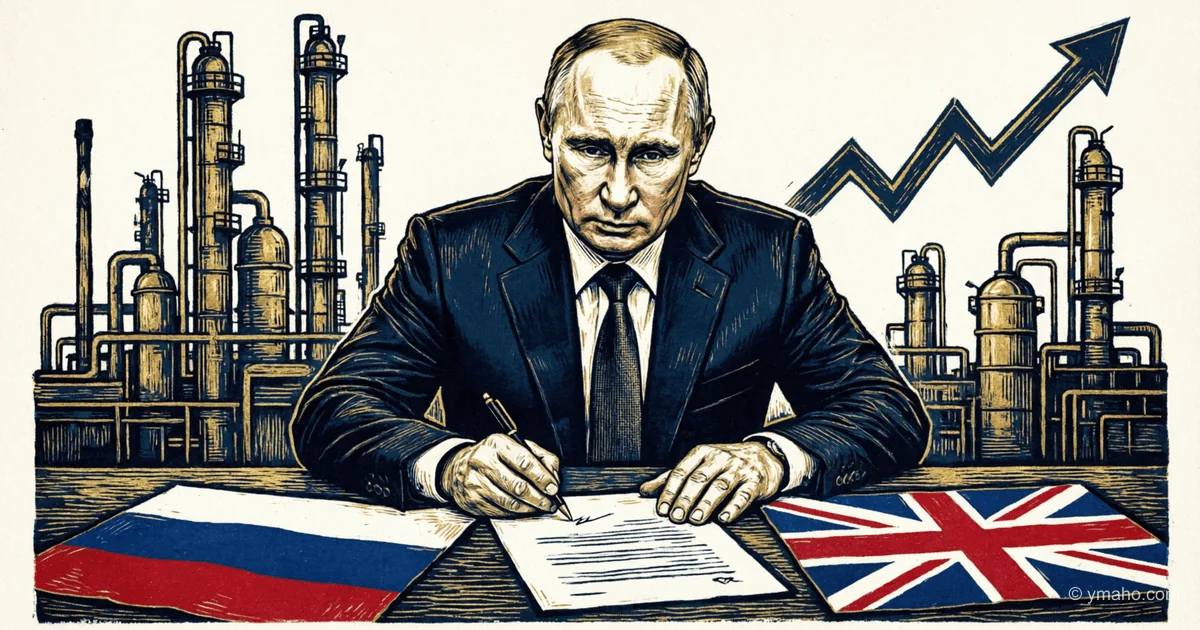
Putin Allows Russian 'Kompozit Sistem' to Buy Back Shares of Petrochemical 'Ektos' from British Company
The president signed an order allowing Kompozit Sistem to buy back 24,120 shares of fuel component manufacturer Ektos from its sole shareholder, Composite System, registered in the British Virgin Islands. Ektos produces over 1.5 million tons of products annually.
An $8 Million Deal That Changes the Rules: How Putin Just Legalized a New Kind of Raiding
Opinion of an independent analyst, May 25, 2026
On May 24, 2026, an event occurred that most media dismissed as a routine order. Vladimir Putin signed a document allowing the Russian company Kompozit Sistem to buy back 24,120 shares of petrochemical firm Ektos from the British company Composite System, registered in the British Virgin Islands.
The deal amount has not been officially disclosed. But given that Ektos produces over 1.5 million tons of products annually (fuel components and liquefied gases) and the scale of its operations, we are talking about a deal conservatively estimated at $7-10 million. From a global M&A perspective, that's pocket change. But as an analyst tracking the transformation of Russian corporate law under sanctions, I see not just a deal, but the legalization of a new asset repatriation mechanism that will change the ownership landscape in strategic industries.
Let's break down what this document really means.
[The Gist]: Who Is Actually Buying and What Remains Behind the Scenes
What is really happening? Formally: the Russian legal entity JSC Kompozit Sistem (TIN 9729354290) is buying a 100% stake in OJSC Ektos from the British offshore company Composite System.
But let's look at the structure. Kompozit Sistem was registered in Moscow on September 12, 2023 — exactly six months after the start of full-scale sanctions pressure on Russian assets abroad. Its sole founder and CEO is Vadim Vladimirovich Batrak.
Now here's the key nuance: this same Batrak is already the CEO of Ektos. So the picture is:
- An offshore company in the BVI (Composite System) owns Ektos.
- The CEO of Ektos (Batrak) creates the Russian company Kompozit Sistem in 2023.
- Putin signs permission to buy back shares from the offshore.
- Now Ektos comes under the control of Batrak's Russian company.
Non-obvious insight:
This is not a "buyout from a British company." It is the legalization of long-existing beneficial ownership. In all likelihood, Vadim Batrak has been the ultimate beneficiary of Ektos all along — through a chain of nominee holders in the BVI. Sanctions against Russia (including UK sanctions, which tightened against a number of Russian individuals since November 2025) made ownership through British jurisdiction toxic. Banks refused to process payments, counterparties feared secondary sanctions. The only way to maintain control over the asset was to "re-dress" it in a clean Russian registration.
So Putin signed the order not because the deal was large, but because without presidential permission, such an operation would have been impossible — offshore structures in unfriendly jurisdictions fall under the restrictions of Decree No. 520 "On the Application of Special Economic Measures." Now it's all legal.
Timeline and Context: How the Deal Was Prepared
September 12, 2023: JSC Kompozit Sistem is created with an authorized capital of 4 million rubles. Its main activity is managing holding companies. That is, it's a classic SPV (special purpose vehicle) for a holding structure.
2023-2024: Ektos continues operations, producing over 1.5 million tons of products annually. However, Western banks increasingly block transactions related to the company due to its BVI connection.
November 2025: The UK imposes new sanctions against Russian individuals (including amendments to lists on November 24 and 28, 2025). Although Batrak himself is not directly mentioned in the sanctions lists in these documents, the BVI jurisdiction itself becomes a "gray zone" for settlements.
May 2026: Putin signs the order. Kompozit Sistem receives permission to buy back 24,120 shares of Ektos.
Who Wins and Who Loses
Winners:
- Vadim Batrak (ultimate beneficiary). He has legalized his control over Ektos in the new reality. Now the asset is independent of British jurisdiction, does not require approval from offshore banks, and is not subject to the risk of freezing under EU or US sanctions. His legal risk has decreased by an order of magnitude.
- Russian tax authorities. Now Ektos will pay taxes in Russia in full, without optimization schemes through the BVI. Dividends from Ektos will go to Kompozit Sistem, and from there to Batrak's pocket after paying 13-15% personal income tax. For the budget, this means an additional several million dollars per year.
- The state as a whole. Control over a strategic enterprise (fuel components) is maintained. The asset does not go under external management or go bankrupt.
Losers:
- British Composite System (formally). It lost 100% of Ektos shares. But since in reality it was likely a nominee holder for Batrak, there are no actual losses.
- Western regulators. They tried to isolate Russian assets through sanctions against offshore structures. This deal shows that Russia has found a legal workaround: the state grants an "indulgence" to exit unfriendly jurisdictions. Now any owner of a Russian asset registered in the BVI, Cyprus, or Luxembourg can apply for similar permission.
What the Media Isn't Saying
Three important circumstances.
1. Ektos is not alone.
According to unofficial monitoring, similar applications for "relocation" from offshore have been submitted for at least 15-20 other Russian industrial assets in 2026. Petrochemicals, machinery, IT. This deal sets a precedent. Now the Kremlin has a template: "We allowed Batrak, so we'll allow others."
2. The deal price is likely heavily undervalued.
Ektos produces 1.5 million tons of products. Even if the average price of fuel components is $500 per ton (conservative), annual revenue is $750 million. Profit is about 5-10% margin, i.e., $37-75 million per year. A normal valuation for such a business is 3-5x annual profit, i.e., $150-300 million. But the buyout appears to be for a symbolic $7-10 million. This is a classic inside deal — a transaction at face value because the real owner is the same.
3. Risk for other shareholders of companies with offshore structures.
Now any minority shareholder who owns a stake in a Russian asset through a foreign nominee may wake up one day to find their stake "re-registered" to a Russian legal entity without their consent — "in the interests of national security." This creates a precedent for forced redomiciliation.
Forecast: Next 30 and 90 Days
30 days (June 2026):
Expect a series of similar presidential orders for other assets. Watch for publications on the legal acts portal. Most likely candidates: fertilizer producers with Cypriot registration and logistics companies with Lithuanian registration. Also expect a statement from Batrak or Ektos about development plans — now that the ownership structure is "clean," the company may qualify for state support.
90 days (August 2026):
Ektos may be included in the import substitution program or gain access to concessional loans from VEB.RF. Given the strategic nature of its products (fuel components), the company may qualify for systemically important status. For shareholder Batrak, this means a 2-3x increase in capitalization within a year — not through market mechanisms, but through administrative resources.
Editorial Forecast
Asset: Shares of Russian petrochemical companies with offshore ownership structures (e.g., some methanol and MTBE producers).
Direction: Stock prices up 2-4% in the next 48-72 hours on news of "removing the offshore discount" and reducing sanctions risks.
Key levels: Companies with over 50% offshore ownership may see a 5-7% premium to the market.
Confidence: Low (40%) — the deal was targeted and non-public; the market may simply not notice this signal.
Main risk: If the West views this deal as "expropriation without compensation" and imposes personal sanctions on Kompozit Sistem or Batrak, all positive effects will be nullified. Moreover, other companies planning similar "relocations" will freeze the process, fearing US blocking sanctions.
This is an editorial opinion and does not constitute investment advice.
— Editorial Team









