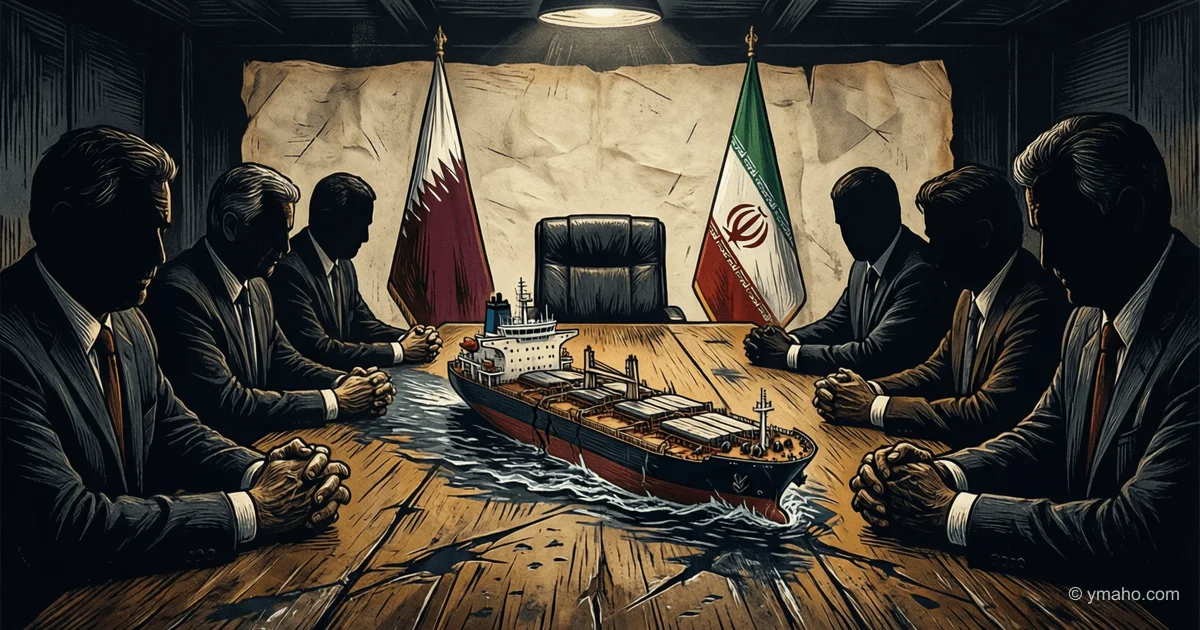
Qatari delegation arrives in Tehran for peace settlement
A negotiating team from Qatar, coordinating with the United States, has arrived in Tehran to facilitate a deal between the US and Iran and resolve outstanding disputes.
Qatari démarche: why Doha returned to the negotiating table with Iran and what it means for the market
[The gist]: what is really happening
The news of the Qatari negotiating team's arrival in Tehran on May 21–22 looks like another diplomatic gesture. But for those who see not headlines but liquidity flows, there is something much more significant hidden here.
Qatar has made a sharp 180-degree turn. Just a month ago, Doha officially distanced itself from mediation after Iran attacked Qatari LNG infrastructure at Ras Laffan with missiles and drones. Qatar's losses from these strikes amount to about 17% of its LNG export capacity, which in monetary terms means roughly $4–5 billion in lost revenue since the start of the war.
And now the same Doha is sending a delegation to Tehran in coordination with Washington. This is not just a change of mood — it is a cry for survival.
The bottom line is that Qatar realized the blockade of Hormuz is killing its economy faster than anyone else's in the region. Saudi Arabia has the East-West oil pipeline with a capacity of 5 million barrels per day. The UAE has a pipeline to Fujairah. Qatar has no alternative for LNG exports. Its gas is trapped inside the Persian Gulf as long as Iran controls the strait. Every day of the blockade costs Qatar about $80–100 million in lost LNG revenue.
So Doha returned. Not out of altruism, but out of pure pragmatism.
Timeline and context
To understand why this visit is not just another round of negotiations, let's reconstruct the chain of events over the past two weeks.
May 9, 2026 — Marco Rubio, Steven Witkoff, and Qatari Prime Minister Mohammed bin Abdulrahman Al Thani meet in Miami. Trump personally pressures the Emir of Qatar to return to mediation after Doha announced its withdrawal from the process.
May 21, 2026 — Rubio speaks at the NATO summit in Helsingborg, stating there are "some encouraging signs" in negotiations with Iran.
May 21–22, 2026 — The Qatari delegation arrives in Tehran. Simultaneously, Pakistan sends its army chief, Field Marshal Asim Munir, to the Iranian capital.
Non-obvious insight: Qatar and Pakistan are acting as two parallel but coordinated channels. Pakistan is the official mediator working with Iran's political leadership. Qatar is the unofficial channel with direct access to the generals of the Islamic Revolutionary Guard Corps (IRGC). This division of labor is no accident: the IRGC is the real power in Iran, and no deal is possible without their approval. Qatar is the only country in the region that has maintained this channel even after Iran attacked its territory.
Who wins and who loses
Qatar itself wins — but only if the deal is signed. The stakes for Doha are enormous: restoring LNG exports through the Strait of Hormuz, which provides up to 80% of Qatar's state revenues. Bloomberg Economics analysts estimate that each month of the strait blockade costs Qatar $2.5–3 billion in direct losses plus penalties for failing to fulfill long-term contracts with Asian buyers.
The Trump administration wins publicly. Qatari mediation allows Washington to show that "Arab allies are on our side," even if behind the scenes those allies are panicking over their economic losses.
The UAE loses — and this is an important nuance that no one discusses. Abu Dhabi this week joined Saudi Arabia and Qatar in urging Trump not to resume strikes on Iran. But there are serious disagreements among the Gulf states over the deal itself. The UAE insists that any agreement must cover the "full spectrum of threats" from Iran — including ballistic missiles, drones, and proxy forces. Qatar, on the other hand, is ready for a "stripped-down" deal that only opens the strait. This contradiction could become a bone of contention if negotiations drag on.
A quiet win for China. While the US and Iran haggle, Chinese companies continue to receive Iranian oil via a "shadow fleet" at a 30–40% discount to market. Qatari mediation does not change this fact. Beijing watches calmly.
What the media are not saying
The biggest omission in all the news is that Qatar returned not to "help the world," but to save its economy from collapse.
According to sources from Vietnam.vn, Iran attacked Qatar's key LNG production facility at Ras Laffan during the war, causing Qatar's export capacity to drop by about 17%. Before the war, about 20% of the world's LNG passed through the Strait of Hormuz, and almost all of that volume came from Qatar. Iran closed the strait — Qatar lost its market. This is not geopolitics. This is bankruptcy within 6–12 months.
The second omission: the Qatari delegation in Tehran is not so much negotiating with the government as with the IRGC. Qatari representatives, as Axios reports, communicate directly with senior generals of the Islamic Revolutionary Guard Corps. It is these military figures who have decisive influence over Tehran's decisions. Qatar is the only mediator with such access. That is why Washington so persistently asked Doha to return.
Third, and most importantly: President Trump on May 22 canceled plans to attend his son's wedding and remained in Washington, convening a national security meeting. The military canceled leave. However, according to Bloomberg, the leaders of Saudi Arabia, the UAE, and Qatar in separate calls persuaded Trump not to strike Iran and to give diplomacy another chance. The Qatari mission is the result of this pressure. If it fails, Rubio's "Plan B" could be activated within days.
Forecast: next 30 days and 90 days
30 days: An agreement on the formula "freedom of navigation in exchange for vague wording on uranium" will be reached within 1–2 weeks. Qatari mediation will be the catalyst that pushes the deal through the IRGC. Expect an announcement in the first ten days of June 2026. This is already priced into current oil prices.
90 days: Once the strait is unblocked, Qatar will return its LNG volumes to the market. This will coincide with Iranian oil at 1.5–2 million barrels per day. Gas prices in Europe and Asia will fall by 20–30% from current levels. Long positions on natural gas (Henry Hub, TTF) are now a risky entry. Smart money is already taking profits and moving to short positions with a 3–4 month horizon.
Editorial forecast
Asset and direction: LNG futures (TTF, Henry Hub) — short-term sideways followed by a decline in 2–4 weeks.
The Qatari negotiating mission increases the likelihood of unblocking the Strait of Hormuz within 2–3 weeks, which will pave the way for the restoration of Qatari LNG exports. However, in the next 24–72 hours, the market will wait for concrete results, so volatility will remain high.
Key levels: TTF — 35–38 EUR/MWh. A break below 34 EUR/MWh will signal the start of a correction.
Confidence level: Medium (60%). Qatar has returned to the table, but that does not guarantee success. Negotiations could collapse at any moment.
Main risk to the forecast: If the Qatari mission fails and Trump activates "Plan B" (military strikes), LNG futures will surge 15–20% in 48 hours. If a deal is signed, they will fall 10–15% in the same week. Watch for statements from Doha and Tehran in the next 48 hours — that is where the first indicators will appear.
— Editorial Team









