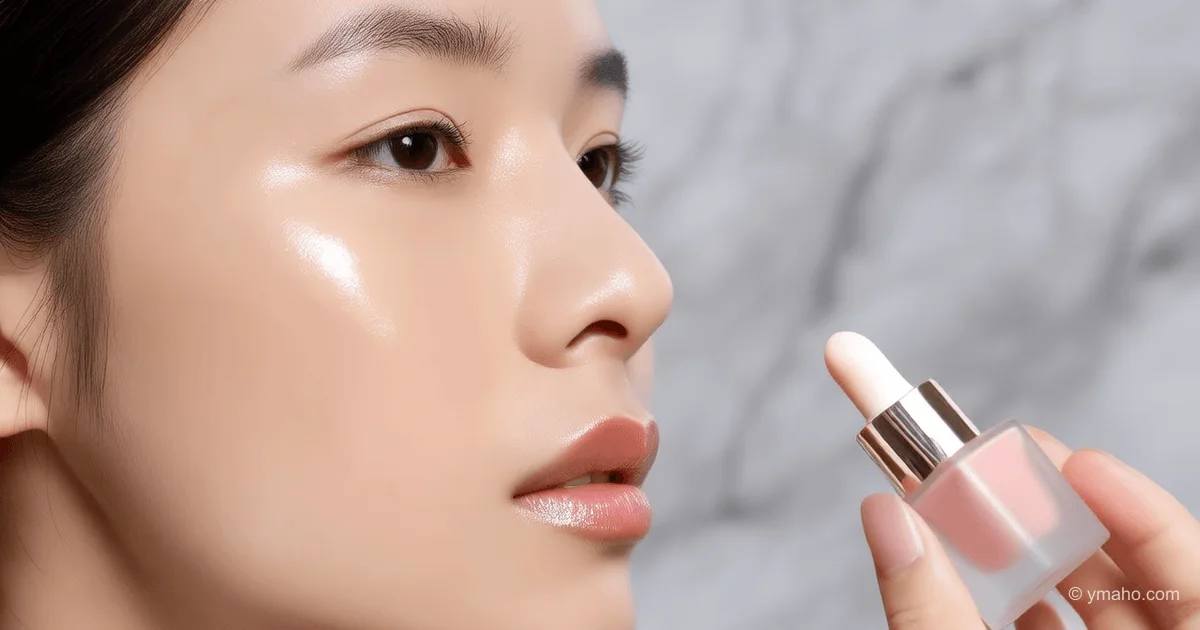
"Quiet Luxury" in Makeup and Skincare: Betting on Invisible Textures
The trend has moved into cosmetics: brands are launching zero-coverage foundation fluids and skincare serums that only provide radiance, masking the absence of makeup with an expensive, well-groomed look of the skin.
The beauty industry is experiencing one of the most elegant and destructive paradoxes in its modern history. Products sold as "makeup" are actually a skincare system. And products labeled "skincare" perform the function of makeup. The line between decorative cosmetics and skincare is disappearing not in laboratory presentations, but right on the consumer's face. Zero-coverage foundation fluids, serums that provide "only radiance," emulsions that mask imperfections not with pigment but with light reflection — this is not a new wave of minimalism. It is a complete restructuring of the optics through which a woman looks at her face.
The Essence: What Is Really Happening
We are not witnessing a trend toward "naturalness." Naturalness was a category of the 2010s, with their BB creams and "no-makeup makeup." What is happening now is fundamentally different. "Quiet luxury" in cosmetics means: the skin should look as if money has been spent on it, but it should be impossible to determine exactly what. It is not an absence of coverage, but coverage that mimics healthy skin. The difference is fundamental.
Technologically, this is achieved through three parallel paths. First, a new generation of light-reflecting particles that imitate not shine, but the refraction of a hydrated stratum corneum. Second, foundation fluids that adjust their viscosity to the skin's topography: filling micro-depressions and thinning on micro-elevations. Third, hybrid formulas where the skincare component (niacinamide, squalane) makes up 70-80% of the volume, and the decorative component is merely an add-on. Essentially, the consumer applies a serum with a slight tinting effect but pays as if for a premium foundation.
The economics of this shift are paradoxical. The cost of an "invisible" foundation fluid formula is often higher than that of a classic full-coverage product, because hiding imperfections without pigments is more difficult than covering them up. According to industry analytics, the average cost of a luxury skin tint is 35% higher than that of a medium-coverage foundation in the same price category. But the retail price is the same. Margins are shrinking, and this is a deliberate strategy: brands sacrifice margin to capture a new behavioral model.
Timeline and Context
The roots of the trend go back to 2023, when the term "quiet luxury" exploded after the Succession finale. But it reached cosmetics with a delay of 18-24 months — the standard product development cycle. The first signs appeared in late 2024: Westman Atelier launched Vital Skincare Complexion Drops, positioned as "skincare with a tint." Chanel in January 2025 introduced Les Beiges Water-Fresh Tint — a product with microcapsules of pigment suspended in a skincare water base.
By May 2026, we see a cascade of launches. Dior, Armani Beauty, Hermès, as well as Korean and Japanese brands, are simultaneously bringing entire lines of "invisible coverage" to market. The reason for this synchronicity is not collusion, but the maturity of microencapsulation technology and a shift in consumer demand. A consumer behavior study by Mintel in March 2026 showed that 58% of women aged 28-45 in the luxury segment want makeup to be invisible even upon close inspection. Two years ago, that figure was 34%.
In parallel, clinical legitimization occurred. Dermatologists, previously quoted in foundation advertisements, now publish studies showing that heavy coverage disrupts the epidermal barrier and contributes to transepidermal water loss. "Coverage-free foundation" has transformed from a marketing oxymoron into a dermatological recommendation.
Who Wins and Who Loses
The main beneficiaries are major luxury houses with resources for R&D in textures. LVMH Recherche, which unites the laboratories of Dior, Givenchy, and Guerlain, has invested about 90 million EUR in developing invisible textures over the past two years. They can afford to patent microencapsulation technology and keep competitors at bay. Japanese pigment manufacturers like Daito Kasei and Korean formulators (Kolmar Korea, Cosmax), who develop "invisible" bases for dozens of brands, also benefit.
A paradoxical win goes to plastic surgeons and cosmetologists. When makeup stops masking and starts "highlighting," the requirements for the quality of the "canvas" itself sharply increase. A woman using a zero-coverage foundation fluid is quicker to decide on injections or laser resurfacing because the skin texture is no longer masked by anything. Requests for skin texture improvement procedures (microneedling RF, fractional laser) in clinics in New York and Seoul have increased by 18% specifically among clients who switched to "invisible" coverage.
Losing are professional makeup brands for shoots and events — Kryolan, Mehron, and MAC's stage lines. Their DNA is coverage and durability. "Invisibility" is their antithesis. Some will try to adapt, but structurally it is a different business: different formulas, different logistics, different marketing. Not all will survive.
Also losing are beauty bloggers whose content is built on "before/after" demonstrations. If a product provides zero coverage, the effect cannot be conveyed through a camera. Photography and video kill the main advantage of such a product — its invisibility in real life. This means selling "invisibles" through traditional influencer marketing is becoming increasingly difficult. Bloggers who transition to offline formats — private events, personal consultations, closed clubs — are winning.
What the Media Aren't Saying
The media present the trend as "liberation" and "self-acceptance." But inside the industry, there is nervous laughter about this. "Quiet luxury" in makeup is not a rejection of beauty standards, but their tightening. The bar is being raised, not lowered.
First uncomfortable fact: skin without coverage must be perfect for the "invisible" to work. If a woman has acne, rosacea, or post-acne marks, zero coverage is either useless or requires such preparatory skin care (treatments, procedures) that costs 5-10 times more than the foundation fluid itself. This is a trend for the privileged — and the further it goes, the more it will exacerbate beauty inequality.
Second fact: the line between an "invisible" foundation and a skincare serum is deliberately blurred to bypass regulatory requirements. Cosmetics registered as skincare are not required to undergo durability and coverage testing mandatory for the decorative category. Brands intentionally classify their skin tints as skincare to avoid part of the regulatory burden. But the consumer is left without familiar benchmarks: it is unclear what you are buying and how to evaluate effectiveness.
Third, the most non-obvious insider point: "invisible" makeup kills repeat sales. A classic foundation runs out — a woman buys a new one. A zero-coverage skin tint is applied in micro-doses, lasting 3-4 times longer. At the same bottle price, purchase frequency drops. For the brand, this means the customer's lifetime value decreases. This can only be compensated by expanding the line of ancillary products — primers, finishing mists, special sponges that "activate radiance." Thus, an ecosystem is born where the flagship product is sold rarely, but around it is built a constellation of high-turnover accessories. This is the Gillette model — sell the razor cheap, make money on blades. But in luxury cosmetics, this model requires a complete overhaul of distribution.
Forecast: Next 30 Days and 90 Days
In the next 30 days, another 15-20 skin tints from premium brands will hit the market, and chaotic differentiation will begin. Absurd hybrids will appear, like "invisible foundation with SPF 50 but no white cast." Laboratories will work at the limits of chemical possibilities, and we will see products with unstable formulas that separate during storage. Returns in the category will increase by 10-15% simply due to consumer misunderstanding of what exactly they were sold.
In the next 90 days, the category will become institutionalized. Major retailers — Sephora, Ulta, Douglas — will introduce a separate shelf for "Hybrid Skin Enhancers," which belongs neither to makeup nor to skincare. This will be accompanied by retraining consultants and new in-store testing standards. Unlike foundation, which is applied to the jawline to check the shade, skin tint requires application to the entire face — otherwise, the invisible effect cannot be assessed. This means retailers will have to invest in express care and consultation zones, increasing operating expenses by 3-5%.
The main forecast: in 90 days, we will see the first brand that completely abandons classic foundations in favor of "invisible" textures. Most likely, it will be a young luxury brand building its identity on "new luxury" — for example, Augustinus Bader or Dr. Barbara Sturm. They will remove heavy coverage from their assortment and declare that the future lies in "skin without makeup, which itself is makeup." This will be a strong PR move that will force market veterans to justify why they still sell foundations with talc and silicones.
We are on the threshold of a world where a woman spends $95 on a bottle whose contents are not visible in the mirror. The value of the product becomes entirely intangible — like in contemporary art. And the question "does it work" is replaced by "do you feel it." This is the most radical shift in the definition of beauty since the invention of powder. And those brands that do not learn to sell the invisible will disappear themselves.
— Editorial Team









