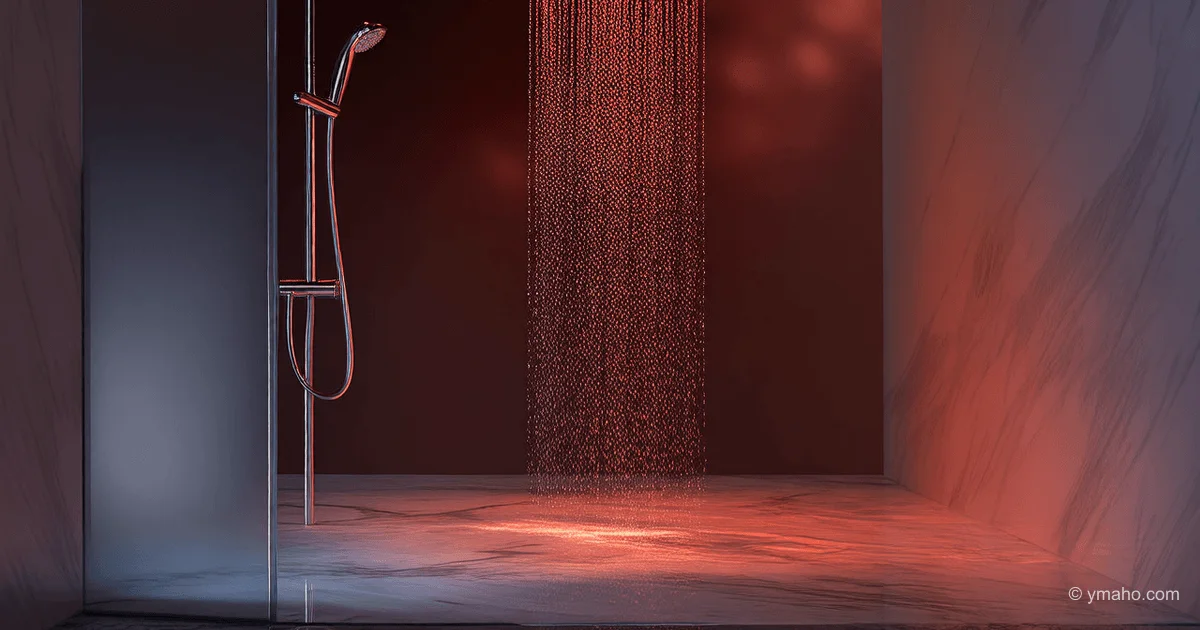
Red Light Everywhere: From Cosmetician's Office to Your Shower Head
Red LED therapy is becoming as routine as washing your face: searches for masks have surged by a third, and brands like HigherDose have already embedded it into shower filters. Now it's easier to 'charge' your skin and boost your mood while simply washing your hair.
Your shower now doubles as a medical device. The beauty industry didn't see this coming.
The red LED therapy market is projected to grow from $0.96 billion in 2025 to $1.11 billion in 2026, nearly doubling to $1.95 billion by 2030. But the numbers tell only half the story. The other half is unfolding right now in bathrooms: HigherDose has just embedded therapeutic red and near-infrared wavelengths into a shower head, and this isn't a biohacker gadget. It's a product for people who want to 'charge' their skin and reset their circadian rhythm while washing their hair. Red light is no longer a treatment. It's become plumbing.
From the Dermatologist's Office to Your Morning Standing Appointment
Jessica Alcalde, Vice President of Product at HigherDose, articulates the logic with surgical precision: 'Wellness works best when it naturally fits into real life.' The shower is one of the few daily rituals people never skip. It's also the only place where you're guaranteed to be naked, making it an ideal environment for full-body light coverage without extra time or scheduling.
The shower head delivers two wavelengths: 650 nm (red) and 850 nm (near-infrared) at a power of 200 mW/cm². Red light works on the surface level, stimulating collagen and skin repair. Near-infrared penetrates deeper into tissues, supporting circulation and oxygen delivery. Add a 10-stage filtration system that removes up to 99% of chlorine, 75–89% of heavy metals, and 50–60% of microplastics, and you have a device that simultaneously heals skin with light and stops killing it with tap water chemicals.
Dr. Alan Bauman, a board-certified hair restoration surgeon in Boca Raton, calls it 'a convenient, low-effort way to add consistent RLT without extra time or devices.' And that's the essence of the shift.
84% of Users Started in the Last Two Years. Search Queries Have Gone Wild
The BON CHARGE 2026 Global Wellness Tech Trend Report, based on a survey of 7,000 adults, notes that 84% of American red light users started only in the last two years. The primary motivation is no longer post-workout muscle recovery but skin care. Facial care has overtaken sports rehabilitation as the purchase driver.
Search data confirms the mania. Google Trends analysis shows that interest in red light therapy has more than doubled after a TikTok surge in early 2024. Social media has accelerated adoption faster than traditional dermatological channels. The term 'photobiomodulation'—the scientific name for the technology—skyrocketed by 614% in search volume over 2025, signaling engagement from the professional medical community.
The LED face mask market was valued at $277.92 million in 2025 and is expected to reach $303.60 million in 2026, with a forecast of $679.02 million by 2034. The segment of red LED masks alone holds a 39.77% market share—the leading share—and will continue to grow at a CAGR of 10.04%. Omnilux, CurrentBody, FOREO, Shark Beauty—all are vying for the consumer's face. But the real battle is already shifting toward full-body.
Who's Winning the War for Your Body While You Shower
HigherDose made a strategic move that takes RLT from the 'another gadget on the shelf' category to the infrastructure category. The shower head requires no separate session, takes no space on the nightstand, and adds no steps to your routine. It's built into an action you'll perform anyway. 'No added steps. No routine overhaul. Just turn on the water and step into the light,' the brand summarizes.
The winners in this race: companies that package phototherapy into household items—shower heads, wall panels, foldable devices. The red light panel market is heading toward $1.95 billion by 2030 at a CAGR of 15.2%. Key drivers include increased home use, integration into sports recovery, wavelength innovations, and expanding online sales.
The losers are traditional cosmetic clinics, for which RLT was a paid procedure. When the equivalent of an in-office session flows from your shower for a fixed device price, the value of visiting a cosmetologist 'just to get some light' drops to zero. Also losing are traditional skincare brands: a cream can't compete with wavelengths that penetrate the dermis and stimulate mitochondria at the cellular level.
The portable LED mask market will grow from $118.87 million in 2025 to $131.85 million in 2026, reaching $209.32 million by 2032. But a mask is a first-generation product. The second generation is panels. The third is environment-embedded devices that work while you're busy doing something else. HigherDose's shower head has opened exactly that third generation.
2030: Your Toilet Will Measure Biomarkers, and Your Mirror Will Write a Prescription
The direction is set, and it's irreversible. By 2030, the 'home RLT infrastructure' category will absorb part of the market for cosmetic procedures, skincare products, and spa services. Sensors will be built into plumbing. Shower heads will learn to adjust the dose based on the skin inflammation index calculated by a smart mirror. Fitness clubs will start installing full-body panels not in a corner for 'recovery' but in locker rooms as a standard option.
The trend toward multifunctionality will become the norm. Consumers don't want to choose between water filtration and light therapy, between skin hydration and collagen stimulation. A device that does one thing will lose to a device that does three things simultaneously without extra time.
The numbers support the forecast. The red light market will double by 2030. Consumer habits have already shifted: 84% of users entered the category in the last two years, and they're not leaving. The next frontier is not portability but invisibility. Technology that works when you're not thinking about it. A shower that heals. A towel that stimulates regeneration. A pillow that reduces inflammation while you sleep.
Red light no longer looks like the future. It looks like plumbing. And that's the most powerful signal that the technology has finally won.
— Editorial Team









