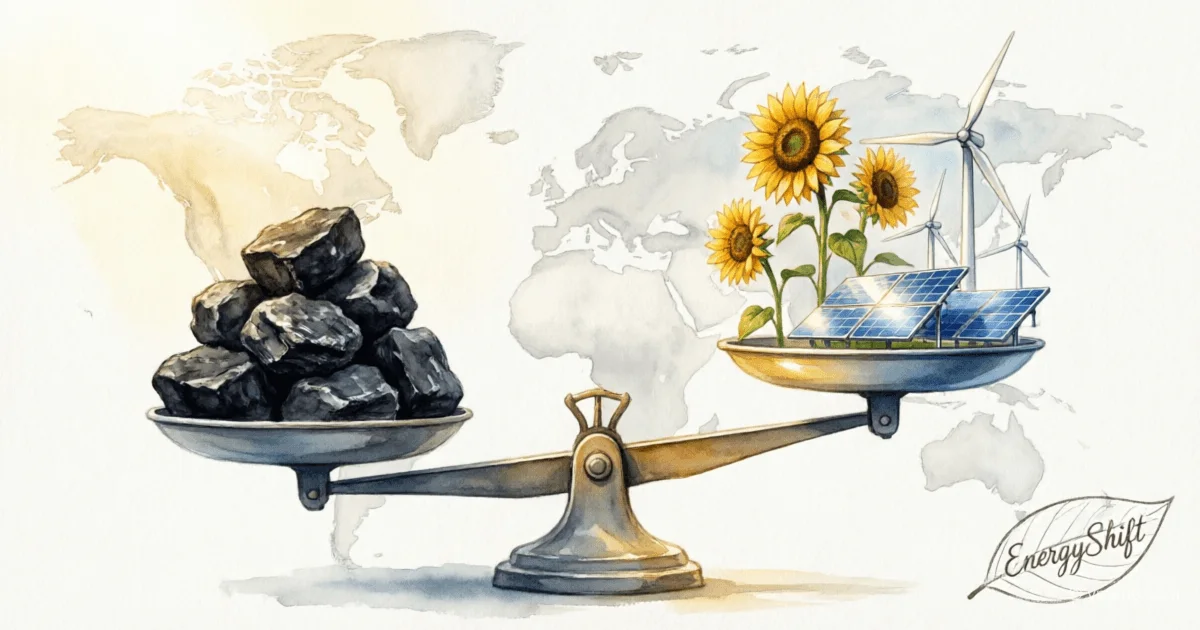
Sun Beats Coal: How Green Energy Changed the Game for All of Us
In 2023, renewable energy became the planet’s primary source of electricity for the first time, surpassing coal. This isn’t just a statistic—it means your electric bills could become more stable, and the world less vulnerable to geopolitical crises.
Historically, every new percentage point of growth in global electricity demand was met with fossil fuels. Now, solar panels and wind turbines are picking up that entire additional load. Imagine instead of overpaying for gas every month due to a war somewhere across the globe, your electricity is generated from free sun and wind. It’s like locking in a permanent fuel price—no more unexpected spikes.
Why Did This Happen Now?
According to analytics firm Ember, renewables now account for 33.8% of global electricity generation. For the first time in history, over a third of the world’s power is produced without coal, oil, or natural gas. The standout performer? Solar power. It satisfied a massive 75% of new electricity demand.
To put that scale into perspective: solar generation jumped by 636 terawatt-hours in a single year. That’s equivalent to double the UK’s annual consumption. A terawatt-hour represents enough electricity to power 100,000 households for an entire year. This surge marks the largest leap ever recorded in tracking data.
How China and India Shifted the Landscape
Until 2023, China and India were the main drivers behind rising coal consumption. Today, they’ve unexpectedly emerged as leaders in the green transition. Despite economic growth, their power sector emissions have actually dipped. Why? Because newly built solar and wind farms outpaced demand.
Here are the key figures highlighting this shift:
- Solar capacity surged by 647 gigawatts (roughly equivalent to adding 647 new nuclear plants)
- Solar adoption grew 18 times faster than natural gas usage
- For the first time since 2020, there was zero growth in fossil fuel-based electricity generation
This isn’t a temporary blip caused by the pandemic or a short-term crisis. Analysts call it a “structural shift”—the moment technology hit a tipping point where renewables simply make better economic sense.
What This Means for the Future
The International Energy Agency projects that demand for oil, gas, and coal will peak before 2030. Meanwhile, global electricity demand is set to rise by 30% driven by EVs, data centers, and air conditioning. The big question: can green sources handle that extra load?
The answer looks promising. According to Ember, solar now dominates new capacity additions, while batteries are stepping up to ensure grid reliability. Think of it as giving an entire city a massive backup battery—when the sun goes down, stored power kicks in to keep things running.
Key Takeaways
- Renewables fully covered new global electricity demand for the first time—with zero reliance on coal or gas
- The sun is the primary engine of change—its growth rate dwarfs all other sources combined
- Leading nations have pivoted strategies—even China and India are now scaling green energy faster than fossil fuels
- This isn’t a passing trend—it’s a structural shift driven by pure economic advantage
So what does this mean for everyday people? First, electricity prices will become far more predictable—sun and wind don’t have market rates subject to wartime volatility. Second, reduced dependence on fuel imports makes nations more resilient during crises. Third, every new percentage point of green energy pushes us further away from the very real threat of climate disasters that are already impacting harvests and weather patterns.
— Editorial Team









