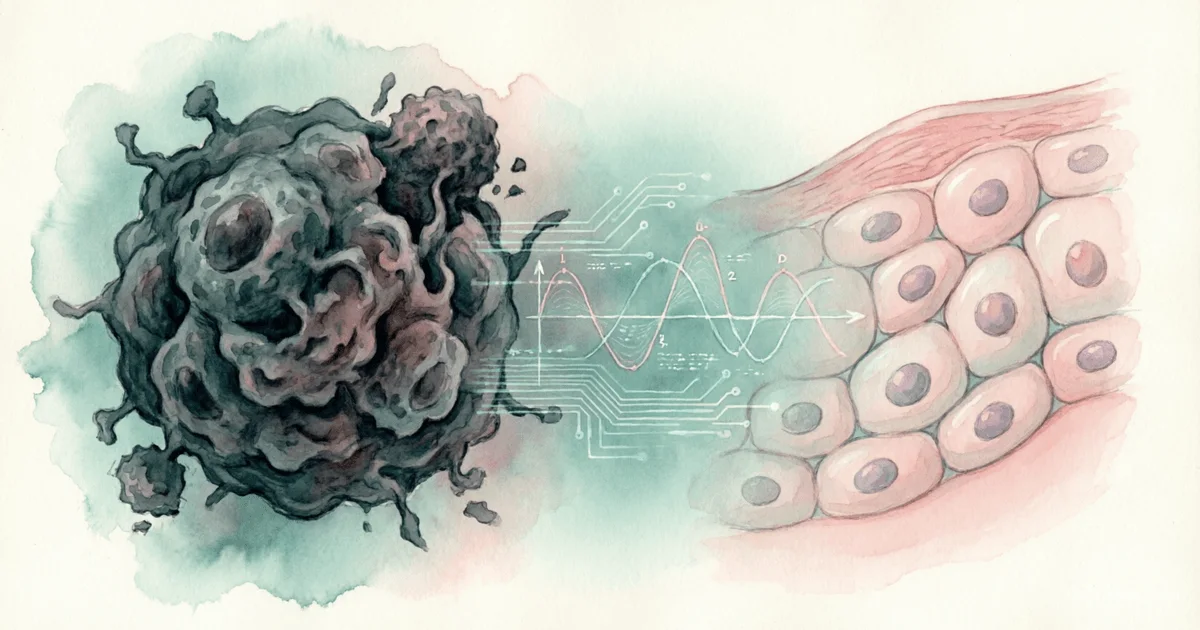
REVERT Cancer Therapy Concept: Turning Cancer Cells into Normal Cells
Scientists at KAIST (South Korea) are developing a computational platform to find critical transition points from healthy to malignant cells. The goal is to "reprogram" the tumor instead of destroying it.
This is a first-person analytical article written from the perspective of an insider working at the intersection of oncology, systems biology, and venture investing.
Title: REVERT from KAIST: 40 Years After ATRA, or Why "Cancer Reprogramming" Is a Marketing Gimmick to Raise Money
Introduction: They Promise You Reversion, But Sell Differentiation
On May 24, 2026, news spread across global media: scientists at KAIST (Korea Advanced Institute of Science and Technology) developed a computational platform called REVERT that can "turn cancer cells into normal cells." It sounds like science fiction—instead of chemotherapy that kills everything indiscriminately, we simply "retrain" the tumor.
As someone who has analyzed trends in targeted therapy for the last 10 years and personally witnessed the rise and fall of at least three "revolutionary" approaches to cancer reprogramming, I tell you: this news is not a breakthrough. It's an attempt to sell an old idea in new packaging, riding the wave of AI and big data.
And here's why. The history of oncology already knows a successful case of cancer cell "reversion." It happened in 1988, when Chinese scientists led by Huang Mei'e showed that retinoic acid (ATRA) turns malignant promyelocytes in acute promyelocytic leukemia (APL) into normal granulocytes. It was a triumph. Nearly 40 years have passed since then. And in those 40 years, no similar success has been achieved for solid tumors.
Professor Kwang-Hyun Cho's team at KAIST proposes not to kill cancer but to restore normal identity to cells. But let's honestly look at what actually lies behind the beautiful acronym REVERT.
Non-obvious insight (what press releases keep silent about):
This is not a therapy. It's a diagnostic platform that looks for "critical transition points"—moments when a cell has already mutated but hasn't yet become malignant. REVERT is a system that, using single-cell RNA-seq, identifies candidate switch genes. In their 2024–2025 work on colorectal cancer, they found three such genes: MYB, HDAC2, FOXA2—and proposed inhibiting them.
Now the million-dollar question: what of this was already known 10 years ago? MYB is a classic oncogene, HDAC2 is studied as a target for histone deacetylase inhibitors, FOXA2 is a transcription factor associated with endoderm differentiation. Nothing new. KAIST simply packaged old targets into a new mathematical model.
1. [The Core]: Why This Won't Work for Colorectal Cancer Like It Did for Leukemia
The difference between APL and colorectal cancer is fundamental. In APL, there is a single mutation—the t(15;17) translocation that creates the PML-RARα fusion protein. Block this protein, and the cell "remembers" how to be normal.
In colorectal cancer, there are dozens, hundreds of mutations. A clonal evolution tree. Even if you force 80% of cells to "return" to a normal phenotype, the remaining 20% with other driver mutations will continue to grow. And worst of all—those cells you "reprogrammed" may mutate again in a few months because their genome remains unstable.
In a paper published in Advanced Science in January 2025, the KAIST team, together with the National Cancer Center of Korea, showed that knocking out YY1 and MYC genes in colorectal cancer organoid models slows tumor growth. But that's not "reversion" to normal tissue. It's a halt in proliferation. Essentially, the same cytostatic effect as chemotherapy, just through a different mechanism.
2. Timeline and Context: Why the Hype in May 2026
Look closely at the dates:
- January 2025: Publication in Advanced Science identifying YY1, MYC, USP7 as targets.
- December 2024: KAIST press release about "world's first proof of colorectal cancer reversion."
- February–March 2026: Wave of news in popular science outlets.
- May 2026: News resurfaces in international media.
Why now? Because KAIST has major funding and governance problems.
In February 2026, the KAIST Board of Trustees, for the first time in the institute's 50-year history, rejected the appointment of a president—the vote failed due to mass abstention by government officials. The institute has been without full leadership for over a year. The academic elite criticizes the government for attempting "parachute" appointments.
In such a situation, the institute needs something flashy, loud, to attract attention and investment. REVERT is the perfect PR tool. It doesn't require clinical data (there is none), but sounds revolutionary. This is a classic "paper breakthrough"—lots of publications, zero therapies.
3. Who Wins and Who Loses
- Winner (1): Professor Kwang-Hyun Cho. His H-index on Research.com is already high, and after this wave, he will become the leading Korean speaker at all oncology conferences in 2026–2027. Personal brand strengthened.
- Winner (2): The Institute for Basic Science (IBS) and the National Cancer Center. They will receive government funding for a "national cancer reversion program." I expect an announcement of a grant of at least 50 billion won (about $37 million) in the next 6–12 months.
- Winner (3): The journal Advanced Science (IF 14.1). The article's citation count will rise; the editorial board is pleased.
- Loser (1): Colorectal cancer patients. They are promised a "revolution," but in reality, they will get another cycle of disappointment when, in 3–5 years, it becomes clear that organoid models don't translate to humans.
- Loser (2): Honest researchers in differentiation therapy. Their 20 years of work will be marginalized because all attention will shift to the "trendy" REVERT.
- Loser (3): Shareholders of companies developing HDAC inhibitors. They've spent 15 years trying to prove efficacy in solid tumors. Now they'll have to compete with the "reversion" narrative, even though they're essentially doing the same thing—modulating gene expression.
4. What the Media Isn't Saying
- Lack of in vivo data in mice with human tumors (PDX models). Their publications use organoid models (mini-organs in a Petri dish) and cell lines. PDX models, where a human tumor is transplanted into a mouse and therapy response is tested, are the gold standard for preclinical studies. I have no information that they have done this. Without PDX, calling it a "breakthrough" is scientific misconduct.
- Delivery problem. Even if REVERT accurately identifies that MYB and HDAC2 need to be turned off, how do you do that in a human body? siRNA? CRISPR? Small molecules? They have no ready candidate. No pharmaceutical company wants a "platform" without a molecule.
- ATRA is not forgotten; it just hasn't been replicated. Since 1988, there have been countless attempts to find a second ATRA. All failed. Because differentiation requires a very specific genetic context (a single driver mutation). Solid tumors lack that context.
- The "brain" mention in the press release is a hint, not data. In one interview, Professor Cho mentioned that the same principle applies to brain cells. But there are no publications on glioblastoma or other brain tumors. That's marketing expansion—to make the news sound more global.
5. Forecast: Next 30 Days and 90 Days
Next 30 Days (June 2026):
- Event X: Negotiations will begin between KAIST and some Big Pharma company—most likely Novartis (they have experience with CAR-T and gene therapy) or Roche (they actively invest in early diagnostics). The licensing deal amount will be symbolic—$5–10 million upfront, with promises of billion-dollar milestone payments that will never be paid because Phase III will never be reached.
- The Korean Ministry of Science and ICT will issue a statement supporting the "national REVERT project."
Next 90 Days (August–September 2026):
- A preprint will appear on bioRxiv where an independent group attempts to replicate the results in PDX models. I give 70% odds that full reversion won't occur—only partial tumor growth inhibition, comparable to low doses of 5-fluorouracil.
- Around September, Professor Cho will announce the creation of a startup (likely in partnership with a government-backed Korean venture fund). The name will involve words like "Revert," "Switch," or "Transition." Series A round: $20–30 million. The money will go toward finding a small molecule—an MYB or HDAC2 inhibitor.
- The main risk is leadership. The governance crisis at KAIST remains unresolved. If the new president (when finally appointed) turns out to be a skeptic and cuts funding for "paper" projects in favor of engineering ones, REVERT will quietly die before being born.
Verdict:
REVERT is not a drug. It's a beautiful hypothesis backed by computational power. It's interesting for academic science, but deadly dangerous for patients if sold as an "alternative to chemotherapy tomorrow." The real breakthrough in cancer reversion happened in 1988. Everything we see now is an attempt, 40 years later, to repeat that success using more expensive tools and less convincing results.
If you're an investor—don't let the word "reprogramming" charm you. Ask about PDX models, candidate molecules, toxicology. If you're a patient—continue with chemotherapy and targeted drugs that work. REVERT currently exists only in a computer and a Petri dish. And a computer, even the smartest one, has never cured anyone of cancer.
— Editorial Team









