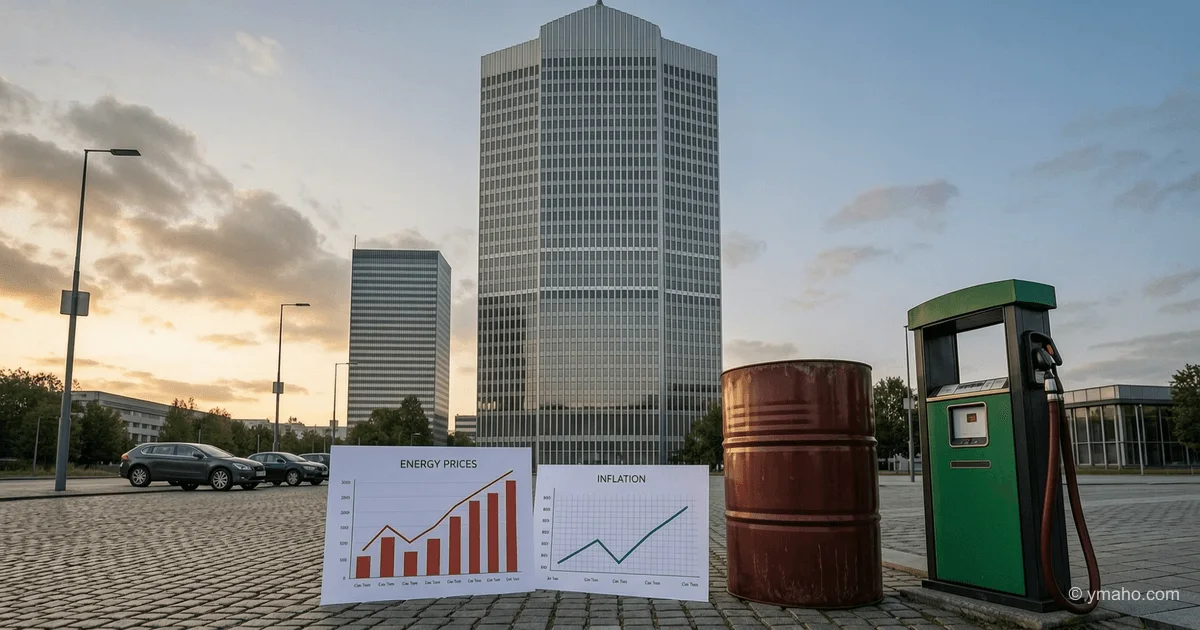
ECB Calls Sharp Rise in Energy Prices a Serious Challenge for Europe
ECB President Christine Lagarde reiterated that the sharp rise in energy prices poses a serious challenge to the eurozone economy. Meanwhile, gasoline prices in the US continue to hold above $4.50 per gallon.
Energy Shock as Anesthesia: Why the ECB Talks About Prices but Stays Silent on Irreversibility
The Core: What's Really Happening
Christine Lagarde's statement that the sharp rise in energy prices is a "serious challenge" for the eurozone economy is not just stating the obvious. It is a rhetorical cover-up operation hiding a fundamental shift in the European Central Bank's monetary strategy. Lagarde publicly laments dependence on energy imports, but the current crisis gives the ECB what it could not get for years: a legitimate reason to maintain tight financial conditions for an extended period without direct political responsibility for the consequences.
In reality, the energy shock serves the Frankfurt regulator as an external enemy, allowing it to explain any economic failures without acknowledging structural miscalculations. Inflation triggered by the blockade of the Strait of Hormuz and the US military operation against Iran starting February 28, 2026, is an externality the ECB can cite for months, postponing the inevitable discussion of internal eurozone imbalances. Lagarde talks about "alternative energy sources" and the "unsustainability" of the current model, but her real task is to buy time for the eurozone banking system, which is not ready for a new round of rate cuts, fearing a squeeze on net interest margins.
Timeline and Context
The chain of events leading to Lagarde's May statement forms a logical but alarming sequence.
On February 28, 2026, the US and Israel begin a military operation against Iran. Within weeks, the Strait of Hormuz—a route for about 20% of global oil supplies—is effectively blocked. Brent crude prices surge 58% since the start of the conflict.
By April 2026, ECB Executive Board member Frank Elderson publishes a policy article introducing the term "fossilflation" for the current situation. He directly states that Europe's dependence on fossil fuel imports turns any external shock into a price stability problem. The same article reveals a key figure: Europe needs investments of €660 billion annually until 2030 to achieve energy independence.
On April 30, 2026, the ECB keeps rates unchanged, but fierce debates rage within the Governing Council, including discussions about raising borrowing costs. Lagarde forecasts that eurozone inflation will "significantly exceed" the 2% target. The regulator, which earlier in the year was preparing for an easing cycle, is now forced to keep rates high—and not by its own choice.
On May 5, 2026, Lagarde speaks at an environmental conference in Frankfurt, stating that Europe imports about 60% of its energy, calling this situation "clearly unsustainable." She links the rise in energy costs to the war in Iran and urges faster adoption of alternative sources. Importantly, this speech takes place not at a monetary policy press conference but at a climate platform—the rhetoric is camouflaged as an environmental agenda.
According to Gas Infrastructure Europe data as of May 2, EU underground gas storage fill levels have fallen to a critical 33%, and injection rates are at their lowest in two years—6.7 billion cubic meters. Germany, Europe's industrial heart, has storage fill of only 25.43%.
Meanwhile, US gasoline prices are rising: on May 6, the average retail price reached $4.54 per gallon, and in California, $6.14. This creates political pressure on the Trump administration ahead of the November midterm elections. GasBuddy analysts warn that if the Strait of Hormuz remains closed, gasoline prices could reach $5 per gallon.
Who Wins and Who Loses
The losers are obvious—European industry and households. According to the IMF, European industry pays two to three times more for energy than competitors in the US and China. This is a structural gap, not a temporary imbalance. Eurozone GDP growth in 2026 is forecast at just over 1%, down from the 1.4% expected before the conflict. In a prolonged crisis, the IMF does not rule out a recession.
Germany loses doubly. Low gas storage levels mean the country could face a repeat of the 2022 scenario next winter. Spiegel warned as early as May 1 that Germany risks running out of sufficient gas reserves. Given that German industry is already operating under higher costs, a new wave of energy crisis could trigger a wave of bankruptcies in the chemical and engineering sectors.
The winners are less visible, but their positions are strengthening. The first beneficiary is the Spanish and Portuguese economies. As Lagarde noted, countries with a higher share of non-fossil energy suffered less. According to the Bank of Spain, wholesale electricity prices in early 2024 were about 40% lower than they would have been if wind and solar generation had remained at 2019 levels. In the current crisis, this gap is only widening, giving the Iberian economies a competitive advantage.
The second beneficiary is Christine Lagarde herself and the hawkish wing of the ECB. The energy shock provides them with a perfect alibi to keep rates high. The regulator can argue that easing is premature because the external shock requires caution. This protects bank margins while curbing the debt burden growth of peripheral countries, which would inevitably accelerate with cheap credit.
The third unexpected winner is renewable energy producers. The investment argument they have pushed for years is now voiced by the head of Europe's largest central bank. Lagarde effectively gave political blessing to an accelerated energy transition, and this happened not within a climate discussion but in the context of monetary stability. The €660 billion in annual investments the ECB mentions is a giant market, and its beneficiaries are already mobilizing lobbying resources.
What the Media Leave Out
The first and most glaring omission is the cost of the energy transition for European taxpayers and consumers. Lagarde publicly talks about "alternative sources" as a solution but remains silent about short-term costs. Switching to renewable energy requires not only €660 billion per year but also a complete modernization of power grids and storage systems. The IMF emphasizes that the European Commission's grid package proposed in December 2025 is critically important, but its implementation will take years. In the meantime, Europe will continue to pay a double price: for imported fuel and for building new infrastructure. Lagarde does not mention this.
The second insight concerns the US. The gasoline price of $4.54 per gallon is not just an economic statistic. It is a political toxin for Republicans ahead of the November 2026 midterm elections. Oil futures traded around $3 per gallon for most of the conflict but spiked sharply in the last week of April. If the trend continues, Trump will face unprecedented pressure: he promised fuel would become cheaper after the war ended, but the longer the Strait of Hormuz remains closed, the less credible those promises sound.
The third omitted aspect is the link between the energy crisis and the European Emissions Trading System (ETS). The IMF, in its report, warns that the ETS was "on the brink of collapse" and insists on its preservation as a key market instrument. However, amid the energy shock, the price of carbon allowances becomes an additional tax on industry that competitors in the US and China do not pay. Lagarde sidesteps this issue because any hint of weakening the ETS would be seen as backtracking on climate commitments.
The fourth insight is European gas storage. A fill level of 33% at the start of May is not just a seasonal low; it is a systemic failure. For comparison, in 2023 and 2024, Europe entered winter with reserves above 90%. Now, with only weeks left before injection season, fill rates are at their lowest in two years. If the summer season does not bring significant improvement, Europe will enter the 2026-2027 heating period with critically low reserves, guaranteeing a price spike in gas and, consequently, electricity.
Forecast: Next 30 Days and 90 Days
30 days (until early June 2026)
In the coming month, the ECB will maintain its rhetoric but not the rate. Lagarde will continue to publicly link inflation to the external energy shock, emphasizing the need for structural reforms but not monetary intervention. The Governing Council at its June meeting will likely keep rates unchanged with 80% probability, using uncertainty around the Strait of Hormuz as justification.
US gasoline prices will continue to rise. The approach of Memorial Day and the start of the summer driving season will create additional demand. GasBuddy analysts have already warned that if the blockade continues, prices could reach $5 per gallon. US gasoline inventories are at their lowest for this time of year since 2014, and Morgan Stanley forecasts further declines. For Trump, this means growing political pressure.
European gas storage fill levels will remain low. If the conflict in the Persian Gulf does not end, LNG supplies to Europe will stay limited, and Asian buyers will continue to outbid European prices.
90 days (until late July to early August 2026)
By August 2026, the European economy will reach a point where the choice between recession and reforms becomes inevitable. The IMF has already warned that a prolonged crisis could push the eurozone into recession. If the Strait of Hormuz remains closed, eurozone GDP risks zero or negative growth in the third quarter.
The ECB will face an impossible choice. Raising rates to fight inflation would deepen the recession. Lowering them would fuel inflation, which is already well above the 2% target. The most likely scenario is maintaining the status quo with a shift to targeted support measures, such as temporary fiscal interventions. European Commissioner for Economy Valdis Dombrovskis has already stated that any support measures must be temporary, targeted, and not increase aggregate demand.
The political effect for the US will intensify. If gasoline settles above $5 per gallon by August, Republicans will enter the fall election campaign with a toxic asset. Trump will face the need to either escalate the conflict to achieve military victory or seek a humiliating diplomatic exit—both options carry electoral risks.
For Europe, the summer of 2026 will be a moment of truth. The structural vulnerability Lagarde spoke about at the Frankfurt conference will cease to be a topic of expert discussion and become everyday economic reality for hundreds of millions of Europeans. Industry paying two to three times more for energy than US and Chinese competitors will begin to irreversibly lose market positions. And when that happens, the rhetoric about the "green transition" will face a harsh test of strength—a test for which the European political class, judging by current dynamics, is completely unprepared.
— Editorial Team









