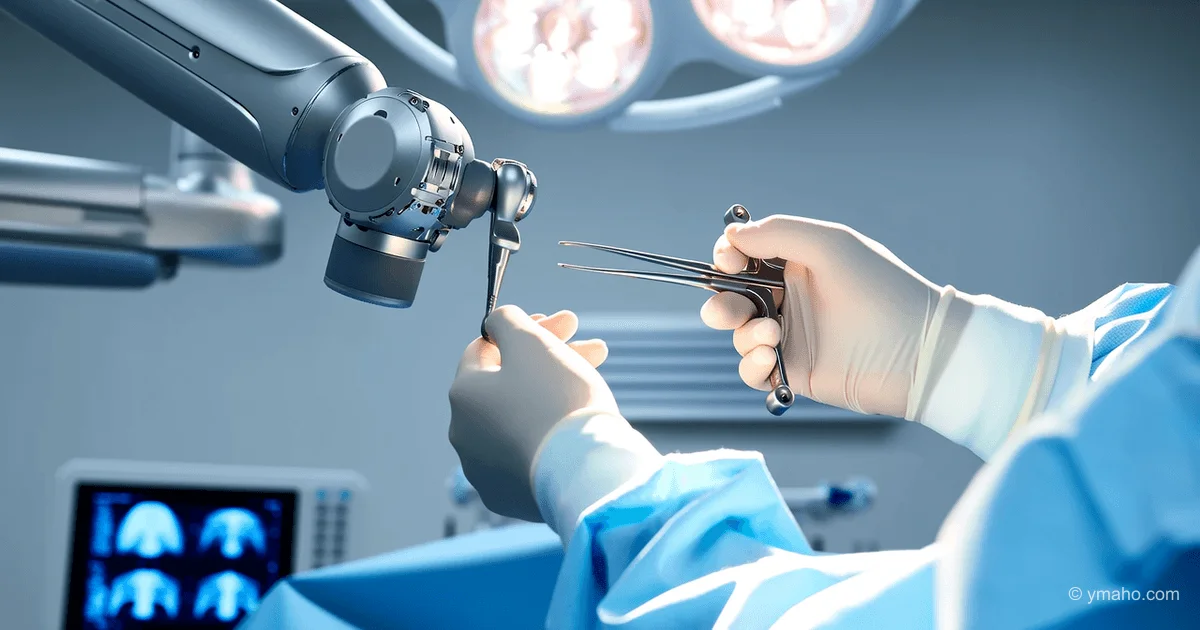
Reinforcement Learning Improves Surgeon-Robot Interaction in the Operating Room
A concept for adaptive pose control of a robotic assistant during laparoscopy using reinforcement learning has been introduced. The system recognizes the surgeon's actions and automatically moves the camera-holding manipulator to free up workspace when needed, improving ergonomics.
A robot that gives way: How Reinforcement Learning turns a surgical assistant from a tool into a colleague
[The Gist]: What's Really Happening
In May 2026, researchers from the University of Alberta presented a concept for adaptive pose control of a robotic assistant during laparoscopy based on reinforcement learning (RL). The system recognizes the surgeon's current action and automatically moves the camera-holding manipulator to free up workspace exactly when needed.
At first glance, it's an engineering detail. The robot moved a bit, the surgeon felt more comfortable. But in reality, this work marks a fundamental shift: the surgical robot is learning not just to execute a command, but to interpret context and yield to the human without being asked—like a human assistant who sees the surgeon reaching for an instrument and steps back half a step.
This is not automation. It's delegation with elements of situational awareness—a capability that was previously considered exclusively human.
Timeline and Context
The idea of a "smart" robotic assistant has been maturing over the past five years in several labs simultaneously. As early as 2021, Fan and colleagues showed that reinforcement learning could be used to correct instrument pose in the da Vinci Research Kit. But those early works solved the problem through iterative optimization—the robot "thought" for several seconds before moving. For a live operation, this is unacceptable: when the surgeon says "suction," suction is needed now, not three seconds later.
The breakthrough in 2026 is speed. The new architecture based on Vision Transformer, trained via differentiable rendering, operates in near real-time (22 Hz)—four times faster than predecessors. This is enough for the system to respond to the surgeon's actions without noticeable delay.
The context is the rapid growth of the AI surgical robot market. According to industry reports for 2026, the global market for AI-based surgical robots is estimated at $9.37 billion, with a projected growth to $17.35 billion by 2030 (CAGR 16.6%). The overall surgical robot market, according to Technavio forecasts, will grow by $9.1 billion from 2025 to 2030 at a CAGR of 15.3%. In this context, every innovation that improves ergonomics and reduces cognitive load on the surgeon is not a scientific abstraction but a direct path to expanding indications and increasing the number of procedures.
Who Wins and Who Loses
Winners:
- Intuitive Surgical—manufacturer of da Vinci, dominating the market with over 20 million procedures performed by the end of 2025. RL algorithms for adaptive pose can be integrated into the software of da Vinci 5, whose computing power is 10,000 times greater than the previous generation Xi and is built on the NVIDIA Blackwell architecture. The company is already actively investing in AI/ML: the Case Insights platform uses video and kinematic data for postoperative analytics, and Intuitive's Digital and AI/ML head Tony Jarc publicly states a desire for an "infinite discovery engine" in surgery. RL adaptive pose fits perfectly into this strategy.
- Aging surgeons and patients with complex cases. Ergonomics is not a comfort issue but a safety issue. An uncomfortable position of the assistant blocking the view is a micro-delay that in a critical moment (ulcer perforation, spleen rupture) can cost blood loss. Surgeon Douglas Stoddard, Director of Surgery and Robotics at CHRISTUS Health, describes how being able to review the operation recording with force data allowed him to avoid a repeat gallbladder rupture—simply by changing the grip angle. An RL assistant that frees the workspace solves a related problem—preventing instrument conflict, which similarly goes unnoticed until video analysis.
- Research groups at McGill, University of Alberta, and other centers. Professor Amir Khoshyar from McGill, Director of the Surgical Performance Enhancement and Robotics Centre, presented a vision for "intelligent autonomy" in surgery in April 2026, where AI integrates vision, kinematics, and sensory data in real time. RL adaptive pose is one of the building blocks of this vision.
Losers:
- Manufacturers of "passive" robotic assistants without an AI component. If competitors start embedding RL algorithms that make the assistant proactive, systems requiring manual pose reconfiguration mid-operation will instantly become obsolete. This is analogous to how the advent of automatic transmissions killed manual transmissions in the premium segment.
- Surgical teams in countries with low automation levels. The gap in postoperative mortality between high- and low-income countries is threefold. RL robots could exacerbate this: those who can afford da Vinci 5 with an AI assistant will see faster improvements in outcomes.
What the Media Isn't Saying
Non-obvious insight: An RL algorithm that yields to the surgeon is the first step toward a robot that can say "no."
Currently, the system is trained through simulation: the policy is optimized to minimize conflict between manipulators and maximize free space. But the same architecture—Vision Transformer + RL—can be trained on other criteria: for example, preventing the instrument from entering a dangerous zone (proximity to a major vessel). Then the robot transforms from an assistant that "moved aside" to an assistant that "doesn't let you in."
This raises a question that is not yet publicly discussed: where is the boundary between assistance and limiting the surgeon's autonomy? If the RL agent is trained on hundreds of thousands of hours of video and "knows" that in 3% of cases entering that zone results in bleeding, should it block the movement? Robot manufacturers are currently avoiding this topic, but architecturally it is already being solved—just change the reward function.
Second insight: RL adaptive pose is not a product but a proof of concept for a "surgical autopilot" in tasks unrelated to resection.
In public discourse, "autonomous surgery" is associated with a robot that sutures an anastomosis itself. But that is the most complex and risky scenario. RL adaptive pose shows that there is a huge field for automating support functions—camera holding, instrument delivery, exposure maintenance. These tasks take up to 30% of operation time and carry almost no risk to the patient. This is where AI commercialization in surgery will happen fastest—not because it's technically easier, but because the regulatory barrier is lower.
Forecast: Next 30 Days and 90 Days
30 days (by mid-June 2026):
Intuitive Surgical is expected to demonstrate the integration of RL adaptive pose algorithms into da Vinci 5 at a closed session for key clients. The company just held a presentation at NVIDIA GTC 2026, where VP of Digital Technologies Tony Jarc and surgeon Douglas Stoddard detailed the architecture for collecting and analyzing surgical data. The logical next step is to show an AI application working in real time, not just in postoperative analysis. If Intuitive doesn't do this, the niche will remain open for academic spin-offs.
90 days (by mid-August 2026):
The key catalyst will be the publication of the first RL policies trained on multi-platform data. The Open-H dataset, announced in April 2026, contains 770 hours of synchronized video and kinematic data from 20 robotic platforms. When RL algorithms start training on this data, they will become platform-independent—meaning adaptive pose will work on da Vinci, Senhance, and new platforms. This will lower the entry barrier for small companies and accelerate commoditization of the technology.
In parallel, expect the first presentation of an RL algorithm that not only frees space but also predicts instrument conflict 2–3 seconds before it occurs. This is the transition from "reactive" to "proactive" behavior that turns the assistant from a tool into a colleague. And it is this phrasing—"AI as a colleague, not a tool"—that will become central in keynote presentations at the robotic sessions of the ACS Clinical Congress in October 2026.
— Editorial Team









