Breakthrough in RNA Editing: Photoactivatable CRISPR/Cas13d for Deep Tissues
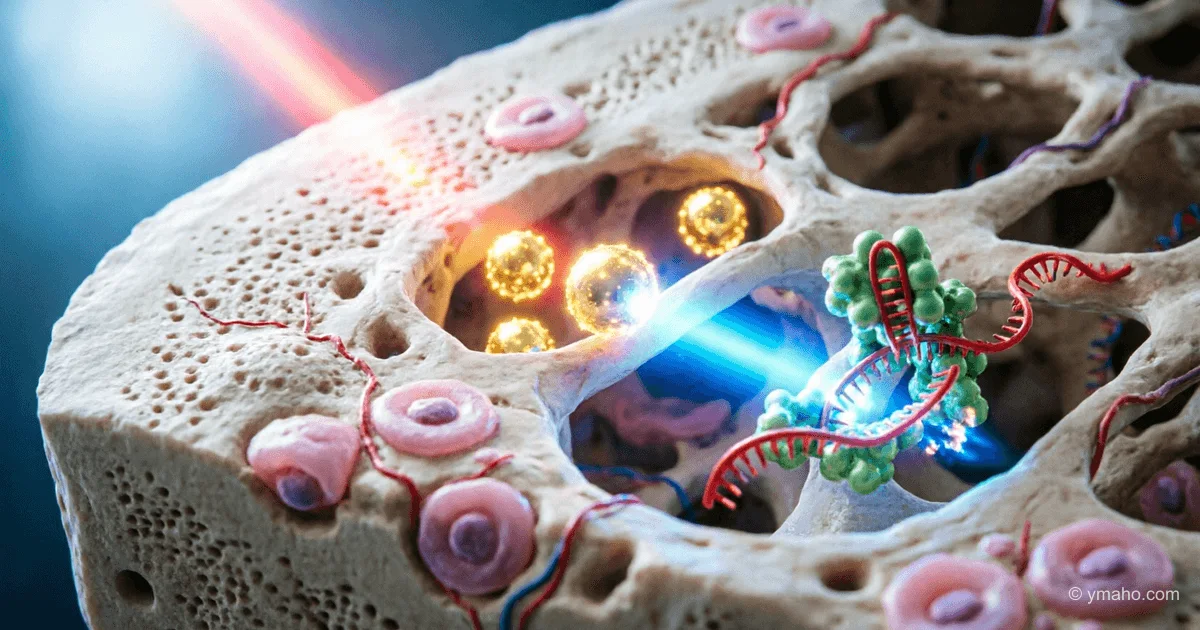
Scientists have developed the paCas13d system using nanoparticles that convert near-infrared light into blue light for non-invasive control of RNA therapy. In a mouse experiment, the system successfully cured osteonecrosis, preserving bone tissue.
Photoactivatable CRISPR/Cas13d: A Breakthrough in RNA Editing for Deep Tissues
Introduction
In April 2026, an international research team published a paper in Nature Communications describing a new RNA editing technology with an unprecedented level of control. The researchers developed a photoactivatable CRISPR/Cas13d system (paCas13d) that allows non-invasive control of gene expression in deep tissues using light. This achievement addresses a key challenge in modern RNA therapy: the lack of spatiotemporal control when delivering therapeutic molecules to hard-to-reach areas such as bone, cartilage, or internal organs.
The system combines three advanced technologies: CRISPR/Cas13d for precise RNA editing (unlike Cas9, Cas13d does not alter DNA, providing a temporary and safer effect), optogenetic proteins for light-dependent activation, and upconversion nanoparticles that convert deep-penetrating near-infrared light into activating blue light. In experiments on mice with a model of steroid-associated osteonecrosis, the system successfully prevented bone destruction while preserving the systemic efficacy of glucocorticoid therapy.
Event Details and Timeline
Background: The Problem of Spatiotemporal Control in RNA Therapy
A key limitation of existing gene-editing technologies is the inability to turn them on and off at the right time and place. Traditional approaches (viral vectors, lipid nanoparticles) lead to constitutive activity of therapeutic molecules, which can cause adverse effects in healthy tissues. Optogenetic systems that use light to control proteins offer an elegant solution, but their application is limited by the low penetration of visible light (blue light effectively penetrates only fractions of a millimeter into tissues).
Development of paCas13d: From Concept to Implementation
The work was carried out by researchers from several institutions: Tianjin Hospital, Nankai University, Tianjin Medical University, and Harvard Medical School. Key development stages:
- Structural design of split Cas13d: Based on bioinformatic analysis of RfxCas13d, optimal sites for splitting the protein into two non-functional halves were identified. Light-sensitive domains CRY2PHR and CIBN—a classic optogenetic pair from Arabidopsis—were attached to these fragments.
- Synthesis of upconversion nanoparticles (UCNPs-PEI): To overcome the tissue penetration barrier, nanoparticles based on rare-earth elements (e.g., Yb³⁺ and Tm³⁺ doped in NaYF₄) were created, capable of absorbing two or more near-infrared photons (980 nm) and emitting one blue photon (470 nm). The particle surface was functionalized with polyethyleneimine (PEI), ensuring efficient binding to negatively charged plasmid DNA encoding paCas13d and guide RNA.
- Formation of the UCNPs-PEI@paCas13d complex: The nanoparticles served both as a delivery system and as a local activation source.
Several key models were used for validation:
| Model | Purpose | Validation Result |
|---|---|---|
| Cell culture (HEK293T) | System control and efficiency measurement | Strict light-dependent activity |
| Orthotopic model (bone explants) | Confirmation of light-induced suppression of endogenous genes (TET3) | Successful activation through several millimeters of tissue |
| Mouse model of osteonecrosis (in vivo) | Therapeutic efficacy assessment | Suppression of osteocyte apoptosis, preservation of trabecular architecture |
| Biodistribution and toxicology | Safety assessment of nanoparticles | Minimal retention in non-target organs, no obvious toxicity |
Molecular Mechanism of Action
The study identified a new pathophysiological axis mediating steroid-induced osteonecrosis: TET3-5hmC-PTEN. Glucocorticoids increase expression of TET3 (a DNA dioxygenase that hydroxylates 5-methylcytosine). This increases production of 5-hydroxymethylcytosine (5hmC) in gene promoters, particularly PTEN. Elevated PTEN triggers a cascade leading to osteocyte apoptosis—a key step in the development of ischemia and bone collapse. paCas13d targeting TET3 mRNA breaks this chain.
Impact and Significance
For Medical Science and Biotechnology
Fundamental breakthrough. For the first time, non-invasive, reversible, and strictly localized RNA editing in deep tissues of a living organism has been demonstrated. This is not just an incremental improvement but a transition to a qualitatively new level of control over genetic interventions.
Expansion of optogenetic tools. Until now, optogenetic methods were only applicable to superficial or optically accessible tissues (brain with implanted fiber optics, skin, transparent embryos). Upconversion nanoparticle technology brings optical control to any body region accessible to IR radiation.
Platform nature. The system is modular: replacing the guide RNA redirects Cas13d to any transcript of interest. This means the same technological platform could potentially be adapted for dozens of diseases with different molecular etiologies.
For Orthopedics and Regenerative Medicine
Steroid-associated osteonecrosis (SAON) is a severe complication of systemic glucocorticoid therapy used for autoimmune diseases, organ transplantation, COVID-19, etc. The incidence of SAON in patients receiving high-dose steroids reaches 10–40%, and existing treatments (decompression, bone grafting, total joint replacement) are either invasive or palliative. The new approach offers minimally invasive prevention and treatment via a single injection of the nanocomplex followed by IR irradiation.
Important nuance: The authors emphasize that local suppression of TET3 in bone did not affect the systemic anti-inflammatory efficacy of glucocorticoids. This demonstrates the fundamental possibility of separating a drug's therapeutic effect from its side effects through spatially restricted RNA editing.
For Society and Patients
For millions of patients taking steroids for life-threatening conditions (rheumatoid arthritis, asthma, inflammatory bowel disease, lupus), SAON is a constant threat of disability, especially when the hip joint is affected. Developing a method that prevents this outcome without discontinuing baseline therapy would mean a dramatic improvement in quality of life and reduced costs for joint replacement.
Reactions of Key Players
At the time of this analysis (April 2026), the publication is just beginning to circulate, and full-scale expert comments from major research centers or regulators (FDA, EMA) have not yet arrived. However, based on the paper's content and scientific press reactions, several areas of expected discussion can be identified:
Optimistic assessment (Scienmag, bioinformatics portals): The technology is hailed as a "breakthrough," "turning point," and "new era of minimally invasive editing therapies." The synergy of CRISPR with nanotechnology and optogenetics is particularly noted as an example of interdisciplinary success.
Cautious stance from practicing physicians: The key question that will arise in the professional community is scalability and biodegradability. Although the study confirms UCNPs' biocompatibility, their long-term fate in the body (months and years) is not fully understood. Studies in large animals with long-term follow-up are needed. Additionally, the method requires specialized equipment for IR irradiation of deep tissues with spatial navigation, which may limit its widespread clinical adoption.
Patents and commercialization: Long before the Nature Communications publication, in 2022, Chinese researchers (including some co-authors of the current work) had already filed a patent for "a light-controlled CRISPR/Cas13d gene editing system, its application method and composition" (CN202210375019.9). This indicates a well-thought-out intellectual property strategy. The technology will likely be licensed to a biotech company (possibly a university spin-off) for preclinical development and preparation for clinical trial phases.
Forecast and Conclusions
Short-term Outlook (1–3 years)
- Preclinical trials in large animals (sheep, pigs) to confirm efficacy in weight-bearing bones and optimize dosing regimens.
- Biodegradation studies of UCNPs, as well as potential immunogenicity of repeated administrations.
- Expansion of target range — beyond TET3, attempts to target genes related to osteoarthritis (MMP13, ADAMTS5), bone metastases, and local inflammation can be expected.
Medium-term Outlook (3–7 years)
If preclinical data remain convincing — filing an IND (Investigational New Drug) application with FDA/NMPA and starting Phase I clinical trials. At this stage, tough questions will arise: how to precisely target nanoparticles to the affected area? how to control the depth and dose of IR irradiation to ensure full activation without tissue overheating? is generation of adaptive immune responses to bacterial proteins (Cas13d) or rare-earth elements possible?
Long-term Forecast
The technology has the potential to become a second-generation therapeutic platform for diseases requiring local, temporary modulation of gene expression. In oncology — activation of anti-tumor genes only within solid tumors; in neurology — suppression of mutant transcripts in Huntington's disease or Friedreich's ataxia in deep brain nuclei; in cardiology — limiting fibrosis after myocardial infarction.
However, it is critically important to note: None of the articles (including the original publication) provide data on cross-reactivity or off-target effects of CRISPR/Cas13d in the context of the photoactivatable form. Although Cas13d is considered more specific than Cas9, cases of non-specific collateral RNA cleavage ("satellite effect") are known. Will the activated small fraction of the paCas13d complex be sufficient for therapeutic effect without causing unwanted degradation of other transcripts? The answer to this question will determine whether this technology becomes a routine tool or remains an elegant but impractical proof-of-concept.
Conclusion
The development of photoactivatable CRISPR/Cas13d with upconversion nanoparticles is, without exaggeration, an important scientific achievement demonstrating how tools with previously unattainable capabilities emerge at the intersection of genetic engineering, nanotechnology, and optics. Successful treatment of osteonecrosis in mice paves the way for clinical trials. The fact that a patent was filed four years before the results were published speaks to the maturity of the research group and their confidence in the technology's potential. Now the ball is in the court of reproducibility in independent labs, large animal models, and ultimately regulators who must weigh the balance between innovation and risks of this complex multicomponent therapy.
— Editorial Team









