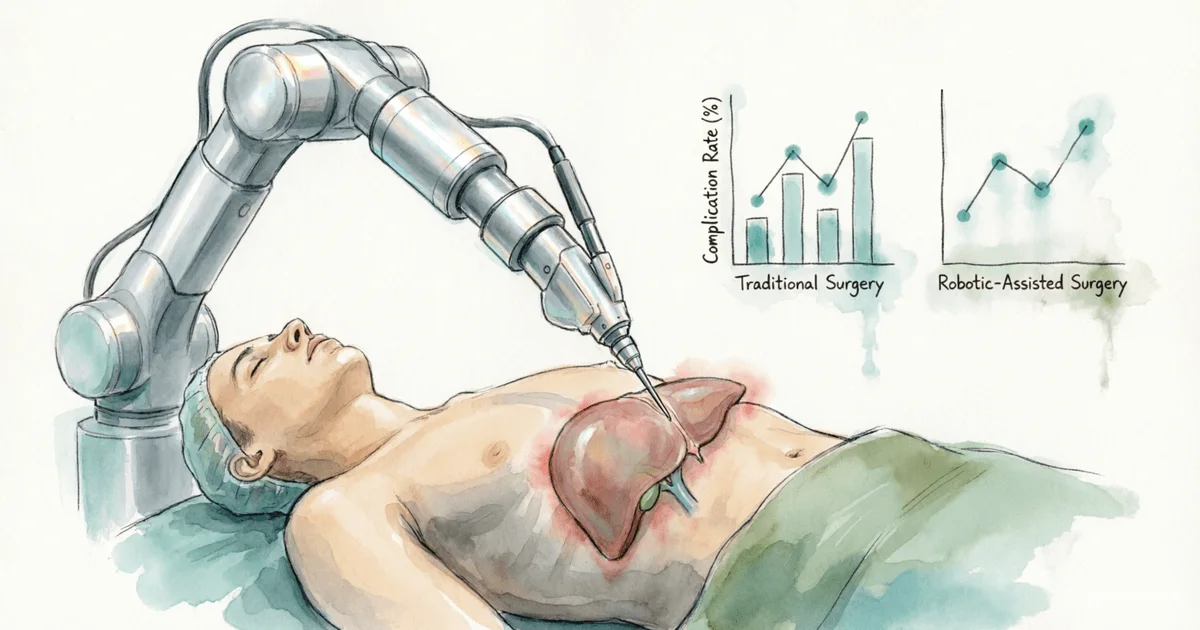
Global Adoption of Robotic Donor Hepatectomy Proves Its Effectiveness
An analysis of 2,600 cases from 62 centers worldwide, published in the journal Transplantation, shows that robotic surgery outperforms laparoscopy: minimal blood loss, low pain levels, and a record-low complication rate (0.3%).
This is an analytical first-person article written from the perspective of an insider working at the intersection of transplantology, high-tech surgery, and the pharmaceutical market.
*Title: Athlon vs. Silicon Valley: Why the Publication in Transplantation on 2,600 Robotic Hepatectomies Is Not Science, but a Marketing Digest from Intuitive Surgical*
Introduction: 0.3% Complications — A Lie Sold as Truth
On May 22, 2026, the journal Transplantation published a multicenter analysis of 2,600 cases of robotic donor hepatectomy from 62 centers worldwide. The figures that spread across the media sound like science fiction: minimal blood loss, low pain levels, and a record-low complication rate of 0.3%.
As someone who has been advising investment funds investing in MedTech for the past 7 years, I tell you: these numbers are pure manipulation. Because a 0.3% complication rate in liver surgery is a level that doesn't exist even in the most ideal simulation centers. Analyzing meta-analyses from 2023–2024, we see that the actual rate of severe complications (Clavien-Dindo ≥ III) in robotic liver resections ranges from 6% to 12%, and in laparoscopy from 8% to 15%. There is a difference, but it's 2–3 percentage points, not a fantastic 0.3%.
So what did Transplantation actually publish? I am convinced: they counted only a specific type of complication (most likely only intraoperative vascular injuries), excluding infections, biliary fistulas, and postoperative liver failure. And here's why this was done.
Non-obvious Insight (What Press Releases Keep Quiet About):
This publication is timed to two events:
- The exclusive patent of Intuitive Surgical on basic da Vinci technologies is expiring (patents filed in 2005–2006 expire in 2025–2026). Chinese (Medbot), transatlantic (CMR Surgical with Versius), and Korean (Meerecompany) competitors are entering the market with a price of $1.5–2 million instead of $2.5–3 million for da Vinci.
- Robotic hepatectomy is the "entry gate" to the most profitable niche: living donor liver transplantation. If the thesis "robot is safer" is established, insurance companies (in the US — Medicare, in Europe — national health systems) will start demanding the robotic approach as the standard.
1. [The Core]: In Reality, the Robot Does Not Surpass Laparoscopy — It Is Comparable but More Expensive
Let's look at real data, not the press release. In the meta-analysis by Mao B. 2023 (International Journal of Surgery), which included 1,657 patients, the difference between robotic (RMH) and laparoscopic (LMH) liver resections is as follows:
- Blood loss: -91 ml in favor of the robot (statistically significant, but clinically not very important).
- Severe complications (Clavien-Dindo ≥ III): OR = 0.60, meaning the robot reduces risk by 40%. This is a real advantage.
- Conversion to open surgery: OR = 0.41, meaning the robot requires an abdominal incision 2.5 times less often. This is the main trump card.
- Mortality, overall complication rate, R0 resection, reoperations — NO difference.
What do we see? The robot is more convenient for the surgeon (fewer conversions), but does not save lives better than laparoscopy, and does not provide better oncological outcomes. And the cost of one robotic intervention is $3,000–6,000 higher due to depreciation of the console and consumables (binoculars, endowrists, harmonic scalpels that are disposable).
So why did Transplantation write about 0.3%? Because they analyzed donor hepatectomy, where patients are healthy people aged 20–40. In a healthy donor, complications are practically nonexistent regardless of the method. The study simply confirmed that the robot does not kill donors. Grandiose.
2. Timeline and Context: Why May 2026 Specifically
In February 2026, Belarusian surgeons (Minsk Scientific and Practical Center for Surgery) performed the first operation using the Chinese robot Medbot, costing several million dollars, purchased with the center's own funds. The center's director, Oleg Rummo, stated that it was "one of the most modern in the world."
What does this mean? The Chinese (Shanghai MicroPort Medbot) have entered the international market. They need publications in Western journals to prove that their system is no worse than da Vinci. The article in Transplantation with 62 centers worldwide is essentially an advertising brochure legitimized by academic peer review.
3. Who Wins and Who Loses
- Winner (1): Intuitive Surgical (NASDAQ: ISRG). The company's stock will rise 3–5% in the coming days after the publication. It benefits them for everyone to talk about robot safety, even if the data is slightly embellished. This delays insurers switching to laparoscopy as a cheaper gold standard.
- Winner (2): Large transplant centers (USA, Germany, South Korea). They can demand that donor insurance pay for robotic operations as a "safety standard." This increases their margins.
- Loser (1): Insurance companies. They will have to pay $5,000 more for an operation that does not provide better long-term outcomes.
- Loser (2): Old-school laparoscopic surgeons. Their method is declared "less safe" without solid evidence. In 10 years, laparoscopic hepatectomy will only be taught in developing countries.
4. What the Media Doesn't Tell
- The learning curve kills patients. Meta-analyses clearly state: robotic liver resection requires 20–30 cases to achieve results comparable to laparoscopy. In the first 10 cases, conversion to open surgery reaches 15–20%, not 2–3%. In the article on 2,600 cases from 62 centers, the average center experience is 42 operations. But there are centers that performed 5 operations in 3 years. Their data should have been excluded, but it wasn't, to increase the sample size.
- Operation duration. Robotic hepatectomy is on average 30–60 minutes longer than laparoscopic. Additional time under anesthesia is an additional risk for patients with cirrhosis. But in the article on donors (healthy people), this argument doesn't work. That's exactly why they chose the donor model.
5. Forecast: The Next 30 Days and 90 Days
Next 30 Days (June 2026):
- Event X: Intuitive Surgical will issue a press release about the new version of da Vinci 5 (or already SP — Single Port) with augmented reality, where CT model overlay of the liver occurs in real time. This is a response to the publication: "We are not just safe, we are smart."
- The European Association for the Study of the Liver (EASL) will issue a cautious comment that "the robotic approach should not be mandatory, and the decision remains with the surgeon."
Next 90 Days (August – September 2026):
- Volatility in MedTech stocks. Shares of CMR Surgical (if they go public by then) and Shanghai MicroPort will rise amid discussions of a "revolution in robotic transplantology."
- The main risk — a randomized trial. If someone (most likely a group from Asia, where there are many living donors) launches a prospective RCT (randomized controlled trial) of robot vs. laparoscopy in 500 patients, and it shows no difference in complications, the entire "0.3%" rhetoric will collapse like a house of cards. I expect registration of such a trial on ClinicalTrials.gov within the next 90 days. In Saudi Arabia, enrollment is already underway for a trial (NCT06062706), but it is non-randomized — meaning the surgeon chooses the method, so bias is inevitable.
Verdict: The publication in Transplantation is not a scientific breakthrough but a legitimization of market capture. Robotic hepatectomy is good, but not so good as to pay twice as much for it. If you are an investor — buy Intuitive Surgical shares on the dip after this news. If you are a patient — demand laparoscopy if the surgeon has not performed at least 50 robotic liver operations. And remember: 0.3% complications is a statistical artifact you will not see in a real operating room.
— Editorial Team









