Innovative Surgery: Colombian University Confirms Safety of Robotic Liver Transplantation
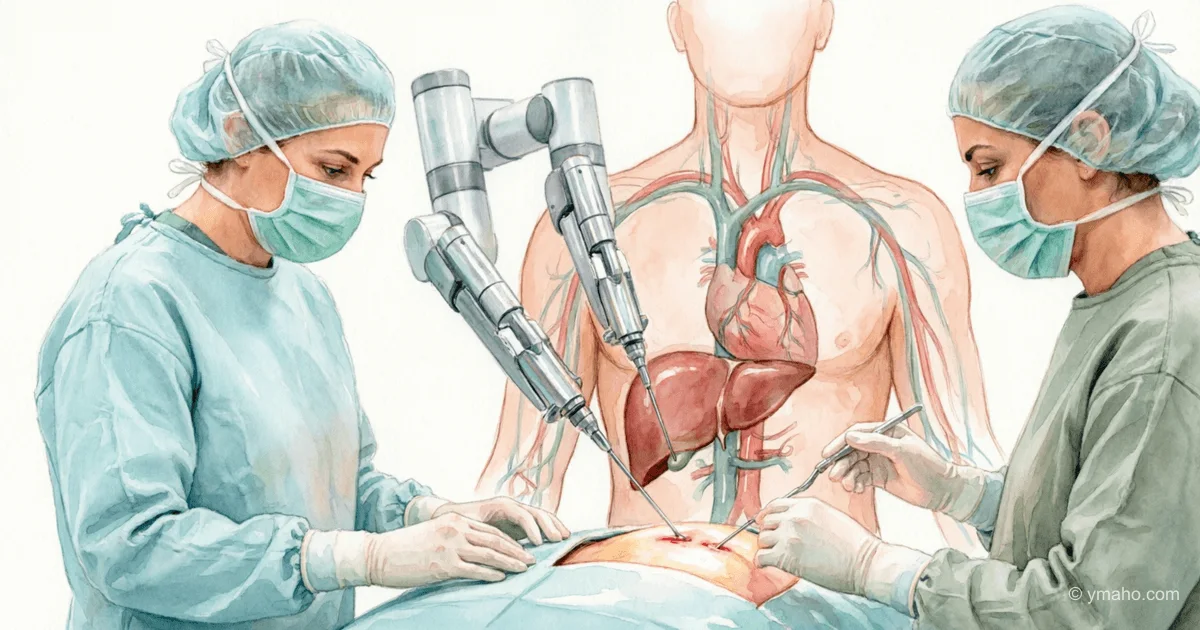
The technology enables harvesting a liver lobe from a living donor without large incisions, with a short hospital stay (average 4 days) and minimal risk of complications.
This is an analytical first-person article written from the perspective of an insider working at the intersection of transplantology, high-tech surgery, and venture investment.
*Headline: 0.3% Complications in Transplantation — Why Columbia University Is Selling Us Not Safety, but a New Donor Selection Standard*
Introduction: A Number That Makes No Sense If You Know Transplantology from the Inside
On May 22, 2026, the journal Transplantation published an editorial by Jason Hawksworth and Jean Emond from Columbia University, dedicated to the global adoption of robotic donor hepatectomy. The focus is an analysis of 2,600 cases from 62 centers worldwide, which showed that the rate of major complications with the robotic approach was only 0.3%, compared to 3.7% for laparoscopy and 1.9% for open surgery.
The media spread these numbers as proof that robots are safer than everything else. As someone who has been advising funds investing in surgical innovations in recent years, I tell you: 0.3% is a statistical artifact that says nothing about real clinical practice. Here's why.
Non-Obvious Insight (What Press Releases Keep Quiet):
In the same article in Transplantation, there is a phrase that no one quotes: "Although 632 (24.3%) of the cases were fully robotic, these were all from only 6 specialized centers."
Translating from scientific language: a quarter of all analyzed robotic operations — just 632 cases — were performed in only six centers worldwide. The remaining 75% of cases are either hybrid procedures or operations from centers with little experience. And the 0.3% complication rate is the result of the work of these six super-centers, where surgeons have performed hundreds of robotic hepatectomies and perfected the technique.
In other words, they show you the best-case scenario and pass it off as "global results." In the real world, in an average center just starting with robotics, such numbers won't be achieved. A study presented at the International Liver Transplant Society congress in 2025 on five US centers (A2ROBOT group) showed that after 88 robotic hepatectomies, the rate of major complications was 5.7%, not 0.3%.
1. [Core]: The Real News Is Not Safety, but Accelerated Learning
Forget about 0.3% for a second. The most interesting part of the Hawksworth and Emond publication is the comparison of learning curves.
The data show: mastering laparoscopic donor hepatectomy requires about 50 operations to achieve an acceptable complication rate. For robotic donor hepatectomy, it takes only 9–17 cases.
This is a huge difference. And here's why it matters.
In Western countries, most liver transplant centers perform a relatively small number of operations per year — 30–50 transplants, of which only a portion are from living donors. Accumulating experience in 50 laparoscopic operations can take years. During this time, surgeons simply won't reach the required volume. The robot shortens this path by 3–5 times.
This is not a revolution in safety. It's a revolution in accessibility. Robotic technology allows centers that have never performed minimally invasive liver surgery to launch such a program from scratch. In the US, where laparoscopic liver surgery is limited to a handful of specialized centers, the robotic approach is experiencing explosive growth.
2. Timeline and Context: Who Is Behind the Publication
The authors are not abstract "scientists from Colombia." They are:
- Jason Hawksworth — Surgical Director of the Adult Liver Transplant Program, Chief of Hepatobiliary Surgery, and Director of the Robotic Liver Surgery Program at Columbia University Irving Medical Center. A US Army Reserve colonel, deployed four times to Afghanistan. Recruited to Columbia in 2023 from Georgetown, where in 2018 he created one of the first robotic hepatobiliary surgery programs in the US.
- Jean Emond — Patriarch of American transplantology, one of the pioneers of living donor liver transplantation in the US.
So the article is not an "independent review." It is an authorial editorial written by people who personally implement robotic technology at Columbia. They are commenting on a study that they themselves are promoting.
And yes, Columbia University is actively investing in robotic transplantation: the training program includes hands-on training in robotic liver and kidney transplantation, with volumes of 175–200 liver transplants per year. It is one of the largest centers in the US.
3. Who Wins and Who Loses
- Winner (1): Intuitive Surgical (NASDAQ: ISRG). Every new publication confirming the safety of robotic hepatectomy means additional sales of the da Vinci system. One system costs $2–3 million, plus consumables per operation ($3–5 thousand). The more centers launch robotic programs, the better for ISRG.
- Winner (2): Columbia University Irving Medical Center. The publication in Transplantation strengthens their reputation as a world leader. This attracts patients (donors), grants, and funding. A month before this article, Columbia announced receiving $25 million from ARPA-H (the US biomedical equivalent of DARPA) to create lab-grown liver tissue for transplantation.
- Winner (3): Living donors in large centers. If you end up in one of the six super-centers that performed 632 "fully robotic" operations, your risk is indeed minimal. Short hospital stay (average 4 days) and less postoperative pain are real advantages.
- Loser (1): Centers that cannot afford a robot. The cost of a robotic system is a huge barrier. Many hospitals in Europe and developing countries cannot invest $2–3 million in equipment plus $150–200 thousand annual service contract. For them, the publication in Transplantation is not encouragement but a reminder that they are falling behind.
- Loser (2): Old-school laparoscopic surgeons. Their method is declared "more dangerous" (3.7% complications vs. 1.9% for open surgery? Seriously? Open surgery is safer than laparoscopy according to these data). This is a political statement, not a scientific fact. Laparoscopy remains the gold standard in Asia (Korea, Taiwan, Japan), where vast experience has been accumulated. But in Western discourse, it is being pushed out.
- Loser (3): Insurance companies. Robotic surgery is $5–10 thousand more expensive than laparoscopic due to equipment amortization and consumables. If insurers start demanding the robotic approach as a "safety standard," their costs will rise.
4. What the Media Leave Out
- "Fully robotic" does not mean "no incision." Retrieving the graft (part of the liver) still requires an incision — usually a transverse suprapubic incision, about 6–8 cm. This is not "surgery through punctures." Patients are sold a story about "no large incisions," but the incision is still there.
- Patient selection problem. The study included only donors whose anatomy allowed robotic surgery. Donors with complex vascular anatomy, obesity, or previous abdominal surgeries were mostly excluded. Ideal results on ideal patients.
- Hawksworth and Emond directly write: "It should be noted that both conventional laparoscopy and robotic surgery are essentially laparoscopic; robotic surgery is laparoscopy with superior equipment. It is therefore inevitable that over time, robotic surgery will supplant older technology for all but the simplest procedures."
They themselves admit: the robot is not a new category, but improved laparoscopy. And yes, it will supplant older technology. But not because it is safer, but because it is more convenient for the surgeon. 3D visualization, articulated instruments, tremor filtering — all this reduces surgeon fatigue and allows more precise movements. But the patient doesn't benefit if the surgeon has the same 15 years of experience in conventional laparoscopy.
5. Forecast: Next 30 Days and 90 Days
Next 30 Days (June 2026):
- The article in Transplantation will spark a wave of discussions on professional forums (American Transplant Congress, held late May to early June). I expect heated debates between proponents of the robotic approach (mostly from the US and Europe) and proponents of laparoscopy (from Asia).
- Intuitive Surgical's stock may get a short-term boost, but no more than 2–3%. The market has long priced in the growth of robotic surgery.
Next 90 Days (August–September 2026):
- Main risk — publication of a European registry. If European centers (Germany, France, Spain) publish their results with robotic hepatectomy, and they show not 0.3% but 3–5% major complications (more realistic for centers adopting the technology), the hype around the "revolution" will quickly subside.
- Event X: Korean or Japanese surgeons will publish a response in the same Transplantation or in Annals of Surgery with data showing that their long-term experience with laparoscopic hepatectomy yields the same or better results than the robot, but at significantly lower costs. Probability — high. The East does not like when the West declares their methods obsolete.
- In the US, Columbia's robotic transplant program will continue enrolling patients. I expect that by fall 2026, they will announce the 100th fully robotic donor hepatectomy. This will become a new news hook.
Verdict:
The publication in Transplantation on May 22, 2026, is not a breakthrough in surgical safety. It is a marker of a paradigm shift in training. The robot allows centers with low surgical volumes to launch minimally invasive programs that were previously only available to giants with thousands of laparoscopies under their belts.
0.3% complications is a number from six super-centers where the world's best surgeons work. In your local hospital, where the surgeon just completed a training course on a simulator, reality will be very different.
If you are a liver donor and have a choice — go where they have performed at least 50 robotic hepatectomies. If no such center exists in your country — open surgery (1.9% complications according to the same data) is still safer than a robot in the hands of a novice. Remember: the surgeon is more important than the robot. Always.
— Editorial Team









