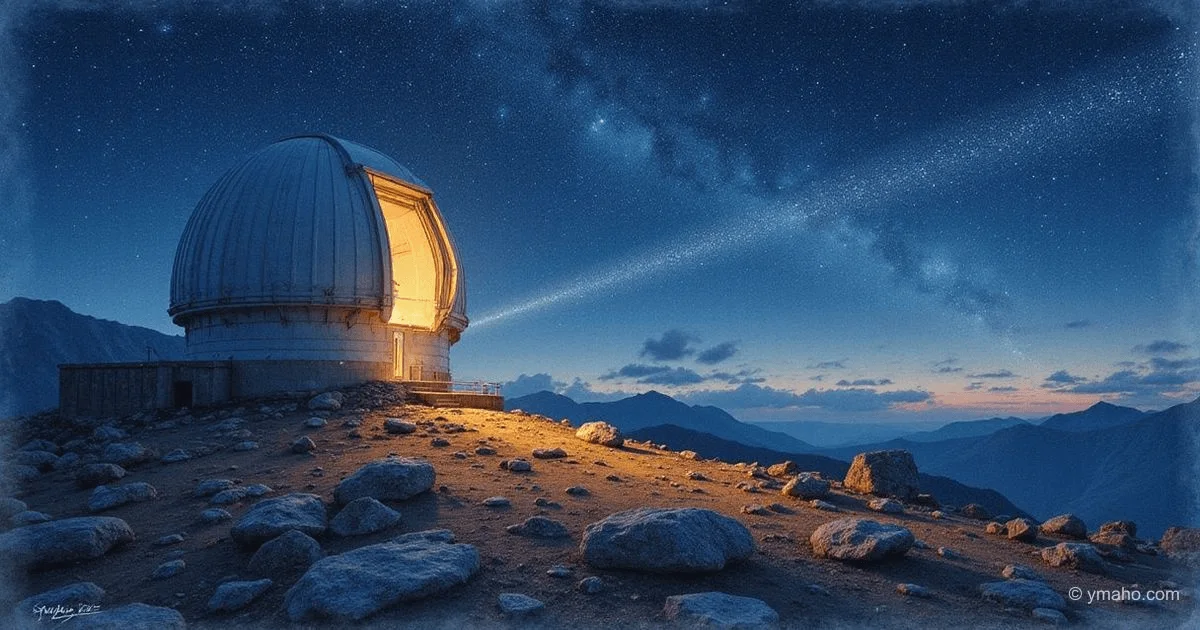
Rubin Observatory Spots 11,000 New Asteroids — And It’s Just Getting Started
A powerful new telescope in Chile has already discovered 11,000 previously unknown asteroids—and tracked tens of thousands more—using just a few days of early test data. For anyone who’s ever wondered what’s floating around our cosmic neighborhood, this matters: the more we know about these space rocks, the better we can understand how our solar system formed and whether any might one day come too close to Earth.
A Sky-Scanning Machine Like No Other
The Vera C. Rubin Observatory isn’t your average telescope. Perched on a mountain in Chile, it’s built around an 8.4-meter mirror and a camera so big it could capture the entire southern sky every few nights. Think of it like a high-speed cosmic security camera that doesn’t just take snapshots—it builds a living movie of the night sky, frame by frame, night after night.
This constant re-imaging lets astronomers spot objects that move or change brightness—like asteroids zipping between planets. Older surveys might find tens of thousands of asteroids in a whole year. Rubin found thousands in just days.
What Did It Actually Find?
Most of the new discoveries are main-belt asteroids—rocky leftovers from the solar system’s birth, orbiting quietly between Mars and Jupiter. But Rubin also spotted:
- 33 new near-Earth objects (NEOs): These are asteroids whose paths bring them relatively close to our planet. None pose a threat now, but tracking them is crucial for long-term planetary safety.
- About 380 trans-Neptunian objects (TNOs): Icy bodies far beyond Neptune, moving so slowly they’re hard to detect. Finding them is like spotting a drifting iceberg in a dark ocean from miles away.
To uncover these distant specks, scientists used smart software that tests billions of possible motion paths across massive image sets—like solving a billion-piece puzzle where only a few pieces actually move.
Why This Changes Everything
Before Rubin, we knew of roughly 1.4 million asteroids. That sounds like a lot, but it’s likely just a fraction of what’s really out there. Over its planned 10-year mission, Rubin could add millions more to the catalog.
More importantly, it will refine the orbits of known asteroids with incredible precision. Right now, we’ve only tracked about 40% of the larger near-Earth asteroids that could cause regional damage if they hit us. Rubin is expected to push that number to 70%—giving us earlier warnings and more time to respond if needed.
As Kevin Napier, a scientist at the Harvard-Smithsonian Center, put it: “These objects are like time capsules from the early solar system. They can tell us how planets migrated, whether a hidden ninth planet exists, and how chaos shaped our cosmic backyard.”
What Does This Mean for Regular People?
You don’t need to be an astronomer to care about asteroids. First, knowing where they are helps protect Earth—early detection is our best defense. Second, studying them reveals how rocky planets like ours formed billions of years ago. And third, it reminds us that the solar system isn’t static; it’s a dynamic place full of moving parts we’re only beginning to map.
Key Takeaways
- The Rubin Observatory discovered 11,000 new asteroids in just a few days of early testing.
- It also tracked tens of thousands more with far greater accuracy than before.
- Among the finds: 33 near-Earth objects (none dangerous) and 380 icy bodies beyond Neptune.
- Once fully running, Rubin could triple the number of known hazardous asteroids we’ve tracked.
- This isn’t just about counting rocks—it’s about understanding our origins and safeguarding our future.
— Editorial Team









