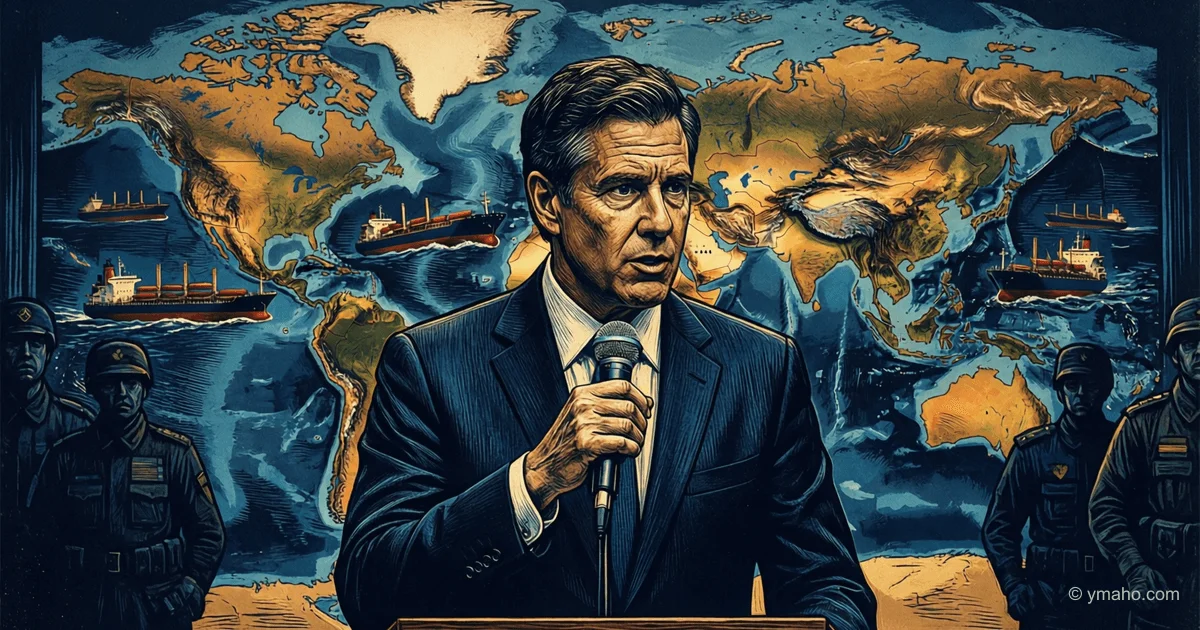
Media: US Secretary of State Rubio Says 'Plan B' Needed if Iran Talks Fail
Speaking to NATO foreign ministers in Sweden, Secretary of State Marco Rubio stated that the US must have a 'Plan B' if Iran does not compromise. Washington insists on the full reopening of the Strait of Hormuz, cessation of Iranian nuclear activities, and no sanctions relief without serious concessions.
Rubio's 'Plan B': Why the US is Preparing for War While Pretending to Want Peace
[The Gist]: What's Really Happening
Secretary of State Marco Rubio's speech at the NATO foreign ministers' meeting in Helsingborg on May 22, 2026, is no routine diplomatic démarche. It is a public admission that Washington no longer believes in the success of negotiations with Iran and is shifting to operational planning for coercion by force.
The key phrase, which markets have not yet fully digested: 'We must have a Plan B in case someone shoots.' Rubio directly stated that the question is no longer whether Iran will open the strait, but what to do if it says no.
Official rhetoric maintains a positive facade: 'some progress has been made,' 'a little movement.' But these stock phrases sharply contrast with the concrete naval preparations already underway without official announcement. Rubio effectively confirmed that France and the UK are forming a naval coalition to ensure shipping. The US emphasizes: 'We are not asking NATO for help, but allies are ready to provide it.'
What does this mean for investors? 'Plan B' is a euphemism for military escalation. And markets are beginning to price it in.
Timeline and Context
- May 18, 2026: President Trump announces a delay in strikes on Iran to give diplomacy a chance. However, media simultaneously report large-scale preparations by the US and Israel to resume strikes. Trump warns: time for Iran is running out.
- May 19: The planned strike is canceled at the request of Gulf states. Trump speaks of 'very good chances' for a deal.
- May 20-21: Pakistan intensifies mediation. The head of Pakistan's Joint Chiefs of Staff flies to Tehran — his third trip in recent days. The US transmits a new package of proposals to Iran through intermediaries.
- May 22: NATO foreign ministers meet in Helsingborg. Rubio makes the 'Plan B' statement. He confirms that Washington is waiting for Iran's response to its proposals but is preparing an alternative.
- May 23: The news is published in global media. Markets begin reassessing the probability of a military scenario.
Key context often overlooked: The NATO ministers' meeting was scheduled in advance, but the Strait of Hormuz became the central topic precisely because of the failure of the diplomatic track. The US did not ask NATO for direct involvement but received 'many approving nods' from allies. This is important: behind the scenes, consensus has already been reached.
Who Wins and Who Loses
Winners:
- US defense contractors (Lockheed Martin, RTX, General Dynamics). Any military escalation in the Persian Gulf means a new round of procurement of precision munitions, cruise missiles, and air defense systems. Estimates suggest that merely replenishing stocks after Operation Epic Fury will cost the Pentagon $3-5 billion. 'Plan B' would add another $2-3 billion.
- Oil volatility traders. Hedge funds holding long positions on Brent options with strikes of $120-130 will see multiplicative profits if 'Plan B' becomes reality. Implied volatility on oil options has already risen 15-20% after Rubio's statement.
- Gold. As a classic safe haven, gold gains momentum from any increase in geopolitical risk. Demand for physical gold in Asia (especially China and India) has been rising for the third consecutive week.
Losers:
- Global supply chains through the Persian Gulf. If 'Plan B' involves forcibly opening the strait, it means at least several weeks of military operations with a complete halt to shipping. Container freight rates (FBX) would skyrocket 200-300% within a month.
- Oil-importing countries (Japan, South Korea, India, EU nations). They are already paying 20-30% more for oil than pre-crisis levels. Military escalation would add another $20-30 risk premium to Brent.
- Tourism sector in the UAE and Qatar. Hotels in Dubai and Abu Dhabi report a wave of cancellations for June-July — tourists do not want to risk being in a potential conflict zone. Hotel industry losses are estimated at $300-400 million per month.
What the Media Isn't Saying
Non-obvious insight: Rubio's 'Plan B' is not just a military scenario. It is a political signal for the domestic US audience and for allies, while simultaneously serving as an element of negotiating pressure on Iran.
The statement was made on the eve of Pakistan carrying another US proposal package to Tehran. The public threat of 'Plan B' is a classic 'good cop/bad cop' tactic, but at the interstate level. The US tells Iran: 'Here are our terms. If you accept them, we make a deal. If not, we have an alternative, and you don't want to know what it is.'
A second detail that goes unmentioned: Rubio's statement that the US 'does not need NATO's help' but 'welcomes it' is a diplomatic euphemism. In reality, the Pentagon critically needs logistical support from European allies. An aircraft carrier group is powerful, but for a full blockade and coercion to open the strait, dozens of ships, tanker aircraft, reconnaissance data, and bases are required. Without British bases in Cyprus and French bases in Djibouti, the operation would be far more difficult.
Third: the domestic political context in the US. The Senate is considering a bill that could force Trump either to end the war with Iran or obtain official congressional authorization to continue it. 'Plan B' is also a way for the administration to show Congress that it is 'acting decisively' rather than 'dragging out negotiations.' It's a public relations play ahead of the November 2026 midterm elections.
Forecast: Next 30 Days and 90 Days
30 days (by end of June 2026)
- Probability of military escalation: 25-30%. Trump has indicated he is willing to wait 'a couple of days' but no longer. If by May 28-30 Iran does not give an acceptable response on the strait and nuclear program, Trump's rhetoric will harden and military preparations will become more overt.
- Pakistani mediation will continue, but its effectiveness is waning. Iran has already used pauses in negotiations three times to strengthen its position in the strait.
- Brent oil will remain in the $100-110 range, but with asymmetric upside risk. Any news of military preparations will add $3-5 within 24 hours.
90 days (by end of August 2026)
- Optimistic scenario (40% probability): Iran makes concessions on the strait (abandons the fee system) and freezes enrichment at 3.67%. The US partially lifts sanctions. 'Plan B' stays in the drawer. Oil at $80-90.
- Base scenario (45% probability): Status quo with constant low-intensity threats. 'Plan B' remains a pressure tool but is not implemented. Negotiations drag on for months. Oil at $95-105.
- Pessimistic scenario (15% probability): Iran rejects all compromises. The US and allies launch an operation to forcibly open the strait ('Plan B'). The Strait of Hormuz is completely blocked for 2-4 weeks. Oil at $130-150. A global recession by end of 2026 becomes inevitable.
Editorial Forecast
Asset: Brent crude. Direction: Moderate rise in the next 24-72 hours to the $106-108 per barrel zone. Key levels: Support — $100 (psychological level), resistance — $112 (current conflict high). Confidence level: Medium (55%). Main risk: If Pakistan announces a breakthrough in negotiations within 48 hours, oil could correct 5-7% in a single day — markets will prefer to price in peace, even if fragile.
The editorial opinion is analytical in nature and does not constitute individual investment advice.
— Editorial Team









