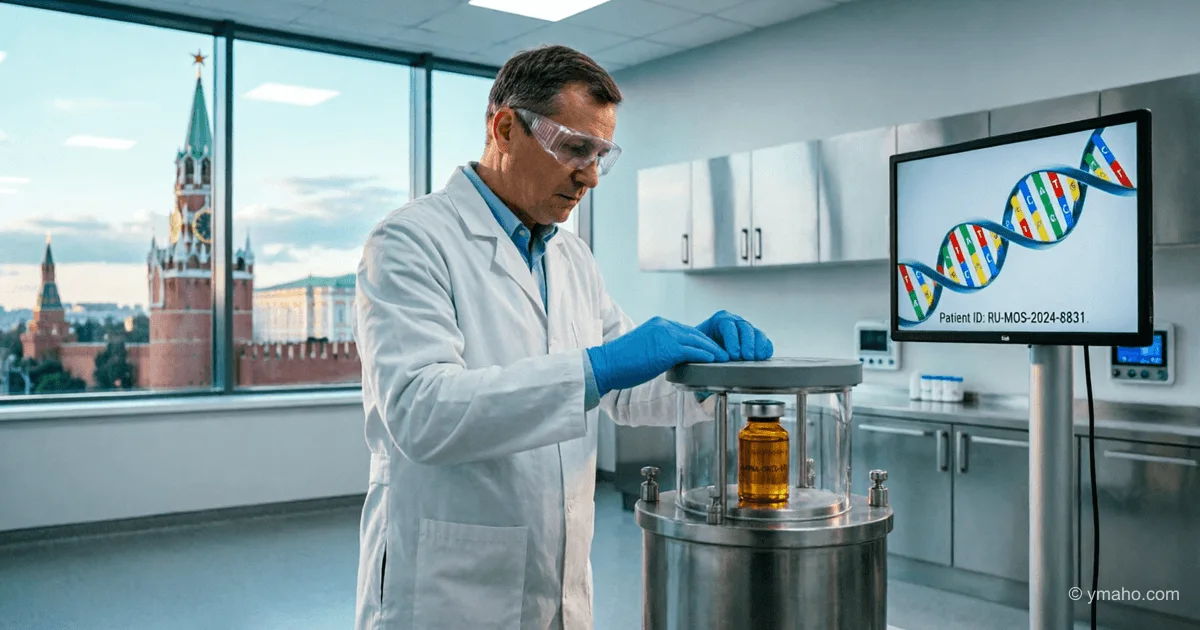
Russian mRNA Cancer Vaccine Included in State Guarantee Program for 2026
The personalized mRNA vaccine from Gamaleya NRCEM ("Oncopept") has been approved for inclusion in the state guarantee program for cancer treatment.
Russian mRNA Cancer Vaccine: Inclusion in the 2026 State Guarantee Program
Introduction
April 2026 marked a turning point in the history of Russian oncology. The Russian government included personalized anticancer vaccines and CAR-T therapy in the state guarantee program for free medical care. This decision, announced by Prime Minister Mikhail Mishustin at a meeting with deputy prime ministers, opens access to the most advanced treatment methods for thousands of Russian patients who previously could only rely on them within clinical trials or on a commercial basis.
Development is proceeding along two main directions. First, the mRNA vaccine "Neooncovac" from the Gamaleya National Research Center for Epidemiology and Microbiology, intended for the treatment of melanoma—an aggressive form of skin cancer. Second, the peptide vaccine "Oncopept" from the FMBA of Russia, targeting metastatic colorectal cancer. The FMBA portfolio also includes a third vaccine—the mRNA drug "Oncorna" for treating the same type of cancer.
Event Details and Timeline
Development Timeline: From Idea to Clinic
The journey of the Russian anticancer vaccine to the patient was rapid by pharmaceutical standards, but went through several key stages:
- 2024 — Active announcements about creating a full-cycle technology for producing personalized mRNA drugs, testing on animals.
- February 2025 — The government adopts a resolution on a special legal regime for personalized biologics produced directly in medical institutions.
- November 2025 — The Russian Ministry of Health issues approvals for clinical use of two vaccines: "Neooncovac" (mRNA for melanoma) and "Oncopept" (peptide for colorectal cancer). Minister Mikhail Murashko emphasizes that "this is just the beginning of applying an innovative approach, and at the initial stage, we are not talking about mass use."
- December 2025 — A factory for producing mRNA vaccines is launched at the Gamaleya Center, with the first three validation batches of the drug released. A full package of permitting documentation "from diagnostics to application" is obtained.
- March 31, 2026 — Historic moment: the first patient with colorectal cancer receives three doses of the "Oncopept" vaccine, with good tolerability.
- April 1, 2026 — A 60-year-old resident of the Kursk region with skin melanoma is the first to receive the personalized mRNA vaccine "Neooncovac".
- April 2, 2026 — The government adopts Resolution No. 365 on including vaccines and CAR-T therapy in the state guarantee program.
- April 20, 2026 — Administration of the vaccine to a second patient is scheduled.
Mechanism of Action: "Training" the Immune System
Both drugs belong to the class of neoantigen vaccines. The technology is as follows: a tumor tissue sample is taken from the patient, and complete genome sequencing is performed. Using bioinformatics, unique mutations (neoantigens) specific to that tumor are identified. In the laboratory, peptides (or messenger RNA encoding these peptides) are synthesized and administered to the patient.
The immune system "gets acquainted" with these structures foreign to normal tissues and activates T-lymphocytes to precisely destroy tumor cells throughout the body. This is not a preventive vaccination, but a personalized therapy—each vaccine is produced individually for a specific patient and cannot be used for another person.
Financial Aspects and MHI Tariffs
Inclusion in the state program involves detailed elaboration of financial standards:
| Therapy Type | Cost (RUB) | Indication |
|-------------|-----------------|-----------|
| CAR-T therapy | 7.03 million | B-cell lymphomas, leukemias |
| "Oncopept" (peptide) | 863.7 thousand | Colorectal cancer, 3rd+ line |
| Diagnostics (neoantigen profile) | 428.5 thousand | For mRNA vaccine |
| Initiation course (mRNA) | 5.8 million | Includes design and synthesis |
| Maintenance dose + monitoring | 342.7 thousand | Efficacy assessment |
Treatment will be provided only in federal clinics with the necessary equipment, funded by the normalized insurance reserve of the Federal Compulsory Medical Insurance Fund.
Impact and Significance
For Russian Healthcare and Patients
The main significance of the event is accessibility of innovations. Previously, personalized vaccines were either not used at all in Russia, or were available to a few within experimental protocols or at huge costs abroad. Now the state takes over funding, and this changes the landscape of cancer care.
Using the "Oncopept" vaccine as an example: as of April 2026, 543 applications have been processed, and 24 patients have been selected for treatment. The indication is metastatic colorectal cancer after two or more lines of unsuccessful systemic therapy. For these patients, for whom standard methods have been exhausted, the vaccine becomes a "salvage therapy."
The production cycle for one dose of "Oncopept" takes 49 days (including 7 days of quality control). This imposes limitations on scaling, but the first step has been taken.
For Medical Science and Industry
Russia enters an extremely narrow circle of countries capable of developing and producing personalized mRNA vaccines (alongside the USA and Germany, where Moderna and BioNTech operate). Creating its own technological platform is an achievement of technological sovereignty.
It is important to understand the nuance emphasized by Mikhail Murashko: "this technology is not a panacea, but just one of the treatment methods." Efficacy remains to be evaluated in real clinical practice. However, the very fact of launching a full cycle of "diagnostics—synthesis—application" on a national scale is a technological breakthrough.
Reactions of Key Players
Alexander Gintsburg, Director of the Gamaleya Center, called the key achievement the receipt of a full package of permitting documentation and the launch of the factory. According to him, the development has already attracted interest abroad—about a dozen inquiries have been received from other countries.
Mikhail Murashko, Minister of Health, takes a cautious but optimistic stance in his statements: "it is clear that at the initial stage, we are not talking about mass use. This can be discussed after evaluating efficacy and safety."
Mikhail Mishustin, Chairman of the Government, stated at a meeting with deputy prime ministers: "Now, free of charge under the compulsory medical insurance policy, it will be possible to undergo treatment using Russian oncovaccines. First of all, personalized ones, which are developed individually for a specific patient and train their immune system to fight the tumor."
The professional community (RUSSCO) assesses the situation with restraint. Society Chairman Dmitry Nosov notes that "there is no clear understanding of the effectiveness of this approach yet." Experts emphasize that this is only the beginning of a long journey.
Forecast and Conclusions
The inclusion of oncovaccines in the state guarantee program in 2026 is not a finish line, but only the start of clinical application. According to the official position of the Ministry of Health, the first stage will involve evaluating the efficacy and safety of the drugs in real patients. Only after accumulating data can we talk about expanding indications and scaling.
The most realistic scenario:
- 2026–2027 — Accumulation of clinical experience, logistics optimization (49-day production, patient selection), assessment of real-world efficacy.
- 2028–2030 — Expansion of indications to other tumor types (developments are already underway for glioblastoma and other nosologies).
The main challenge remains the personalized nature of the therapy: each new patient requires a full cycle of sequencing and production. This fundamentally limits the system's throughput. Nevertheless, the very fact that a Russian patient can receive innovative therapy free of charge under compulsory medical insurance is a historic achievement.
Key conclusion: The government's decision signals that Russia is betting on high-tech personalized medicine. At the same time, both the scientific community and regulators emphasize: this is not a miracle weapon, but a new, promising method of treatment that requires careful study. Now the word belongs to clinical practice—will the vaccine demonstrate the efficacy expected of it?
— Editorial Team









