Cell Metabolism: Garlic Compound Reverses Muscle Weakness in Old Mice
Scientists from Japan have discovered that S-1-propenyl-L-cysteine (S1PC) activates the 'adipose tissue-brain-muscle' axis via eNAMPT exosomes, significantly improving skeletal muscle strength and reducing the frailty index in model experiments.
Garlic Compound and Muscle Aging: Why This Is Much More Than Just 'Eat Garlic'
When Cell Metabolism publishes a paper on May 7 showing that a garlic derivative reverses muscle weakness in old mice, most media outlets run variations of the headline 'scientists find another benefit of garlic.' That's a superficial reading. In reality, this is an event that could reshape the $60+ billion anti-aging supplement market—and simultaneously set a precedent for how traditional nutraceuticals can achieve pharmaceutical-grade evidence.
The Core: What's Really Happening
The Japanese team led by Dr. Shin-ichiro Imai—the pioneer behind the 'NAD World' concept and systemic aging—demonstrated something far more fundamental than 'garlic is good.' They identified a specific compound, S-1-propenyl-L-cysteine (S1PC), that activates a cascade of inter-organ communication: adipose tissue → hypothalamus → skeletal muscles. Crucially, they proved this cascade works not only in mice but also in humans.
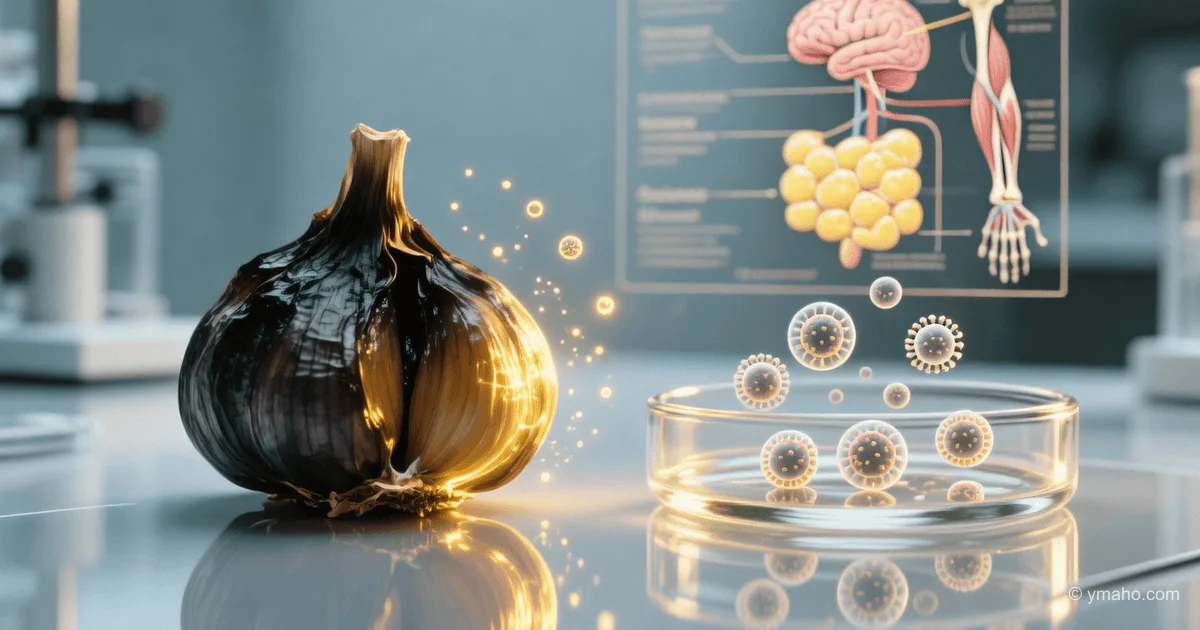
The key point: S1PC does not act directly on muscles. The molecule enters white adipose tissue, activates the enzyme LKB1 (a key regulator of cellular metabolism), which triggers the SIRT1 pathway and the release of exosomes containing eNAMPT—an enzyme critical for NAD+ synthesis. These exosomes travel through the bloodstream to the hypothalamus, where they boost local NAD+ levels, enhance sympathetic nerve signaling to muscles, and only then do muscles receive the command to perform better.
Why is this important? Because until now, all the hype around NAD+ was built on direct supplementation with precursors—NMN and NR. Their efficacy in humans remains controversial, and NMN's regulatory fate in the US hangs in the balance after the FDA began considering it a pharmaceutical ingredient. S1PC offers a fundamentally different approach: not flooding the body with NAD+ boosters, but making your own tissues produce eNAMPT on command from adipose tissue.
Timeline and Context
The story of this work didn't start yesterday. The Institute for Research on Productive Aging (IRPA) in Tokyo was established in 2019 with Imai's involvement as a non-profit organization aimed at translating fundamental aging science into practical interventions. The partnership with Wakunaga Pharmaceutical—Japan's leader in aged garlic extract production—wasn't spontaneous either: the company had spent decades perfecting the stabilization of sulfur-containing garlic compounds, and S1PC was identified as one of the most promising candidates in early screenings.
Previous research on S1PC mainly focused on cardiovascular and anti-inflammatory effects. But Imai, whose lab at Washington University had studied the eNAMPT-hypothalamus axis in aging for decades, saw an overlap: the symptoms S1PC alleviated strikingly resembled the effects of NAD+ boosters. This led to the hypothesis that S1PC works through an NAD+-related mechanism.
Timeline of key events:
- 2019: IRPA founded under Imai's leadership
- 2024-2025: Screening of AGE compounds, identification of S1PC as a candidate activating LKB1
- Early 2026: Completion of 8-month mouse experiments (dose 5 mg/kg/day) and a pilot double-blind, placebo-controlled human trial (n=40, single dose 25 mg)
- May 7, 2026: Publication in Cell Metabolism
- June 2026: Scheduled presentation at the FASEB SRC conference on NAD+ metabolism in Florida
Who Wins and Who Loses
Wakunaga Pharmaceutical wins—the obvious beneficiary. The company already holds the registered trademark 'S1PC' in the US and Japan and, together with IRPA, has filed a provisional patent (US Patent Application No. 63/796,082). Their flagship product, Kyolic Aged Garlic Extract, gains scientific validation that 99% of nutraceuticals on the market lack. With savvy marketing, this could add hundreds of millions of dollars to the company's valuation within two years.
The concept of 'nutraceuticals with pharmaceutical-grade evidence' wins. The supplement market for older adults suffers from two problems: either cheap, ineffective products with no evidence base, or expensive drugs (growth hormone, testosterone) with side effects. S1PC carves out a niche: a safe compound from a product with centuries of consumption history, tested in a double-blind, placebo-controlled trial and published in a journal with an impact factor of 27-31.
The synthetic NAD+ booster market loses. NMN and NR—an industry built on the promise of raising NAD+. S1PC, with its safety, low cost, and clear mechanism, creates an alternative channel for the same consumers. The blow is especially hard for companies that bet on NMN before the FDA changed its regulatory status. The synergy between S1PC and NAD+ boosters shown in the study may soften competition somewhat, but in the long run, S1PC will eat into market share.
Producers of cheap, non-standardized garlic supplements lose. Once consumers learn that raw garlic contains almost no S1PC (the compound forms only during prolonged aging of the extract), ordinary garlic capsules lose their appeal.
What the Media Isn't Saying
First non-obvious insight: Imai's conflict of interest is not a bug, but a translational strategy. The 'declaration of interests' section of the paper states that Shin-ichiro Imai receives royalties from MetroBiotech (USA) and IRPA through Washington University, serves as president of IRPA and co-CEO of LongGen Bioscience—and that the conflict of interest was officially resolved through Washington University's Conflict of Interest Committee.
Media either ignore this or present it as a sensational 'scientist profits from his discovery.' Insider view: this is not a classic conflict of interest but the 'scientist-entrepreneur' model that David Sinclair (Harvard) and Imai himself have consciously built over the past 15 years. The idea is that the only way to quickly bring a fundamental aging discovery to people is for the researcher to be involved in commercialization. Without this model, S1PC would have remained an academic paper that no one would turn into a product for decades.
Second non-obvious insight: adipose tissue as an 'endocrine driver of longevity'. The study showed a counterintuitive result: for S1PC to be effective in humans, a sufficient amount of adipose tissue was required. Participants with a BMI below 18.5 did not show a significant increase in eNAMPT. This flips the paradigm of 'less fat is better for health' and turns healthy adipose tissue from a passive depot into an active longevity organ. Biohackers on extreme caloric restriction may actually lose out due to insufficient adipose tissue for eNAMPT secretion.
Third non-obvious point: Japan's regulatory landscape as a competitive advantage. Japan has the Foods for Specified Health Uses (FOSHU) category, which allows products with proven efficacy to receive accelerated approval and be sold with health claims. S1PC, created by a Japanese company from a traditional product, can navigate this path much faster than a similar product in the US FDA system.
Forecast: Next 30 Days
Second half of May (14-31): Expect a wave of replication attempts by independent labs. The key question is reproducibility of LKB1 activation data in adipocytes from different donors. If confirmed, scientific discussions will focus on possible synergies with existing NAD+ boosters.
June 2026: Presentation at the FASEB SRC conference on NAD+ metabolism in Melbourne, Florida. This will be the first public discussion of the data before an audience of NAD+ experts. Additional details on the design of the long-term human study are expected.
By June 9, 2026: Wakunaga will likely announce an expanded phase of clinical trials—either via press release or an update on ClinicalTrials.gov. Market reaction: stocks of public companies in the NAD+ booster segment could drop 5-15% at the first signs that S1PC is being positioned as a competitor.
Forecast: Next 90 Days
July 2026: Wakunaga begins dialogue with the FDA regarding S1PC's status. The key question is whether the compound will be classified as a dietary supplement (DSHEA) or as a new dietary ingredient (NDI) requiring notification. If the FDA requests additional toxicological data, product entry into the US market could be delayed by 6-12 months.
August 2026: Expect at least two independent reviews/comments in Nature Aging or Cell Metabolism critically analyzing the study's limitations. Main vulnerabilities: small human sample size (40 people), lack of long-term data on muscle function in humans, unclear oral bioavailability of S1PC across different populations.
By September 2026: Likely expansion of the IRPA/Wakunaga patent portfolio to cover combinations of S1PC with NMN/NR—the study showed significant advantage with synergy. This is a classic strategy: patent not just the molecule, but the combination, blocking competitors from using S1PC together with NAD+ boosters.
The main long-term takeaway: this event marks the transition of anti-aging interventions from the era of 'biohacker self-experimentation' to the era of 'nutraceuticals with pharmaceutical-grade evidence.' S1PC won't become a blockbuster tomorrow. But it creates a template by which all future claims about traditional products for longevity will be evaluated. Investors watching the longevity space should pay close attention not so much to S1PC itself, but to the model—'non-profit research institute + pharmaceutical company producing a traditional product'—that underpins this publication.
— Editorial Team









