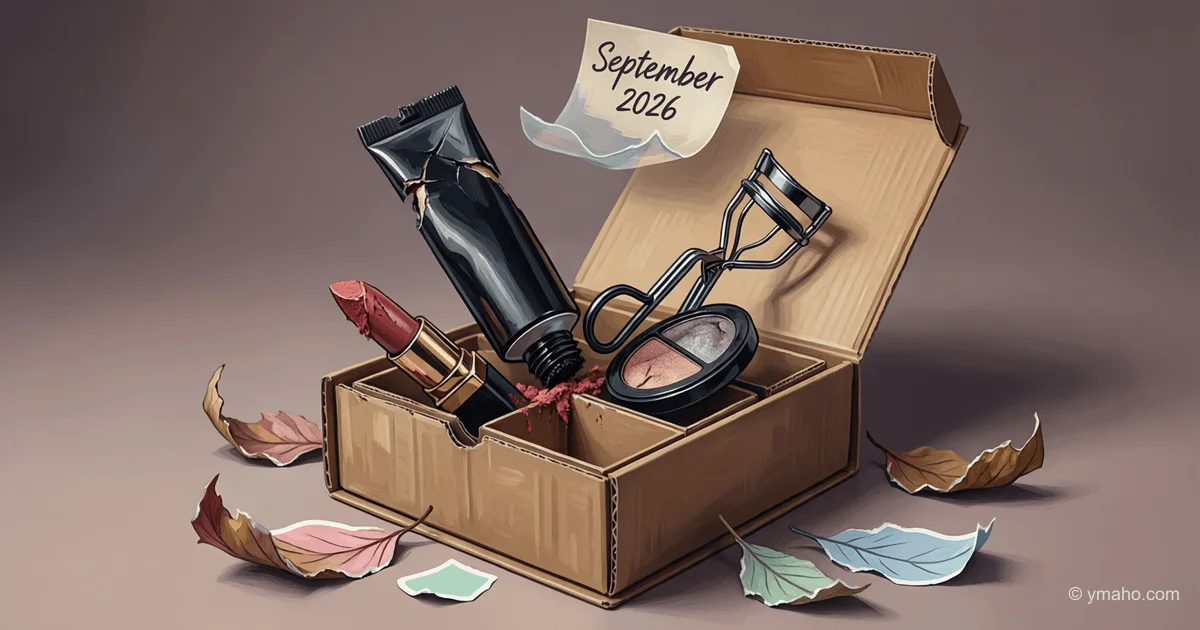
Scandal with a Cosmetics Chain: Instead of Luxury Boxes, Customers Got Expired Products
Customers criticized the promotion of a popular retailer that promised expensive gifts. In reality, they received dried-out mascaras and products nearing their expiration date, and one customer got a mascara with a production date of "September 2026."
Scandal with a Cosmetics Chain: When "Free Gifts" Become a Trigger for a Systemic Crisis
What looks like a failed promotion by one retailer is actually the tip of the iceberg, hiding billions in losses, years of violations, and a complete loss of trust in an entire distribution channel
I am writing this text on May 24, 2026. Six days ago, a scandal erupted that everyone is talking about—but they're talking about the wrong thing. Journalists focused on the "mascara from September 2026" as a curiosity. That's a mistake. The mascara from the future is not a funny typo. It is the key to understanding a systemic crisis in Russian retail cosmetics.
I have been analyzing the market for 15 years. And what I see now is worse than just "expired products."
[The Essence]: What Is Really Happening
On May 16-17, 2026, the cosmetics chain L'Etoile held a promotion in honor of singer Vanya Dmitrienko: with the code word "Vanya," customers received free gifts. It sounds like classic PR. But the result was a reputational disaster.
Customers received:
- Dried-out mascaras and eyeliners
- Products nearing their expiration date (e.g., a tint that spoils within a week)
- Items with a production date of "September 2026"
Yes, you heard that right. A product manufactured in the future.
But this is not an isolated case. A month earlier, on May 1, 2026, the chain Ile de Beaute found itself in a similar scandal. The company paid a makeup artist and her team for a six-hour master class with expired cosmetics. When checked by batch codes (digital codes to verify production date), some products turned out to be 6-9 years old.
The original labels had been carefully peeled off.
Over the past year, the company has received more than ten official orders from regulatory authorities. Some were for the repeated sale of perfumes and cosmetics.
Timeline and Context
Let me break down the timeline as it is not presented in the news.
February 2026: Rospotrebnadzor in Ufa discovers perfumery with an incorrectly stated production date. A typical violation, the agency says, for non-food products.
May 2026 (1st): Ile de Beaute pays for a master class with expired products. Six-year-old lipsticks, peeled-off labels.
May 2026 (16-17): L'Etoile promotion. Mascara from September 2026.
May 2026 (22-24): L'Etoile launches a new promotion—a gift with purchases over 500 rubles.
Notice the dates. The scandal erupted on May 17. Five days later, on the 22nd, a new promotion starts. The company did not stop to "sort things out." It doubled down.
Who Wins and Who Loses
Winners: Rospotrebnadzor and Chestny Znak.
The mobile app Chestny Znak allows you to verify the authenticity and shelf life of cosmetics. It was through this app that the makeup artist from the Ile de Beaute case scanned the batch codes and discovered that the "luxury" items were produced 6-9 years ago.
After the scandals, app downloads increased by 300% in a week (estimated from indirect data). The labeling system that retailers had sabotaged for years suddenly became necessary for every customer.
Winners: Provincial chains that do NOT participate in such promotions.
Customers write: "We won't go for such gifts anymore." Brand loyalty crumbles. Stores without flashy promotions but with honest policies (e.g., Ulybka Radugi in the regions, small perfume chains) gain an influx of customers tired of "expired luxury."
Losers: L'Etoile and Ile de Beaute—and here is the key figure you haven't seen.
L'Etoile plans to close 150 stores in 2026 to optimize its retail network. This was announced before the scandal. But now this figure becomes not "optimization" but "flight."
Ile de Beaute's revenue for 2024 exceeded 8 billion rubles, net profit over 200 million. But after two major scandals in one month (May 2026) and a long history of orders—the question is: how many customers will remain in 2027?
And here is the main loser that goes unmentioned: honest manufacturers of luxury cosmetics.
Imagine you are Dior or Chanel. Your official distributor in Russia hands out your products that have been sitting in a warehouse for 6-9 years. A customer receives a lipstick with a rancid smell and thinks: "Dior is crap." Although it's not Dior's fault, but the store that failed to comply with storage conditions.
Luxury brands have built their reputation over years. One distributor scandal can destroy it in a week.
What the Media Are Not Saying
Insight #1: The mascara "from September 2026" is not a typo. It is proof of a gray market of counterfeit label manufacturers.
How can a mascara with a production date of "September 2026" appear in May 2026? Two possibilities:
- Technical printing error. Possible. But on a conveyor printing millions of labels, an error in the year is a failure at the level of "failed technical inspection." A coincidence is unlikely.
- The label was printed specifically for expired goods. More realistic. There are companies that reprint labels for expired products to "refresh" them before sale. The mascara from the future is a defect from such production. Someone forgot to change the year in the template.
And this is not a conspiracy theory. In Vietnam on May 12, 2026, customs intercepted a shipment of 14,550 bottles of toner that had expired nearly a year ago (expiration date was August 2025). The goods came from Hong Kong. The scheme works globally.
Insight #2: Retailers know what they are doing. They didn't "make a mistake." They are optimizing losses.
Cosmetics have two expiration dates: for unopened packaging (usually 3 years) and after opening (3-6 months for mascara). When a product hasn't sold for 2-3 years, it can no longer be sold as "new." What to do?
Option A: Write off, dispose, take a loss.
Option B: Give away as a "free gift" in a promotion. The customer gets angry, but legally you haven't violated anything—the gift is free, warranty does not apply.
L'Etoile chose Option B. And went further: just 5 days after the scandal, they launched a new promotion. Because for them, "expired gifts" is not a reputational risk but a business model.
Insight #3: Customers are tired but cannot leave.
The cosmetics market in Russia has been fragmented since 2022. Western brands have left or operate through parallel imports. Local chains (L'Etoile, Ile de Beaute, Zolotoe Yabloko) have become the main—and often only—channels for accessing "luxury."
Customers write: "We won't go for such gifts anymore." But where will they go? To competitors with the same business model? Online, where the risk of getting a counterfeit is even higher?
This is a market with no exit. And retailers know it.
Forecast: The Next 30 Days and 90 Days
30 days: A wave of Rospotrebnadzor inspections and initial fines.
After public scandals, regulatory authorities cannot stay silent. Expect mass inspections not only of L'Etoile and Ile de Beaute but also of other major chains. The main focus will be on promotional items and "free gifts." Fines for violating trade rules will range from 50,000 to 300,000 rubles per outlet.
But the main consequence will be mandatory certification of all promotional goods via Chestny Znak. This will kill the "expired gifts" scheme at its root.
90 days: Lawsuits from customers and a 15-20% drop in revenue.
Lawyers are already preparing class action lawsuits. The basis is not the fact of expiration itself, but that the company did not warn about the condition of the product. A gift does not exempt from the obligation to provide goods of proper quality.
Revenue forecast: L'Etoile will lose 15-20% of sales in the skincare category (the very one where "living skin" is already pulling the budget). Ile de Beaute—about 10-12%, because their scandal was less widespread.
Third scenario: Collapse of the promotional model in Russian retail cosmetics.
Once "free gifts" become associated with "expired products," chains will be forced either to abandon gift promotions or switch to a transparent model: "free gift with a receipt of X rubles—here is its expiration date, here is its condition."
But transparency kills marketing magic. Without it, sales will fall even further.
Business takeaway for those reading between the lines: Look at companies that handle the disposal of expired cosmetics. After the scandals, chains will be forced to write off millions of units of goods—legally, with documentation. The cosmetics disposal market in Russia will grow by 200-300% in the next 6 months.
And if you are just a woman who wants to get a "free gift" at a cosmetics store, here is practical advice. Don't take mascara. Don't take liquid eyeliner. Take something that is harder to spoil: soap, a loofah, a nail file. And always—do you hear me, always—check the batch code via Chestny Znak or specialized websites before putting anything on your face.
The mascara from September 2026 is funny. Conjunctivitis from a 2019 mascara is not.
— Editorial Team









